

Insulated vinyl siding is worth the premium for homeowners who are already re-siding, live in a colder climate, or care about durability and a flatter, quieter exterior. If you’re siding purely to shave heating bills, the payback is slower than sales pitches suggest: expect a few percentage points to modest heating savings, against a premium that often runs $1 to $3.50 more per square foot. Read on for the field data and a quick decision checklist.
TL;DR:
- Insulated vinyl siding offers modest energy savings, typically reducing heating energy by 8% to 11% in colder climates, with a premium of about $1 to $3.50 per square foot.
- Field studies show an average improvement in airtightness of 9.5%, but real-world R-value gains are usually between 2.0 and 2.7, providing limited additional insulation beyond existing wall systems.
- The main benefits are improved wall flatness, noise reduction, impact resistance, and a more durable appearance, especially for homeowners already re-siding or seeking quieter exteriors.
- Proper installation is crucial; incorrect fastening or gaps in the weather barrier can eliminate most of the insulation and airtightness benefits.
- The upgrade makes the most sense if re-siding is already underway, the home is in a cold climate, or the homeowner plans to stay long-term, but cheaper attic insulation or air sealing often yields faster returns for utility savings.
Table of Contents
- What Is Insulated Vinyl Siding, Exactly?
- Does the Field Data Back Up the Energy Savings?
- Are the Durability and Appearance Gains Real?
- How Much Does It Cost, and When Does It Pay Off?
- What Installation Mistakes Ruin the Benefits?
- What Does Building Science Actually Conclude?
- Should You Upgrade? A One-Minute Checklist
- How We Advise Homeowners During a Siding Inspection
- Ready for a No-Obligation Siding Estimate?
- Sources
What Is Insulated Vinyl Siding, Exactly?
Insulated vinyl siding is a standard vinyl panel with a layer of rigid foam, usually expanded polystyrene (EPS), laminated to the back. That foam backing is what separates it from hollow vinyl, and it’s why the panels feel stiffer and hang flatter against a wall.
Manufacturers typically advertise modest R-value increases around R-2 to R-2.7 range, though some heavier products claim more. That number describes the panel itself, not your whole wall system, which matters because ENERGY STAR’s insulation R-value reference shows cavity insulation in most walls already sits far higher than what a siding panel adds on top.
A few construction details drive real-world performance:
- Foam thickness and density vary by manufacturer, so “insulated” doesn’t mean one fixed R-value.
- Panels use step-joints, not sealed seams, so they add insulation without creating an airtight barrier on their own.
- Marketing claims often outpace independent field testing, which tends to show smaller, more variable gains.
Does the Field Data Back Up the Energy Savings?
The best evidence comes from a controlled retrofit study, not a brochure. A BA-PIRC and Department of Energy field study on a Kinsley Construction home measured a 9.5% improvement in airtightness and roughly an 8% reduction in normalized heating energy after installing insulated siding. Material costs ran about $1,618 higher than standard vinyl on that project.
By the numbers: One field-tested home saw airtightness improve 9.5% and heating energy drop about 8%, for a material premium near $1,618, per the BA-PIRC/DOE study.
That’s one house, one climate, one installation crew, so treat it as a data point, not a guarantee. Broader industry testing summarized by BuildingGreen found:
- R-value gains of about 2.0 to 2.7 across tested products.
- Utility bill impacts ranging from 1% to 11%, depending heavily on climate and existing insulation.
- Moisture performance in NAHB testing that held up fine, with some cases showing better drying capacity than uninsulated siding.
A separate 2025 OSTI simulation study modeled thicker retrofit claddings up to R-7 and found national average energy-cost reductions near 16%. That’s a useful contrast: standard insulated vinyl at R-2 gets you a fraction of what a much thicker exterior insulation system could deliver.
Are the Durability and Appearance Gains Real?
Energy savings get the headlines, but the foam backing changes how the siding looks and feels day to day, and that’s often the bigger draw for homeowners who’ve lived with wavy, rattling vinyl.
- Foam backing stiffens the panel, so walls read flatter and straighter instead of showing every stud line and dip in the sheathing.
- Panels resist dents and impacts better and move less in wind, cutting down on the rattle and clatter cheap vinyl is known for.
- Homeowners frequently report a noticeable drop in outside noise, since the foam layer dampens sound transfer through the wall.
- A tighter, flatter exterior tends to photograph better and holds up better at resale, even when the energy math is modest.
Pro Tip: Walk the exterior on a windy day before you sign a contract. If existing panels are rattling or bowing between studs, that’s exactly the problem insulated siding solves, regardless of what it does for your heating bill.
How Much Does It Cost, and When Does It Pay Off?
Insulated siding typically costs $1 to $3.50 more per square foot installed, which translates to roughly $2,000 to $4,500 more on a full re-side, depending on home size and product line, according to siding cost comparisons. Whether that premium pays back depends on a short list of factors:
- Are you re-siding anyway? If the labor cost is already spent, the incremental material premium is the only real hurdle, and it’s a much easier number to justify.
- What’s your climate? Colder regions with longer heating seasons see the bigger end of that 1% to 11% utility swing; mild climates see closer to nothing.
- How’s your existing wall insulation? Homes with thin or aging cavity insulation benefit more from any added R-value than homes already well insulated.
- How long will you own the house? A 10 year-plus horizon gives modest annual savings more time to offset the upfront premium.
If your budget is tight, attic and air-sealing work usually delivers a faster return than siding upgrades, since heat loss through the attic and gaps around doors and windows tends to dwarf what a wall panel can fix.
What Installation Mistakes Ruin the Benefits?
Insulated panels are more installation-sensitive than standard vinyl, and a rushed job can erase most of what you paid for. Independent guides warn that crews unfamiliar with the thicker panels often treat them like hollow vinyl, and the results show.
- Insulated panels need specific fastener lengths; using standard fasteners can leave panels loose or improperly seated.
- Uneven sheathing shows through insulated panels more than hollow vinyl, since the foam backing doesn’t flex to hide wall imperfections.
- Gaps in the weather-resistive barrier behind the siding don’t get fixed by the panels themselves. Air can still leak around a tight-looking wall.
- Step-joints need consistent, snug fitting on every course, or you lose the airtightness gains the field studies actually measured.
Pro Tip: Ask any installer for photos of a completed insulated siding job, specifically close-ups of the fastener pattern and corner details. If they can’t produce them, that’s a red flag worth acting on before you sign.
Before your crew leaves, check that walls read flat under raking light, seams sit tight with no visible gaps, and you’ve got warranty paperwork specifying the exact product installed.
What Does Building Science Actually Conclude?
The honest read on insulated vinyl siding is that it’s a real but modest upgrade, not a substitute for a deep energy retrofit. Field studies consistently show measurable gains in airtightness and heating energy, and moisture performance holds up fine in tested cases. None of that adds up to a dramatic transformation.
Insulated siding’s thermal and airtightness benefits are genuine, but they’re best understood as a bonus you capture while re-siding, not a stand-alone reason to re-side. Because panels are step-jointed rather than sealed, pairing the upgrade with targeted air sealing is usually the highest-leverage move for capturing the savings that field data actually supports.
That framing matters more than any single percentage. Insulated siding rewards homeowners who were already committed to the wall work.
Should You Upgrade? A One-Minute Checklist
If you’re already replacing your siding, the insulated upgrade almost always makes sense, since you’re only paying the material premium, not a second labor bill. If you’re not re-siding and your only goal is lower utility bills, cheaper fixes like attic insulation and air sealing will usually beat it on cost per dollar saved.
Run through these three questions before you decide:
- Are you re-siding regardless? If yes, the incremental cost is easy to justify.
- Is your wall under-insulated? Older homes with thin cavity insulation see more benefit from any added R-value.
- Will you own the home 10+ years, or do you value quiet, flat, dent-resistant walls? Either answer tips the scale toward insulated panels.
Get itemized estimates that separate material premium from labor, confirm the installer’s fastening specs in writing, and ask about deeper exterior insulation options if your walls need more than R-2 can offer.
How We Advise Homeowners During a Siding Inspection
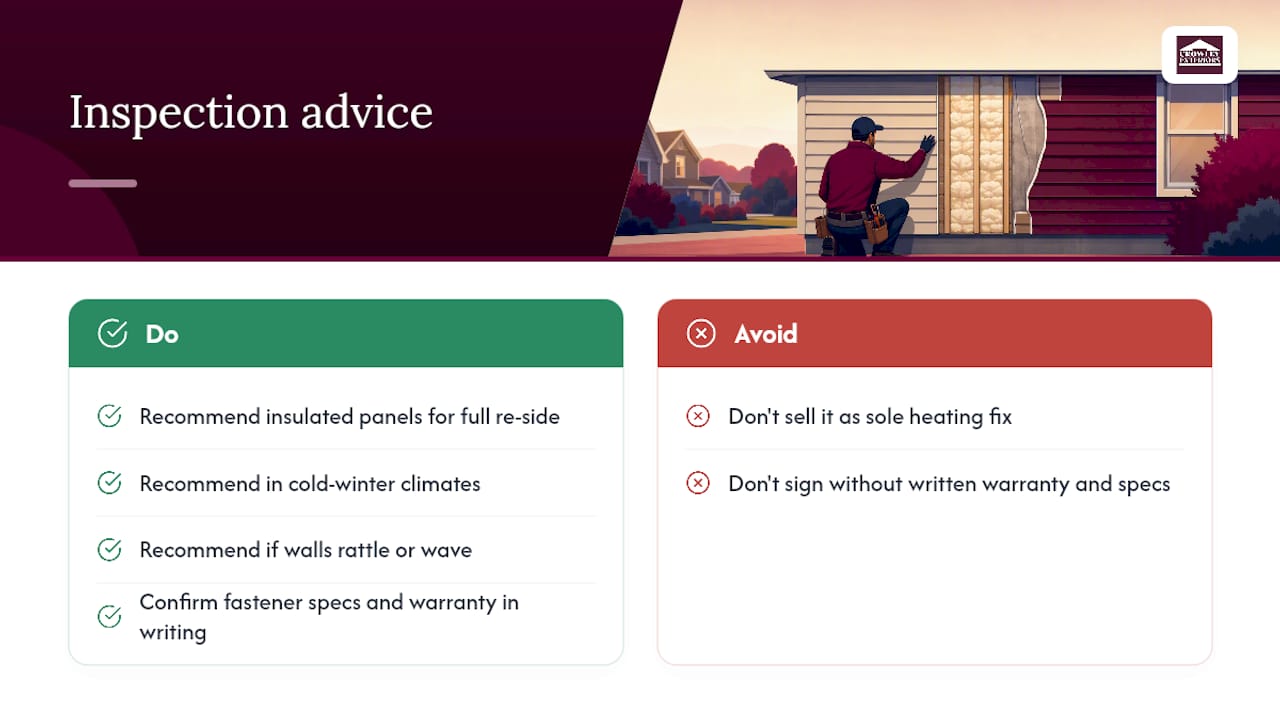
When our crews walk a property for a siding estimate, we’re not just measuring square footage. We check wall flatness, look for gaps or damage in the weather-resistive barrier, and ask how the attic is insulated, since that often matters more than the siding choice itself.
We recommend insulated panels when a homeowner is already committed to a full re-side, lives somewhere winters bite, or is frustrated by rattling, wavy walls. We don’t push it as a fix for a high heating bill on its own. Whoever installs it, we tell homeowners to confirm fastener specs and get warranty details in writing before signing anything.
— Mario
Ready for a No-Obligation Siding Estimate?
We provide homeowners a clear breakdown of exactly what they’re paying for. Our free inspections separate the insulated-panel material premium from labor, so you can see precisely what that upgrade costs on your own house.

When you request an estimate, ask us to itemize the insulated versus standard vinyl option, spell out fastening specs for your wall type, and confirm warranty coverage in writing. We bring extensive experience installing exteriors built for Missouri’s climate, and we’ll help you determine whether the upgrade fits your situation or whether your money is better spent elsewhere. Check out our siding replacement services or request your free, no-obligation inspection today.
Sources
- BA-PIRC / DOE insulated siding field study (Kinsley Construction)
- OSTI 2025 insulated retrofit cladding simulation study
- BuildingGreen analysis of insulated vinyl siding field studies
- LiveAbout insulated vinyl siding explainer
Check figures against your own region and existing wall insulation before deciding.