
Low-E glass cuts heat transfer through your windows, which means lower heating and cooling bills, fewer hot and cold spots near windows, and significantly less UV fading on floors and furniture. The Department of Energy states low-E coatings reduce energy loss through windows by roughly 30% to 50% compared to uncoated glass. Check the U-factor and SHGC ratings on your current windows, or ask for a free inspection, before deciding whether to retrofit or replace.
TL;DR:
- Low-E coatings can reduce energy loss through windows by up to 50%, leading to significant savings and improved indoor comfort.
- Choosing the right type of low-E coating depends on climate, with soft-coat and spectrally selective options performing better in hot climates, while hard-coat is more durable for storms.
- Full window replacement is advisable when seals have failed or frames are deteriorating, but storm windows can be a cost-effective retrofit for preserved or historic windows.
- The cost premium for low-E glass is typically 10% to 15%, and most savings from energy efficiency upgrades happen within a few years through lower heating and cooling bills.
- Be cautious of selecting too low a SHGC in heating climates, and verify U-factor and SHGC ratings, insulation, and seal integrity before upgrading windows.
Table of Contents
- What Are the Key Benefits of Low-E Glass?
- How Does Low-E Glass Actually Block Heat?
- Hard-Coat, Soft-Coat, and Spectrally Selective: Which One Fits Your Climate?
- How Much Do Low-E Windows Cost, and What’s the Payback?
- What Are the Downsides of Low-E Glass?
- Should You Retrofit With Storm Windows or Replace the Whole Unit?
- What I’d Tell a Homeowner Before They Sign Anything
- How Crowley Exteriors Handles Window Upgrades in St. Charles County
- Sources
- FAQ
What Are the Key Benefits of Low-E Glass?
Homeowners weighing a window upgrade usually want the short list before the science. Here it is.
- Lower energy bills. ENERGY STAR qualified windows save households 7% to 15% on energy costs annually, depending on climate and existing window type.
- Steadier indoor comfort. Low-E coatings reduce the radiant “cold window” effect in winter and the greenhouse heat near south and west windows in summer, so rooms near glass stop feeling like a different climate zone than the rest of the house.
- UV protection for interiors. Industry data on window performance suggests low-E coatings block up to 75% to 99% of UV transmission depending on the coating, which slows fading on hardwood floors, rugs, and upholstery.
- Daylight without the heat penalty. Modern coatings let visible light through while filtering infrared energy, so rooms stay bright without turning into a greenhouse.
- Less strain on your HVAC system. Steadier indoor temperatures mean your furnace and air conditioner cycle less often, which can extend equipment life and modestly lower a home’s carbon footprint over time.
How Does Low-E Glass Actually Block Heat?
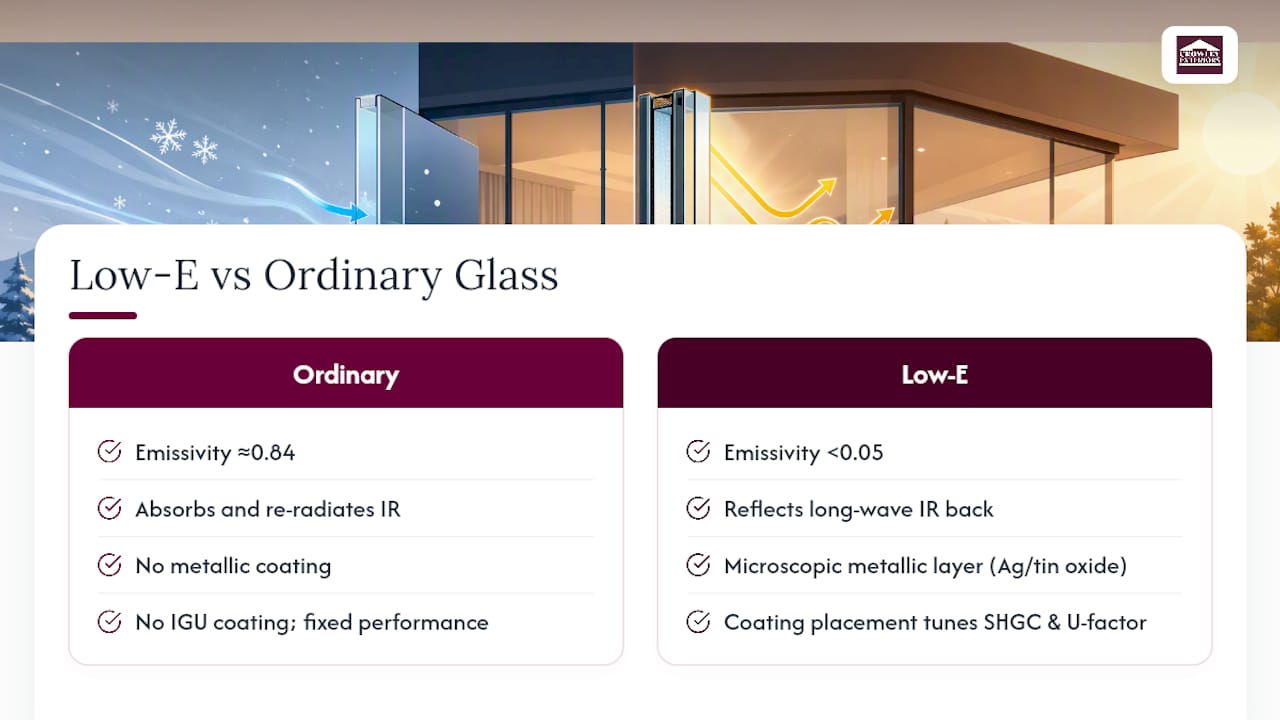
Emissivity measures how much radiant heat a surface releases. A low emissivity number means the glass radiates less heat, which is the entire point of the coating. Ordinary glass has an emissivity around 0.84, meaning it readily absorbs and re-radiates heat. A low-E coated surface can drop that number below 0.05, depending on the coating type.
Heat moves through a window three ways: conduction through the glass and frame, convection from air currents, and radiation, which is the invisible transfer of heat energy across the airspace between panes. Low-E coatings target the radiant piece specifically. The microscopically thin metallic layer, often silver or tin oxide, reflects long-wave infrared energy back toward its source instead of letting it pass through.
Placement inside the insulated glass unit (IGU) matters more than most homeowners realize. In a double-pane window, the coating usually sits on the interior-facing surface of the outer pane. That position reflects summer heat away before it enters the airspace, while still allowing winter sun to warm the room. Manufacturers can also shift placement or use a second coating layer to fine-tune the balance between solar heat gain coefficient (SHGC) and U-factor for a specific climate, which is why “low-E” isn’t a single, uniform product.
Hard-Coat, Soft-Coat, and Spectrally Selective: Which One Fits Your Climate?
Not all low-E glass performs the same way, and picking the wrong type for your climate can actually work against you.
- Hard-coat (pyrolytic) low-E is baked onto the glass during manufacturing, making it durable enough to use on a single pane, such as a storm window. It has higher emissivity than soft-coat and slightly less overall efficiency, but it tolerates handling and exposure well.
- Soft-coat (sputtered) low-E achieves much lower emissivity and better performance, but the coating is delicate and must be sealed inside an insulated glass unit rather than exposed to air.
- Spectrally selective coatings filter a large share of infrared heat, often 40% to 70% according to the Efficient Windows Collaborative, while still letting visible light through. Some cooling-load simulations show reductions above 40% in hot climates when these coatings are used on south and west-facing glass.
Reading a window’s SHGC and U-factor tells you which coating fits your house. SHGC measures how much solar heat passes through, on a scale from 0 to 1. U-factor measures how well the window resists heat flow overall, with lower numbers meaning better insulation.
Pro Tip: If you live in a heating-dominated climate, don’t default to the lowest SHGC on the shelf. A moderate SHGC on south-facing windows lets in free winter sun, which can outweigh the summer cooling penalty. In cooling-dominated regions, prioritize low SHGC on west and south exposures, where afternoon sun hits hardest. Mixed climates usually do best with moderate SHGC across the board and a strong U-factor, since heating and cooling loads roughly balance out over the year.
How Much Do Low-E Windows Cost, and What’s the Payback?
The efficiency numbers only matter if the math pencils out, and for most homes, it does. ENERGY STAR qualified windows can save 7% to 15% of total household energy costs, and low-E coatings reduce window-specific heat transfer significantly, per the DOE. PNNL research found that low-E storm windows are cost-effective over single-pane windows in every U.S. climate zone, and over many older double-pane windows in zones 3 through 8.
Two rough scenarios illustrate how that plays out:
| Scenario | Typical upgrade cost premium | Expected payback pattern |
|---|---|---|
| Replacing old double-pane clear glass with low-E IGUs | Roughly 10% to 15% more than clear glass per industry cost guides | Often recovered within a few years through reduced heating/cooling costs, faster in extreme climates |
| Adding low-E storm windows over single-pane originals | Lower upfront cost than full replacement | Short incremental payback per PNNL, especially in colder zones |
Before estimating your own payback, gather four things: the number and type of windows you’re replacing, your local energy rate, your primary heating fuel, and your home’s current insulation and air-sealing condition. Windows rarely deliver their full potential savings if attic insulation or duct sealing is already poor.
What Are the Downsides of Low-E Glass?
Low-E glass has genuine tradeoffs worth knowing before you buy.
- Slight visible tint. Some coatings introduce a faint color shift, most noticeable at certain angles or in specific lighting. It’s rarely visible once installed, but picky buyers should ask to see a sample installed in a frame, not just a flat pane.
- Wrong SHGC choice can backfire. Choosing an aggressively low SHGC in a heating-dominated climate can block free solar warmth in winter, lengthening payback and reducing comfort exactly when you want the sun’s help.
- Modest cost premium. Low-E typically adds about 10% to 15% to glass cost, which is usually a small slice of total window replacement cost rather than a dealbreaker.
- Incentive confusion. The federal 25C energy-efficiency tax credit expired at the end of 2025. Don’t budget an upgrade around a credit that’s no longer active, and check current incentive rules before assuming any tax benefit applies to your project.
Should You Retrofit With Storm Windows or Replace the Whole Unit?
Full replacement isn’t always the right first move, and PNNL’s own research backs that up.
Low-E storm windows and interior panels add a low-emissivity layer over your existing glass, cutting U-factor and sealing air leaks without touching the original frame. PNNL found this approach cost-effective over single-pane windows in every climate zone in the country, and over many aging double-pane units in zones 3 through 8. That makes storm panels a strong option when you’re preserving a historic home’s original sashes, working with a tight budget, or planning upgrades in stages rather than all at once.
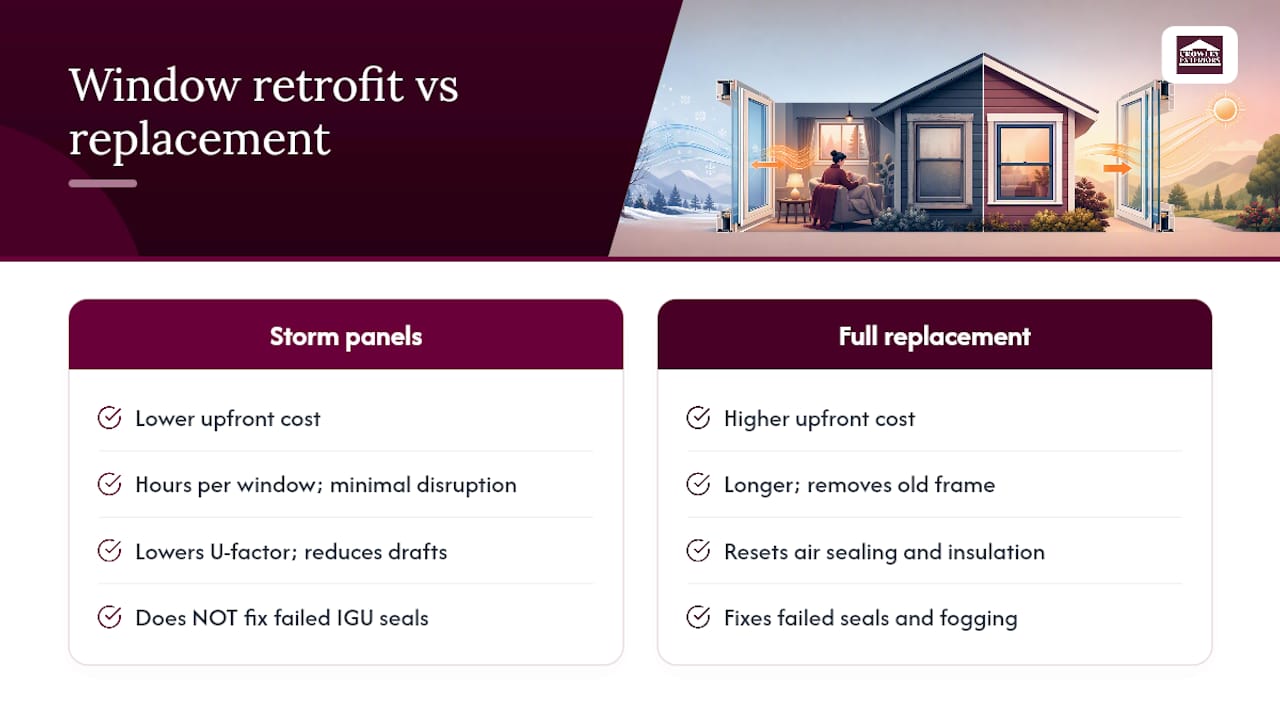
Full replacement makes more sense once the seals in your existing double-pane units have failed, since fogging between panes means the insulating gas has already escaped and no storm panel fixes that. Frame rot, warping, or persistent air leakage around the sash are other signs that the window itself, not just the glass, needs to go. New IGUs with argon fill and a properly placed low-E coating deliver the best long-term return in these cases, even though the upfront cost runs higher than a storm window retrofit.
Installation differences matter too. Storm windows mount on the exterior or interior of an existing frame in a matter of hours per window, with minimal disruption. Full replacement involves removing the old frame down to the rough opening, which takes longer and costs more, but resets the clock on air sealing, insulation, and glass performance all at once. Complementary upgrades, like insulated siding or new interior doors, can further tighten a home’s envelope alongside window work, as this overview of energy-efficient interior doors explains.
What I’d Tell a Homeowner Before They Sign Anything
Most homeowners overthink the coating and underthink the SHGC-to-climate match. If your windows face south and you live somewhere with real winters, don’t let a salesperson push you toward the lowest SHGC number on the sheet. Ask your contractor four things during the free inspection: the U-factor and SHGC of the proposed glass, whether the coating is soft-coat or hard-coat, whether the unit is argon-filled, and what the workmanship warranty covers versus the manufacturer’s glass warranty. Also confirm your attic insulation and air sealing are in decent shape first. New glass can’t compensate for a leaky envelope.
— Mario
How Crowley Exteriors Handles Window Upgrades in St. Charles County
Crowley Exteriors gives you a straight answer on whether your windows need a coating upgrade, a storm panel retrofit, or full replacement, backed by a free inspection instead of a sales pitch.
During that inspection, our team checks the U-factor and SHGC of your current glass, tests seal integrity for fogging or gas loss between panes, and walks you through whether a low-E retrofit or full replacement makes more financial sense for your specific home. Estimates come with no obligation attached. If you want a clear picture of what your windows are actually costing you in lost energy, consider starting with window replacement services or requesting a free inspection.
Sources
FAQ
What Are the Downsides of Low-E Glass?
The main tradeoffs are a slight visible tint on some coatings, a modest 10% to 15% cost premium over clear glass, and the risk of choosing an SHGC that’s too low for a heating-dominated climate, which can reduce free winter solar warmth.
Are the Benefits of Low-E Glass Worth It?
For most homeowners, yes. The DOE reports 30% to 50% less energy transfer through low-E windows compared to uncoated glass, and the cost premium is typically a small share of total window or storm panel cost.
What Are the Disadvantages of Low-E Glass Storm Doors?
Low-E storm doors and panels can slightly reduce visible light transmission and carry a modest upfront cost, but PNNL research found them cost-effective over single-pane windows in every U.S. climate zone.
How Much Does Low-E Glass Cost?
Low-E glass typically adds about 10% to 15% to the cost of the glass itself, according to industry cost guides, which is usually a small fraction of a full window replacement’s total price.
Is a Federal Tax Credit Still Available for Low-E Windows?
No. The federal 25C energy-efficiency tax credit expired at the end of 2025, so homeowners should not factor that credit into current project budgets. Check current incentive guidance before assuming a discount applies.
Recommended
This article was prepared with AI assistance for general information. For recommendations specific to your property, contact Crowley Exteriors. Call or text us at 314-839-3800.