

Low-e glass is window glass coated with a microscopically thin, virtually invisible layer that reduces radiant heat transfer, keeping homes warmer in winter and cooler in summer while cutting energy bills. The coating works with any window style, and the Department of Energy recommends checking NFRC and ENERGY STAR labels before buying. ENERGY STAR estimates low-e storm windows installed over single-pane glass can save homeowners about 10 to 20% on heating and cooling bills each year.
TL;DR:
- Low-e coatings can reduce heating costs by up to 20 percent and cooling costs by minimizing solar heat gain, especially in single-pane storm windows.
- Placement of the coating inside the window and the type—hard-coat or soft-coat—affects durability, performance, and suitability for different climates.
- U-factor and SHGC ratings, verified by NFRC testing, are critical for choosing the right low-e glass based on whether heating or cooling dominates your energy use.
- Proper installation, including a sealed frame and quality weatherstripping, is essential to ensure low-e coatings deliver their expected energy-saving benefits.
- Regular cleaning with gentle methods preserves coating effectiveness, but seal failure causes fogging that cannot be remedied by cleaning alone.
Table of Contents
- What low-e glass is and the terms you’ll see on product labels
- How low-e coatings control heat, explained simply
- Types of low-e coatings and where they sit in the glass
- Reading the labels: U-factor, SHGC, and what the numbers mean
- Benefits homeowners can expect from low-e glass
- Disadvantages and real-world limits of low-e glass
- Choosing the right low-e glass and what to expect for payback
- Cleaning and maintaining low-e windows safely
- How manufacturers apply low-e coatings to glass
- Does low-e glass change how bright your rooms feel?
- Environmental and sustainability considerations of low-e glass
- How long low-e coatings last and what affects durability
- Low-e glass compared with triple glazing and tinted glass
- What a local contractor sees inspecting low-e windows
- Ready to see what your windows need
- Sources
- FAQ
What low-e glass is and the terms you’ll see on product labels
Low-e stands for low-emissivity, a measure of how much heat a surface radiates. Manufacturers apply a metallic or metallic-oxide coating so thin it’s measured in nanometers, bonded directly to the glass or suspended between panes in a sealed unit. The coating is optically clear: you won’t see it, but it changes how the glass interacts with heat and light.
Shopping for windows means decoding a few recurring terms:
- Low-e: the general category of coatings designed to reduce radiant heat transfer.
- Spectrally selective: a coating engineered to block infrared heat while still letting in visible light.
- High-solar-gain or low-solar-gain: shorthand for how much solar heat a coating lets through, which matters more in some climates than others.
You’ll find low-e coatings on primary replacement windows, on storm windows added over existing single-pane glass, and inside insulated glass units (IGUs), the sealed double or triple-pane assemblies used in most modern windows.
How low-e coatings control heat, explained simply
Heat moves through a window three ways: conduction (through the glass and frame material), convection (air currents inside the gap between panes), and radiation (infrared energy passing through, like heat from a fire you can feel without touching it). Low-e coatings target that third pathway.
Emissivity describes how readily a surface gives off radiant heat. A low-emissivity surface reflects long-wave infrared radiation instead of absorbing and re-radiating it, which is the opposite of what plain glass does. Think of it as a mirror for heat rather than light.
In winter, the coating reflects indoor heat back into the room instead of letting it radiate out through the glass. Furnaces run less to hold the same temperature. In summer, the same coating reflects incoming solar heat before it ever gets absorbed into the glass, so air conditioners cycle less. The coating doesn’t block visible light the way tinted glass does. It’s selective about wavelengths, letting daylight through while turning back the infrared portion that carries heat.
Types of low-e coatings and where they sit in the glass
Low-e coatings come in two manufacturing styles, and where they sit inside the window assembly matters almost as much as the coating itself.
- Hard-coat (pyrolytic): applied to the glass while it’s still hot during manufacturing, fusing into the surface for durability, often used on the outer-facing surfaces or single-pane storm windows.
- Soft-coat (sputtered): applied in a vacuum chamber at room temperature, offering better performance but requiring protection inside a sealed IGU since it’s more delicate.
- Spectrally selective coatings: tuned to block infrared while keeping visible light transmission high, so rooms stay bright without extra solar heat.
Placement inside the unit, referred to by surface number, changes how much solar heat gets through without changing the insulating value much. Cold climates often benefit from coatings positioned toward the interior pane to help retain passive solar gain, while hot climates favor placement closer to the exterior pane to reject heat before it enters the airspace. Many manufacturers pair the coating with argon or krypton gas fills between panes, which slows conduction and convection further, compounding the coating’s radiant benefit.
Reading the labels: U-factor, SHGC, and what the numbers mean
Two metrics tell you almost everything about how a window will perform: U-factor and SHGC. U-factor measures how much heat escapes through the window, so a lower number means better insulation. SHGC, or Solar Heat Gain Coefficient, measures how much solar radiation passes through as heat, so a lower number means less solar heat gets in.
NFRC testing verifies both figures independently, and every certified window carries a label listing them so you can compare products on equal footing rather than trusting a manufacturer’s marketing claims.
A U-factor near 0.20 to 0.30 paired with a climate-appropriate SHGC generally signals a strong performer for most residential applications. Cold climates typically call for a higher SHGC to capture passive solar heat, while hot climates benefit from a lower SHGC to reject it. The Department of Energy recommends prioritizing U-factor in heating-dominated regions and SHGC in cooling-dominated ones, then checking that the NFRC label reflects those priorities before signing off on a purchase.
Benefits homeowners can expect from low-e glass
The payoff shows up in three places: the energy bill, day-to-day comfort, and the condition of your furniture.
- Energy savings: ENERGY STAR estimates low-e storm windows installed over single-pane glass save homeowners about 10 to 20% annually on heating and cooling, with EPA estimating a national average of roughly $350 per year.
- Comfort: reflecting radiant heat reduces the cold-spot effect near windows in winter and the greenhouse effect in summer, evening out room temperatures.
- UV protection: low-e coatings can block enough ultraviolet radiation to reduce fading of furniture, flooring, and artwork by as much as 75%.
Full window replacement makes sense when frames are failing or seals have gone, but adding low-e storm windows over sound single-pane glass is often the more cost-effective route to similar comfort gains.
Disadvantages and real-world limits of low-e glass
Low-e glass isn’t free, and the upfront cost varies depending on whether you’re adding storm windows or replacing full units, with payback depending heavily on your current window’s condition and local energy prices. Some coatings introduce a faint color shift or added reflectivity, most noticeable at certain angles or lighting conditions, though spectrally selective versions minimize this.
In very hot, high-humidity climates, a coating chosen for the wrong solar orientation can trap heat inside a room if the SHGC doesn’t match the exposure, which is why climate-appropriate selection matters more than simply buying low-e glass for your sunroom as a checkbox feature. None of this works in isolation either: a high-performance coating installed in a leaky, poorly sealed frame won’t deliver the numbers on the label. Frame material, weatherstripping, and installation quality all factor into real-world performance as much as the glass itself, a point covered in more detail in this guide to fixing window drafts.
Choosing the right low-e glass and what to expect for payback
Picking the right product starts with your climate, not the sales pitch.
- Identify your climate zone and whether heating or cooling dominates your energy use for most of the year.
- Decide your metric priority, U-factor first in cold climates, SHGC first in hot ones.
- Require the NFRC label on any quote so you can verify U-factor, SHGC, and visible transmittance independently.
- Confirm coating placement and gas fill (argon or krypton) match your climate priorities.
- Ask about warranty coverage for both the glass and the seal, since IGU failures often show up as fogging years later.
Pro Tip: Ask your installer for the NFRC number on the quote, not just a brand name, so you can look up the exact tested values yourself.
ENERGY STAR’s own payback example for low-e storm windows over single-pane glass runs around three years under average conditions, though your timeline shifts with local energy costs and how drafty the existing window is. A professional inspection catches sealing and frame issues that would otherwise erase part of that savings before it ever shows up on a bill.
Cleaning and maintaining low-e windows safely
Mild dish detergent, water, and a soft microfiber cloth handle most low-e glass cleaning without risk. Standard glass cleaners like Windex are generally fine on modern low-e coatings since the coating sits on an interior glass surface or beneath a protective layer, but always check the manufacturer’s care instructions first and skip abrasive pads or scrapers, which can scratch coated surfaces.
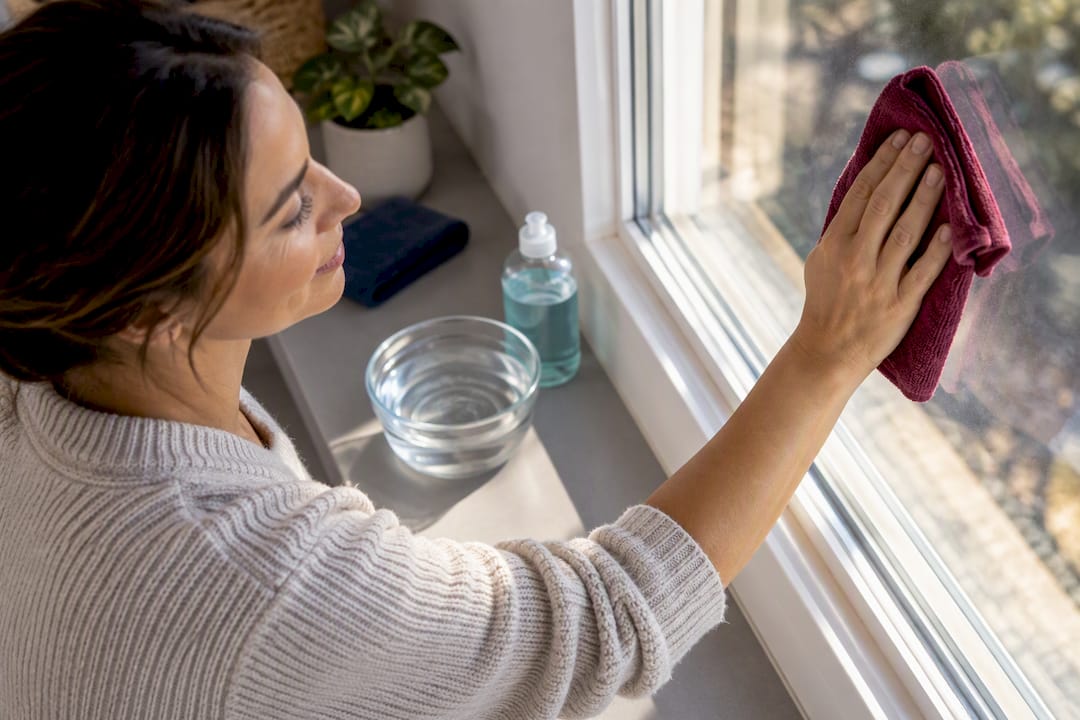
Fogging between panes signals a failed seal, not a dirty window, and no amount of cleaning fixes it. That’s a sign to call a professional, covered in more depth in this guide to foggy double-pane windows.
How manufacturers apply low-e coatings to glass
Low-e coatings are applied in one of two ways, and the method determines the coating’s durability and where it can be used. Pyrolytic, or hard-coat, application happens during the float glass manufacturing process itself. While the glass is still hot from the furnace, a metallic-oxide layer is sprayed on and fuses chemically into the glass surface as it cools, creating a coating that’s baked in rather than layered on top. This makes hard-coat glass tough enough to handle exposure on an exterior-facing surface or in a single-pane storm window.
Sputter coating, or soft-coat, happens after the glass has already been formed and cooled. Sheets of glass move through a vacuum chamber where layers of silver, metal oxides, and other materials are deposited atom by atom using an electrically charged process. The result is a more precise, better-performing coating, typically with lower emissivity than hard-coat versions, but one that’s soft enough to need protection from moisture and handling. That’s why soft-coat glass almost always ends up sealed inside an insulated glass unit rather than used as a single exposed pane. Both processes happen at the factory, long before the glass reaches a window assembly line, and the choice between them shapes which surface of the IGU the coating can occupy.
Does low-e glass change how bright your rooms feel?
A well-chosen low-e coating shouldn’t make your home noticeably darker. Spectrally selective coatings are engineered specifically to let visible light pass through while reflecting the infrared wavelengths that carry heat, so daylight still floods the room even as solar heat gain drops. Homeowners sometimes worry that any coating will tint their windows the way sunglasses would, but that’s more a concern with older or budget tinted glass than with modern low-e technology.
Where you might notice a difference is in coatings chosen for extreme solar control in very hot climates, which can carry a slight visible transmittance reduction as a tradeoff for maximum heat rejection. Checking the visible transmittance figure on the NFRC label alongside U-factor and SHGC tells you exactly how much daylight a specific product allows, so there’s no guessing involved. For most residential applications, the daylighting difference between low-e and standard clear glass is negligible enough that homeowners rarely need to adjust their interior lighting plans after installation.
Environmental and sustainability considerations of low-e glass
The environmental case for low-e glass comes down to reduced energy demand over the life of the window. Less heating and cooling load translates to lower fuel and electricity use, which lowers the associated emissions tied to that energy, particularly in regions where electricity still comes largely from fossil fuel generation.
The coatings themselves use small amounts of metal, mostly silver or metal oxides, applied in layers thin enough that the material footprint per window is minimal compared to the frame and glass substrate. Sealed IGUs also tend to have long service lives, which matters for sustainability since a window that performs well for decades avoids the manufacturing and disposal impact of more frequent replacement. Argon and krypton gas fills used alongside low-e coatings are inert and non-toxic, posing no meaningful environmental risk if a seal eventually fails and the gas dissipates.
End-of-life glass recycling remains a limitation across the window industry generally, since coated and laminated glass is harder to recycle than uncoated glass. That’s a industry-wide constraint rather than one specific to low-e technology, and it’s worth weighing against the energy savings a coated window delivers across its working life.
How long low-e coatings last and what affects durability
Soft-coat low-e coatings, sealed inside an IGU and shielded from air and moisture, typically last as long as the window unit itself, often two to three decades, since the coating never faces direct environmental exposure. The limiting factor is usually the seal around the IGU rather than the coating itself: once a seal fails and moisture or air infiltrates the airspace, fogging and reduced performance follow regardless of how intact the coating remains.
Hard-coat low-e glass, more often used on exposed surfaces like storm windows, is more resistant to scratching and handling damage by design, since the coating is fused into the glass rather than layered on top. It can still degrade faster than protected soft-coat versions if exposed to repeated abrasive cleaning or extreme weather over many years.
Climate plays a role too. Homes in regions with wide temperature swings or high humidity put more stress on seals, which shortens the practical lifespan of the insulating performance even when the coating itself holds up. Routine inspection for fogging, visible seal gaps, or condensation between panes catches failures early, before they undercut the energy benefits the coating was installed to provide.
Low-e glass compared with triple glazing and tinted glass
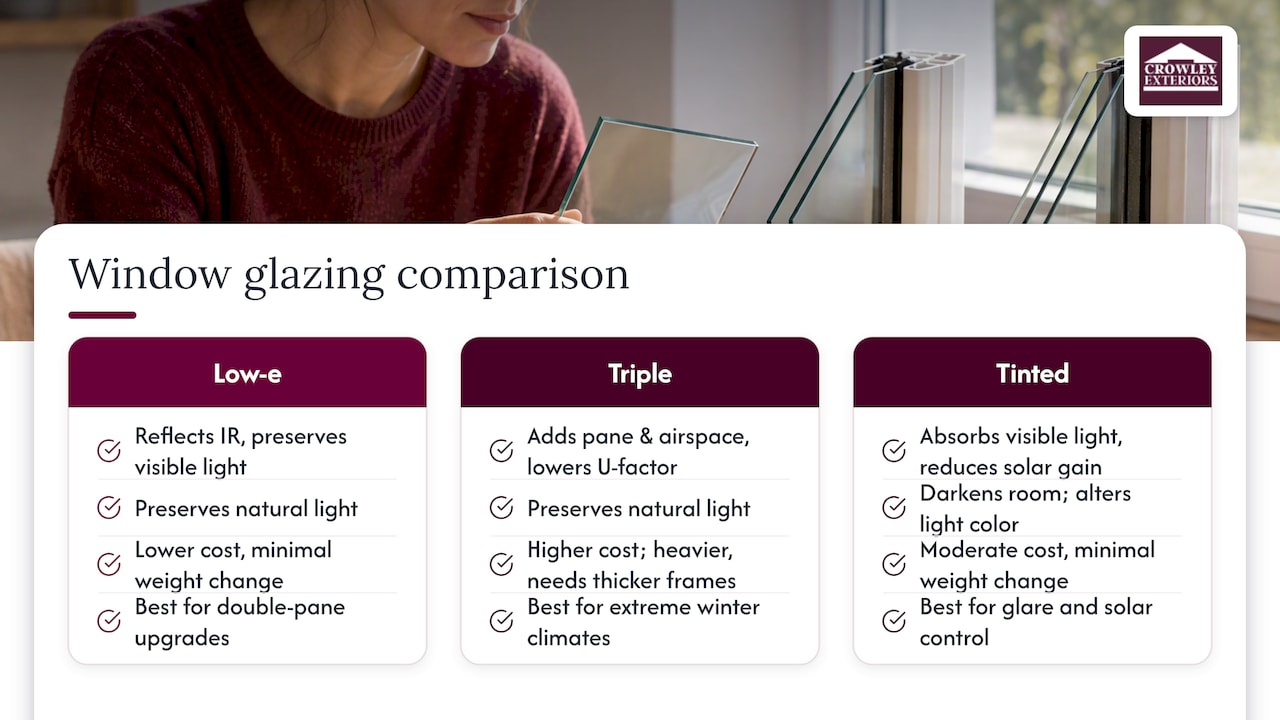
Low-e coatings, triple glazing, and tinted glass all target energy performance, but they work through different mechanisms and suit different priorities.
Triple glazing adds a third pane and a second sealed airspace, which lowers U-factor by reducing conduction and convection losses, and it’s often combined with low-e coatings on multiple surfaces for compounded performance. The tradeoff is weight, cost, and thicker frames needed to support the extra pane, which can be a bigger jump in price than adding a low-e coating to a standard double-pane unit.
Tinted glass reduces solar heat gain by absorbing light across the visible spectrum, which cuts glare and heat but also visibly darkens the room and changes the color of light coming through. Low-e coatings achieve a similar heat-rejection goal without the visible darkening, since spectrally selective versions target infrared wavelengths rather than absorbing visible light broadly.
For most homeowners weighing options within a standard double-pane window, a quality low-e coating delivers the bulk of the available energy performance gain at a lower cost than triple glazing, while preserving natural light better than tinted glass. Triple glazing becomes worth the added cost mainly in climates with extreme winter heating demands, where the extra airspace’s insulating value outweighs its higher price.
What a local contractor sees inspecting low-e windows
Inspecting a home’s windows means checking more than the glass. Crowley Exteriors looks at the NFRC label if one is still visible, the condition of the frame and weatherstripping, and any air-leak paths around the sash or sill, since a strong coating can’t compensate for a frame that’s letting conditioned air escape.
The best outcomes come from combining a quality low-e coating with a properly sealed, well-installed frame. A coating rated for cold-climate performance won’t deliver its full value in a window with gaps around the frame or failed caulking. Crowley Exteriors offers free inspections and no-obligation estimates, so homeowners can find out exactly where their current windows stand before deciding between a storm window retrofit and full replacement.
— Mario
Ready to see what your windows need
The company provides free, itemized estimates for window replacement, backed by an experienced team familiar with local weather demands. If you’re weighing a low-e upgrade against patching up older glass, a free inspection tells you exactly which option pays off faster for your home.
During the visit, we check your existing frames, seals, and glass condition, then walk you through NFRC numbers on any recommended replacement so you know what you’re buying before committing to anything. Get your free window replacement estimate scheduled and find out where your current windows stand.
Sources
- Purchasing energy-efficient residential windows, doors, and skylights — U.S. Department of Energy
- ENERGY STAR — Independently tested and certified energy performance
FAQ
Does low-e glass really make a difference?
Yes: ENERGY STAR estimates low-e storm windows installed over single-pane glass save homeowners about 10 to 20% annually on heating and cooling costs. The difference is most noticeable in homes with older single-pane windows, where the coating addresses a major source of heat loss and gain.
Can you use Windex on low-e glass?
Standard glass cleaners like Windex are generally safe for modern low-e coatings since the coated surface usually sits protected inside the sealed unit. Always check the manufacturer’s care guidance first, and avoid abrasive pads or scrapers that could scratch an exposed coated surface.
What are the disadvantages of low-e glass?
Low-e glass carries an upfront cost that varies by product and installation type, and some coatings introduce a slight color shift or added reflectivity at certain angles. In extremely hot climates, a coating with the wrong solar heat gain coefficient for its orientation can trap unwanted heat rather than reject it.
What are the disadvantages of low-e glass storm doors?
Low-e storm doors share the same tradeoffs as low-e windows: added upfront cost and the need to match the coating’s solar heat gain coefficient to your climate and door orientation. Performance also depends heavily on installation quality, since gaps around the frame or poor sealing can offset the coating’s benefits regardless of the glass itself.
Recommended
- Fix Window Drafts This Winter For Under $50, St. Charles Homeowners
- Stop Wasting Money On Foggy Double Pane Windows: 4 Fixes For Homeowners
- Window Tax Credit 2026: What U.S. Homeowners Need To Know
This article was prepared with AI assistance for general information. For recommendations specific to your property, contact Crowley Exteriors. Call or text us at 314-839-3800.