
A new roof typically recoups a significant portion of its installed cost at resale, according to national remodeling data, but its bigger job is removing deal risk. A roof near the end of its life can trigger lender repair demands, scare off buyers, or blow up a home inspection. Replace it when it’s leaking, visibly failing, or old enough to worry an appraiser; otherwise, a repair or seller credit usually makes more financial sense than a full tear-off.
TL;DR:
- Replacing a roof before selling is most financially justified when it is actively leaking, visibly failing, or near the end of its rated lifespan, especially in storm-prone areas.
- Asphalt shingle roofs typically recoup about 68% of their installed cost at resale, while metal roofs recoup closer to 50%, with the benefit influenced by local market conditions.
- A new roof can shorten time on market, reduce buyer objections, and prevent appraisal or loan issues that might delay or derail a sale, especially when documented with proper inspection reports and warranties.
- The actual return on investment depends on avoiding buyer credits, inspection delays, and renegotiations, which can ultimately offset or surpass the initial replacement costs.
- Conducting a professional, written roof inspection early in the selling process helps sellers decide whether to replace, repair, or credit, avoiding last-minute surprises during negotiations.
Table of Contents
- How Much Value Does a New Roof Add to Your Property?
- Calculating Your Actual ROI on a Roof Replacement
- What Changes the Math on Roof Value
- Should You Replace the Roof Before Selling, Credit It, or Sell As-Is?
- What a Roof Replacement Actually Costs and How Long It Takes
- Cheaper Alternatives to a Full Roof Replacement
- What Contractors Actually Check Before Giving You a Number
- Does an Older Roof Still Hurt Value Even Without a Full Replacement?
- How Regional Roofing Preferences Shape Buyer Expectations
- Does Roof Style Affect How Appraisers Value a Home?
- Do Energy Efficient Roofing Choices Pay Off at Resale?
- How a New Roof Affects Homeowners Insurance and Coverage
- What I Tell Sellers Who Are on the Fence About Replacing
- Get a Free Roof Inspection Before You List
- Sources
- FAQ
How Much Value Does a New Roof Add to Your Property?
The 2025 Cost vs. Value Report from JLC and Zonda puts asphalt shingle roof replacement at roughly 68% cost recoup nationally. Metal roofing recoups closer to 50%. Spend $25,000 on an asphalt replacement and the data suggests you’d see about $17,000 reflected in resale value, everything else being equal.
That gap between what you spend and what comes back at closing confuses a lot of sellers, and it’s worth understanding why it exists.
Appraisers don’t add your invoice to the home’s value line by line. They use what’s called the age life method: they estimate what it would cost to replace the roof new, then subtract depreciation based on its remaining useful life. A new roof lowers the home’s effective age and improves its condition rating, but the appraisal doesn’t treat your $25,000 receipt as a dollar-for-dollar credit. The roof is one component of the whole structure, not a standalone asset.
There’s also a difference between appraised impact and what actually happens at the closing table. An appraisal sets a ceiling for loan purposes. A sale price gets negotiated by real buyers who may ask for credits, walk away over cosmetic concerns, or simply not care as much about the roof as you’d expect in a hot market. Recoup percentages are national averages, not guarantees for your specific listing.
A few things consistently move the needle:
- Material choice. Asphalt shingle jobs recoup a higher percentage than metal, even though metal often costs more upfront and lasts longer.
- Timing relative to the sale. Roofs replaced within a year or two of listing tend to look better to buyers than roofs replaced five years earlier, even if both are technically “new” in the same condition band.
- Local buyer expectations. In markets where storm damage is common, a documented new roof carries more weight than in mild climates where roofs rarely fail early.
- Homeowner satisfaction versus resale math. The NAR Remodeling Impact Report consistently shows roofing projects scoring high on homeowner satisfaction (the “joy” rating) even when cost recovery lags behind other renovations like a minor kitchen remodel.
Quick benchmark: national data shows asphalt shingle roofs recoup about 68% of installed cost at resale, while metal roofs recoup closer to 50%, per the 2025 Cost vs. Value Report.
Calculating Your Actual ROI on a Roof Replacement
Standard recoup percentages only tell half the story. The other half is what you avoid by not selling a house with a bad roof: lower offers, buyer credits, and financing headaches that can derail a closing entirely.
Here’s a simple framework for figuring out your real net position:
- Multiply installed cost by the recoup rate. A $20,000 asphalt job at 68% recoup adds roughly $13,600 in resale value.
- Add avoided buyer credits. Industry data shows buyer concessions for aged or damaged roofs commonly fall between $5,000 and $15,000, so factor that range in as money you didn’t have to give back at the table.
- Add avoided inspection and financing friction. A failed inspection or an FHA appraiser flagging the roof can delay or kill a deal outright, costing you carrying costs and negotiating leverage you can’t easily price but shouldn’t ignore.
- Subtract the installed cost. What’s left is your net position, direct and indirect combined.
Two scenarios make this concrete.
Scenario one: the $12,000 asphalt job. A homeowner with a 22 year old roof showing granule loss replaces it for $12,000 right before listing. At 68% recoup, that’s $8,160 in direct resale value. The old roof would likely have drawn a buyer credit request in the $5,000 to $15,000 range, say $8,000 as a mid-point estimate. Combined avoided cost and direct recoup land close to $16,000 against a $12,000 spend. That’s a clear net win, and it doesn’t even count the faster closing and fewer showings lost to buyers spooked by an aging roof.
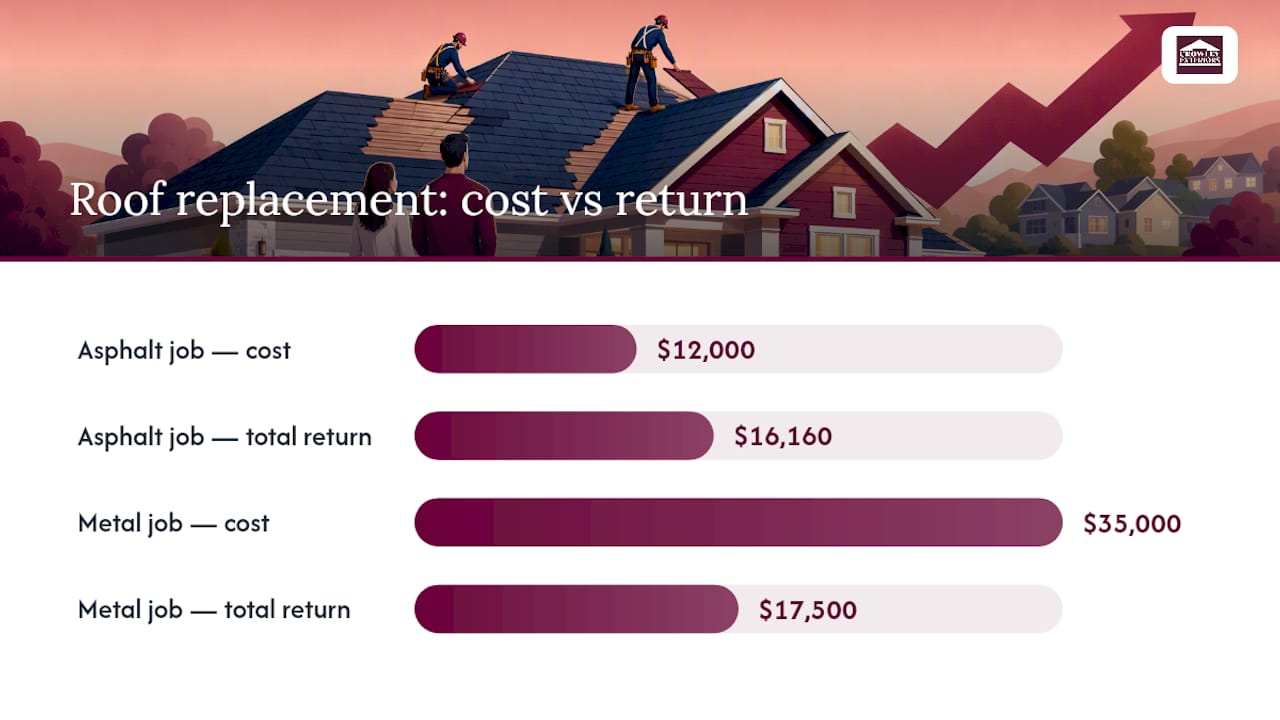
Scenario two: the $35,000 premium job. A different homeowner replaces a functional but dated roof with a high-end metal system for $35,000, mostly for personal preference. At roughly 50% recoup, that’s about $17,500 in resale value added. There’s no buyer credit avoided because the original roof wasn’t failing, and no lender flag was ever at risk. Net position: a loss of roughly $17,500 relative to project cost. That’s not a bad roof, it’s just a poor pre-sale investment.
The pattern holds across most real transactions: replacement pays off financially when the existing roof is genuinely a liability, not when it’s simply older than you’d like.
Beyond the math, a documented new roof tends to shorten time on market, reduce the number of price reductions a listing needs, and keep FHA or VA buyers in the pool instead of scaring them off during underwriting. Those are real dollars even when they don’t show up in a recoup percentage.
What Changes the Math on Roof Value
National benchmarks are a starting point, not a prediction for your specific house. Several variables push your actual outcome higher or lower than the averages.
Material tradeoffs cut both ways. Asphalt shingles recoup a higher percentage of cost because they’re the expected baseline in most markets. Metal and tile often deliver better long-term durability and insurance advantages for owners who plan to stay, but buyers in a resale scenario don’t always pay a premium proportional to what those materials cost to install.
Remaining useful life drives appraiser and buyer behavior more than age alone. A 15 year old roof with a 30 year warranty rating reads very differently than a 15 year old roof rated for 20 years. Visible damage, missing shingles, or sagging decking will draw scrutiny regardless of the roof’s technical age.
Market and climate exposure shift demand. In storm-prone regions, a documented recent replacement can matter more to buyers than the national average suggests, because everyone in that market has seen a neighbor deal with hail damage or an insurance denial.
Transferable warranties build buyer confidence. A roof with paperwork that transfers to the new owner removes a layer of uncertainty that otherwise shows up as a negotiating point.
- Asphalt shingle recoups more percentage-wise than premium materials.
- Remaining life matters more than chronological age.
- Storm-prone markets reward documented recent replacement more heavily.
- Transferable, documented warranties reduce buyer hesitation at the table.
Pro Tip: Ask your contractor for a written warranty transfer letter the day the job finishes, not months later when you’re already under contract. Buyers and their agents ask for it, and having it ready avoids a scramble during closing.
Should You Replace the Roof Before Selling, Credit It, or Sell As-Is?
Most sellers overthink this decision or make it emotionally instead of running the numbers. A short diagnostic gets you to the right answer faster than any amount of worrying.
Ask yourself four questions: How old is the roof relative to its rated lifespan? Are there active leaks or visible sagging? Would a home inspector or appraiser likely flag it? What loan types are common among buyers in your price range, since FHA and VA guidelines are stricter about roof condition than conventional financing.
From there, three paths cover almost every situation:
- Full replacement makes sense when the roof is at or past its rated life, actively leaking, or likely to trigger a lender-required repair before closing. This is the scenario where the ROI math in the prior section tends to favor you, especially in markets with a high share of FHA or VA buyers.
- Targeted repair or seller credit fits when the roof has isolated damage, a few years of useful life left, and no active leaks. A credit at closing, often in the $5,000 to $15,000 range cited in industry data, lets the buyer choose their own contractor and timeline while you avoid managing a project during an already stressful sale.
- Selling as-is works for sellers without the capital or timeline to renovate, particularly with cash buyers or investors who expect to handle repairs themselves. If you go this route, price it by subtracting roughly 110% to 120% of your mid-range repair estimate from your list price. That premium over the raw repair cost accounts for buyer risk and the hassle of managing a project post-purchase, and it prevents an ugly renegotiation after inspection.
The wrong move is doing nothing and hoping the roof doesn’t come up. It will, either from a buyer’s inspector or a lender’s appraiser, and by then you’ve lost your negotiating leverage.
What a Roof Replacement Actually Costs and How Long It Takes
Installed cost ranges vary enormously by material, roof size, and pitch, but industry data puts most full-replacement projects between roughly $9,000 and $75,000, with typical mid-range jobs landing between $30,000 and $50,000 depending on the market and material.
That share climbs when a full tear-off is required instead of a simpler overlay, when the roof has a steep pitch that slows crews down, or when inspectors find rotted decking underneath the old shingles that needs replacing before new material goes down.
- Asphalt shingle: generally the lowest cost per square foot, fastest install.
- Metal: higher material cost, longer lifespan, more specialized labor.
- Tile: highest material and labor cost, often tied to specific architectural styles.
- Tear-off versus overlay: tear-off adds cost but is required in most jurisdictions when there are already two layers of shingles.
- Decking repair: hidden rot found during tear-off is the most common source of mid-project cost increases.
A typical project timeline runs from an initial inspection through a written estimate, then anywhere from one to three days of actual installation for most residential asphalt jobs, followed by a final walkthrough and warranty paperwork. Permitting requirements and weather delays can stretch that window, particularly in the spring and fall when contractors are booked solid across a region.
Cheaper Alternatives to a Full Roof Replacement
A full replacement isn’t always the right call, and knowing when a smaller move works can save you thousands.
Once you cross that threshold, or once water has actually gotten into the attic or ceiling, patch jobs stop being a real fix and start being a delay tactic that can cost you more at inspection time.
Roof credits at closing are often the smarter move for older-but-functional roofs. Lenders typically cap how much of a credit can go toward closing costs versus repairs, so confirm the specific limit with your buyer’s loan officer before you agree to a number.
Documentation is what separates a smooth closing from a renegotiation fight. Put together a professional roof inspection report, dated photos of any repairs, an itemized contractor estimate, and any transferable warranty paperwork before your home ever hits the market.
- Patch or repair when damage is isolated and under roughly 25% of roof area.
- Full replacement or major repair once you see active leaks or widespread wear.
- Credits smooth the path for buyers using FHA or VA financing, within lender caps.
- A written roof inspection report heads off appraisal surprises before they happen.
Pro Tip: Get your roof inspection report done before you list, not after an offer comes in. It gives you time to decide between repair, credit, or replacement on your own schedule instead of a buyer’s deadline.
What Contractors Actually Check Before Giving You a Number
Experienced roofing contractors know that the checks that change an estimate the most rarely show up in a drive-by look from the curb.
Rot around chimneys and vent penetrations, damaged or missing flashing, poor attic ventilation, and trapped moisture in the decking are the four issues that most often turn a straightforward quote into a bigger job once the old shingles come off. None of these show up in a photo from the street, which is why a proper inspection matters more than a guess based on the roof’s age.
For sellers specifically, here’s what to line up before you list:
- Schedule an inspection to get an honest read on remaining life and hidden issues.
- Request a written, line-item estimate, not a single lump-sum number.
- Ask what’s included in the workmanship guarantee and whether it transfers to a new owner. Crowley Exteriors backs its work with a 25-year guarantee.
- Keep copies of any insurance claim paperwork if the work followed storm damage.
- Build a documentation packet an appraiser or buyer’s agent can review without asking follow-up questions.
A free, no-obligation estimate costs you nothing and gives you the real numbers to run the ROI math from the earlier section instead of guessing.
Does an Older Roof Still Hurt Value Even Without a Full Replacement?
Yes, and often more than sellers expect. A roof doesn’t need to be actively failing to depress a home’s perceived value. Buyers and inspectors both react to visible wear, cosmetic issues like moss or discoloration, and the simple math of “how many years until I need to deal with this myself.”
An appraiser factoring in a 20 year old roof on a 25 year rated product will reflect a shorter remaining life even if there’s no active leak, which nudges the condition rating down. Buyers do the same math informally, often mentally subtracting a rough replacement estimate from what they’re willing to offer, and that mental subtraction is frequently harsher than the real cost would be.
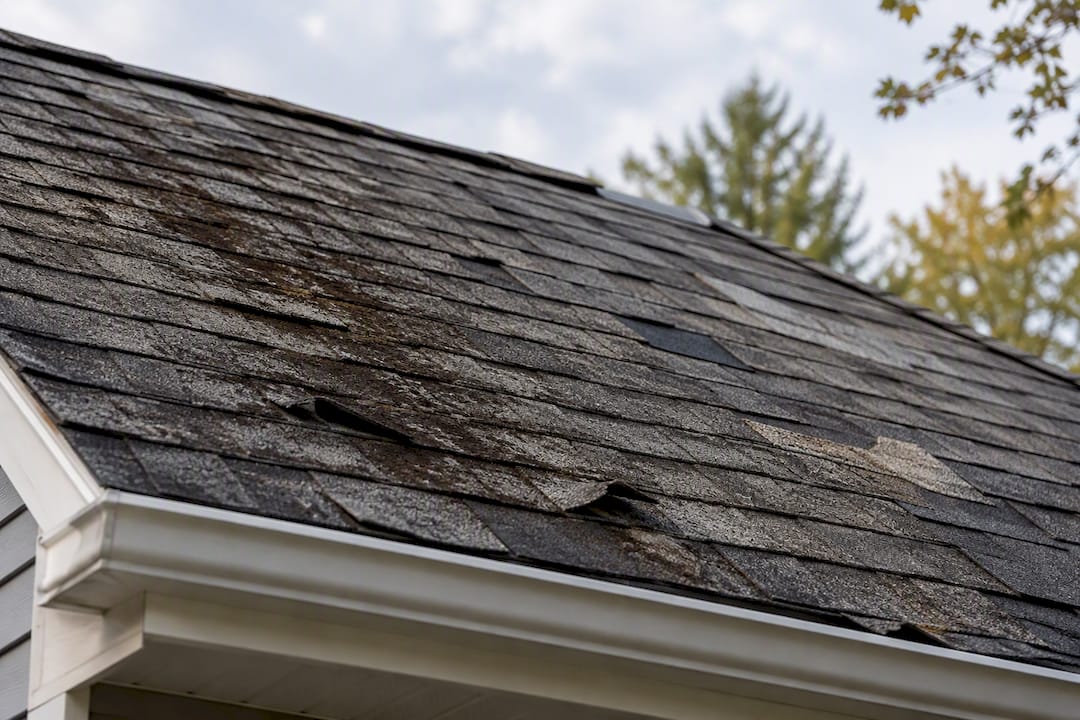
Cosmetic condition matters almost as much as functional condition in a resale context. Streaking, curling shingles, or patchy repairs from past storm damage all signal deferred maintenance, and buyers tend to assume the worst about what else on the property hasn’t been kept up. A roof that’s structurally sound but visually tired can still cost you negotiating leverage, which is one more reason a pre-listing inspection is worth the hour it takes to schedule.
How Regional Roofing Preferences Shape Buyer Expectations
What counts as a “normal” roof varies a lot by region, and that shapes how much a new one adds to your specific listing.
In hail-prone parts of the Midwest, buyers and their agents are far more attuned to roof age and impact-resistant materials than buyers in regions where hail is rare. A documented recent replacement after storm damage can carry more weight there than the national recoup average would suggest, because local buyers have often seen a neighbor go through an insurance fight over a damaged roof.
In coastal or high-wind areas, buyers may specifically ask about wind ratings and fastening methods. In hotter climates, reflective or lighter-colored materials sometimes carry a value premium tied to cooling costs rather than resale statistics alone. Snow-load regions tend to favor steeper pitches and materials rated for ice dam resistance.
None of this shows up cleanly in a national percentage, which is exactly why a local agent’s read on buyer expectations matters alongside the recoup benchmarks. A roof that would impress buyers in one metro might be considered unremarkable, or even undersized for the risk, in another.
Does Roof Style Affect How Appraisers Value a Home?
Roof style interacts with a home’s overall architectural character more than most sellers realize, and mismatches can quietly work against you.
A steep-pitched roof on a colonial reads as expected and unremarkable to an appraiser. The same steep pitch grafted onto a ranch style home during a mismatched renovation can actually raise questions about permitting, design coherence, and resale appeal in that neighborhood. Appraisers pull comparable sales, and a roofline that doesn’t match the norm for the home’s style or the surrounding block can make it harder to find clean comps.
Material compatibility matters too. A metal roof on a historic craftsman in a neighborhood full of asphalt shingle homes might look distinctive to you, but it can complicate an appraiser’s comp search if there’s nothing similar nearby to benchmark against. That doesn’t mean the roof hurts value outright. It means the appraisal process takes a little more work, and the result depends heavily on the specific comps available.
The practical takeaway: if you’re replacing a roof purely for resale purposes, matching the style and material norms of your immediate neighborhood is usually a safer bet than a distinctive upgrade, unless the distinctive option is also the functional standard in your climate.
Do Energy Efficient Roofing Choices Pay Off at Resale?
Energy efficiency is increasingly part of the roofing conversation, but its resale impact is more nuanced than a simple value bump.
Reflective shingles, proper attic ventilation, and added insulation under a new roof system can lower a home’s cooling costs, and buyers in hot climates increasingly ask about these features during showings. Whether that translates into a higher offer depends heavily on local buyer priorities. In some markets, energy-efficient roofing is a genuine differentiator; in others, it’s a nice-to-have that doesn’t move the needle much on price.
Where efficiency upgrades pay off most clearly is in combination with a broader weatherproofing approach, including insulation upgrades alongside the roofing work itself. A buyer comparing two similar homes will often notice if one comes with documentation showing lower utility costs, even if they can’t quantify exactly how much that’s worth. The upgrade rarely stands alone as a resale line item the way a full roof replacement does, but it strengthens the overall pitch when paired with a documented, recent roofing project.
How a New Roof Affects Homeowners Insurance and Coverage
Insurance is one of the most underrated pieces of the property value conversation, and it works in both directions.
An aging or damaged roof can raise premiums, trigger a coverage non-renewal notice, or lead an insurer to reduce a policy to actual cash value coverage on the roof specifically, meaning depreciation gets subtracted from any future claim payout. That’s a real cost that follows the current owner and can become a point of negotiation once a buyer’s insurance agent flags it during underwriting.
A documented new roof often qualifies a home for replacement cost coverage instead of actual cash value, and some insurers offer modest premium discounts for newer roofs or impact-resistant materials in storm-prone areas. For a seller, this matters because buyers increasingly ask about insurability before they even schedule a showing, particularly in regions where insurers have pulled back coverage after a string of severe weather years. A roof that’s easy to insure removes one more friction point in a sale that has plenty of them already.
What I Tell Sellers Who Are on the Fence About Replacing
The mistake I see most often isn’t sellers who replace a roof unnecessarily. It’s sellers who wait too long to get an honest inspection, then find out during underwriting that their timeline just got a lot tighter than they planned. If your roof is old enough to worry about, get it looked at months before you list, not after you’re already under contract.
Document everything. Keep the inspection report, the itemized estimate, and any warranty paperwork in one folder you can hand to a buyer’s agent or an appraiser without scrambling. That folder is worth more than most sellers realize, because it turns a subjective judgment call about roof condition into an objective, verifiable fact.
— Mario
Get a Free Roof Inspection Before You List
Crowley Exteriors gives St. Charles County sellers something most contractors don’t: a free inspection and a no-obligation, itemized estimate before you commit to anything. That means you get the real numbers, remaining life, hidden damage, repair versus replace cost, before you decide whether to fix, credit, or sell as-is.
What you’ll walk away with is a written estimate that breaks down labor and material separately, a realistic project timeline, and details on what the workmanship guarantee covers if you transfer the home to a new owner. If your roof took storm damage, some contractors may also help navigate insurance claims so that process doesn’t stall your listing timeline. For sellers who want documentation ready for buyers and appraisers, a roof inspection report makes that packet easy to assemble.
If your roof is a question mark in your sale plans, start with the roof replacement page to see what’s involved, or request your free inspection directly and get a number you can actually plan around.
Sources
The recoup rates, cost ranges, and appraisal explanations throughout this guide come from a small set of industry sources worth knowing if you want to dig deeper yourself.
- Selling a house with a bad roof (iBuyer blog)
- Does a New Roof Raise Appraised Value? (The Roofing Brief)
FAQ
How much does a new roof increase your property value?
The 2025 Cost vs. Value Report shows that the bigger financial benefit often comes from avoiding buyer credits and inspection delays rather than the direct appraisal bump alone.
What is the 25% rule for roofing?
Once damage affects roughly a quarter or more of the roof surface, patching tends to cost nearly as much as doing the job properly while leaving weak points behind. Crowley Exteriors’ repair versus replace guide walks through this threshold in more detail.
Is $30,000 too much for a roof?
It depends on the material, roof size, and scope of work involved. Industry data shows full-replacement projects commonly range from about $9,000 to $75,000, with typical mid-range jobs falling between $30,000 and $50,000, so $30,000 sits within normal territory for a mid-size or premium-material job rather than being excessive on its own.
What decreases property value the most?
An actively leaking or structurally compromised roof is one of the sharpest value drags a home can carry, since it can trigger both lender repair requirements and steep buyer offer discounts. Industry sources report offers 10% to 20% below market for homes with visibly failing roofs, on top of typical buyer credit requests in the $5,000 to $15,000 range.
Recommended
- 25 To 30% Rule: When Homeowners Should Repair Or Replace A Roof
- What Should Be On Your Roof Estimate Checklist?
- Homeowners: 12 Line Roofing Estimate With Crowley Exteriors Example
- Roof Replacement Timeline: What Homeowners Should Expect
This article was prepared with AI assistance for general information. For recommendations specific to your property, contact Crowley Exteriors. Call or text us at 314-839-3800.