
The best roof financing option comes down to three things: your credit score, how much equity you have in your home, and how fast you need the work done. Homeowners with solid equity and time to spare usually do best with a HELOC or home equity loan. Those with limited equity but decent credit should look at FHA Title I loans or a personal loan. If a storm just tore through and you need a contractor next week, a personal loan or contractor-arranged plan is likely your fastest path.
Quick match by situation:
- Equity + patience: HELOC or home equity loan. Lower rates, longer terms, but expect 2–6 weeks to close.
- Limited equity or moderate credit: FHA Title I (up to $25,000, no equity required under $7,500) or an unsecured personal loan. Faster than home equity products; no lien risk on smaller amounts.
- Urgent repair, need funds fast: Personal loan (funded in days) or contractor financing. Convenient but typically higher APR.
- Low income, qualifying property: USDA Section 504 or Weatherization Assistance Program. Narrow eligibility but potentially grant-based.
- Insurance-covered damage: File the claim first, then finance only the gap (deductible, depreciation shortfall).
Next step before you apply: Get 2–3 itemized contractor estimates. Borrowing against a vague number is how homeowners end up with the wrong loan size. HUD recommends getting professional estimates before applying for any home improvement financing.
Statistic: Many financing guides use $10,000–$12,000 as a representative single-family roof replacement cost for monthly-payment examples — a range that makes financing a practical necessity for most households rather than a luxury.
Key Takeaways
The most cost-effective roof financing route depends on your equity, credit score, and timeline — homeowners with equity typically save the most with a HELOC or home equity loan, while those without equity should check FHA Title I before defaulting to a higher-rate personal loan.
| Point | Details |
|---|---|
| Match the loan to your situation | Equity + time = HELOC or home equity loan; limited equity = FHA Title I or personal loan; urgent = personal loan or contractor plan. |
| FHA Title I is underused | Loans up to $25,000, with no equity required under $7,500; apply through a HUD-approved lender, not HUD directly. |
| Deferred interest is a trap | Same-as-Cash contractor plans apply retroactive interest if the balance isn’t cleared by the promo deadline — always ask for the deferred-interest clause in writing. |
| Get estimates before applying | Two to three itemized contractor estimates prevent overborrowing and speed lender approval for home equity and Title I products. |
| Crowleyexteriors provides the starting point | Free inspections and written estimates in St. Charles County give homeowners the verified project cost lenders require before approving any financing. |
Table of Contents
- How do all the roof financing options compare side by side?
- A closer look at each financing option
- How do you choose the right financing route?
- How to prepare and apply for roof financing
- What will financing actually cost, and how long does it take?
- A roofer’s honest take on financing decisions
- Crowleyexteriors: start with a free estimate, then finance what you actually need
- Authoritative resources to verify lenders and check program rules
- Sources
How do all the roof financing options compare side by side?
The table below covers every major route. Read the “Best for” and “Risks” columns first — they do most of the shortlisting work.
Before you commit to any offer, ask in writing:
- What is the full APR (not just the promotional rate)?
- Are there origination fees, prepayment penalties, or balloon payments?
- If this is a deferred-interest promotion, what happens if I carry a balance past the end date?
- What lien position does this loan take on my property?
The CFPB’s HELOC consumer guide covers your rights on home-secured products specifically and is worth reading before signing anything tied to your home.
A closer look at each financing option
Home equity loan and HELOC
Both tap the equity you’ve built in your home. A home equity loan gives you a lump sum at a fixed rate — predictable monthly payments, straightforward math. A HELOC works more like a credit card: you draw what you need during the draw period, pay interest on the balance, then repay during the repayment phase. The variable rate on a HELOC is the catch. If rates climb after you open the line, your payment does too.
Both typically take 2–6 weeks to close and put your home on the line as collateral. For a $12,000 roof, the lower APR usually makes these the cheapest long-term option — but only if you have the equity and the time.
Cash-out refinancing
You refinance your existing mortgage for a higher balance and pocket the difference. If you locked in a low rate years ago, this route makes little sense right now — you’d be trading that rate for today’s. If your current rate is already high and you plan to stay in the home for years, it can work.
FHA Title I home improvement loans
This is the most underused option on the list. HUD-approved lenders offer fixed-rate loans up to $25,000 for single-family homes, with terms up to 20 years. The key advantage: loans under $7,500 require no equity and no lien, making them accessible to homeowners who haven’t built much equity yet. Loans above $7,500 typically require a recorded lien.
HUD sets no minimum credit score, though lenders will review your credit and apply their own DTI guidelines. You apply through a HUD-approved lender, not through HUD directly. Most homeowners don’t know this program exists — which is exactly why it’s worth checking before defaulting to a personal loan at a higher rate.
FHA 203(k) and renovation loans
These are mortgage products, not home improvement loans. They bundle the purchase price (or refinance balance) with renovation costs into a single loan based on the home’s after-improved value. They’re most useful when buying a fixer-upper or doing a major renovation alongside a roof replacement. The process is more involved — a HUD consultant is required for the standard 203(k) — and funding takes 30–60 days. For a standalone roof job, they’re usually overkill.
Personal loans (unsecured)
Fast, flexible, and no lien on your home. The trade-off is that the rate is almost always higher than a home equity product. For homeowners who need speed or don’t want to risk their home as collateral, a personal loan is often the right call.
Marketplaces like Hearth and LendingTree let you compare multiple lender offers with a single soft inquiry, which is a smart first step before committing.
Contractor financing: same-as-cash, low fixed rate, and in-house plans
Many roofing contractors offer financing through third-party lenders. Three common structures:
- Same-as-Cash (0% for 12–18 months): No interest if paid in full before the promo ends. Sounds great — but most of these are deferred-interest plans, not true 0% APR. If you carry any balance past the deadline, all the accrued interest hits retroactively. On a $10,000 job, that can mean hundreds of dollars added overnight.
- Low Fixed Rate (4.99%–9.99% APR): Predictable payments, no deferred-interest trap. Rates are higher than a HELOC but lower than most credit cards. Good for homeowners who want simplicity and can’t pay off the balance quickly.
- In-House Payment Plans: Informal arrangements with the contractor. Terms vary widely. Always get the payment schedule, total cost, and any fees in writing before work starts.
PACE financing
Property Assessed Clean Energy financing attaches to your property tax bill rather than your credit. It can fund energy-related roof upgrades (cool roofs, solar-ready decking) and typically requires no minimum credit score. The catch: it creates a property tax lien that transfers with the home, which can complicate a sale or refinance. State availability varies significantly — check DSIRE for your state’s current programs.
Credit cards and home improvement store financing
Read the fine print the same way you would with contractor financing.
Insurance claim proceeds
If storm damage caused the problem, file the insurance claim before exploring loans. The payout reduces your out-of-pocket cost, but it rarely covers everything. Deductibles, depreciation holdbacks, and coverage gaps almost always leave a balance. That remaining amount is where a personal loan or Title I loan fills in.
Government assistance programs
The Weatherization Assistance Program covers energy-related improvements for qualifying low-income households at no cost. Both programs have narrow eligibility requirements and longer timelines, but for homeowners who qualify, they’re worth pursuing before taking on debt.
How do you choose the right financing route?
Start with three questions, in this order: What does your credit look like? How much equity do you have? How fast does the roof need to happen?
A practical framework is to assess “credit, equity, urgency” in sequence. Credit determines whether you can access low-cost unsecured options. Equity unlocks home-secured borrowing at lower rates. Urgency decides whether the slower, cheaper routes are even on the table.
Questions to ask every lender or contractor financing partner
- What is the full APR, including all fees?
- Is this a deferred-interest promotion or a true 0% APR?
- What happens if I miss the promotional payoff deadline?
- Are there prepayment penalties?
- What lien position does this loan take?
- Is the lender registered on NMLS Consumer Access?
Red flags to walk away from
- A contractor who pressures you to sign financing paperwork before providing a written, itemized estimate
- Any “same-as-cash” offer where the lender can’t show you the deferred-interest clause in writing
- Lenders who can’t provide their NMLS number or have unresolved CFPB complaints
- Balloon payments buried in the fine print of a long-term plan
Pro Tip: Before signing any contractor-arranged financing, ask for a lien waiver process in writing. A signed lien release from the contractor protects you from mechanics’ liens filed by subcontractors or suppliers after the job is done — an issue that can surface weeks after the roof is finished.
How to prepare and apply for roof financing
Step-by-step checklist
- Get 2–3 written, itemized contractor estimates. Signed estimates with line-item breakdowns give lenders a clear picture of the project and protect you from scope creep.
- Pull your credit report. Check all three bureaus (Equifax, Experian, TransUnion) at AnnualCreditReport.com before applying. Dispute any errors — even a small score bump can shift your rate tier.
- Calculate your home equity. Current market value minus your mortgage balance. Most lenders require 15%–20% equity to approve a HELOC or home equity loan.
- Gather your documents. You’ll typically need: two years of tax returns, recent pay stubs or proof of income, your current mortgage statement, homeowner’s insurance declaration page, and photo documentation if storm damage is involved.
- Locate HUD-approved Title I lenders. The HUD lender list is available at hud.gov. Cross-check any lender’s license at NMLS Consumer Access and review their BBB and CFPB complaint history before applying.
- Prequalify with multiple lenders. Most personal loan lenders and some home equity lenders offer soft-pull prequalification that doesn’t affect your credit score. Use it to compare real offers.
- Submit your formal application. Once you’ve selected a lender, submit the full application with your documentation package. For home equity products, expect an appraisal.
Timeline expectations by product
- Personal loan: 1–5 business days from application to funding
- Contractor financing: Same day to 1 week
- FHA Title I: 2–4 weeks
- HELOC / home equity loan: 2–6 weeks
- Cash-out refinance / FHA 203(k): 30–60 days
Pro Tip: Order your contractor estimates before you apply, not after. Lenders for Title I and home equity products often want to see the project scope. Having signed estimates ready shortens the approval timeline by days.
What will financing actually cost, and how long does it take?
Sample monthly payments on a $12,000 roof
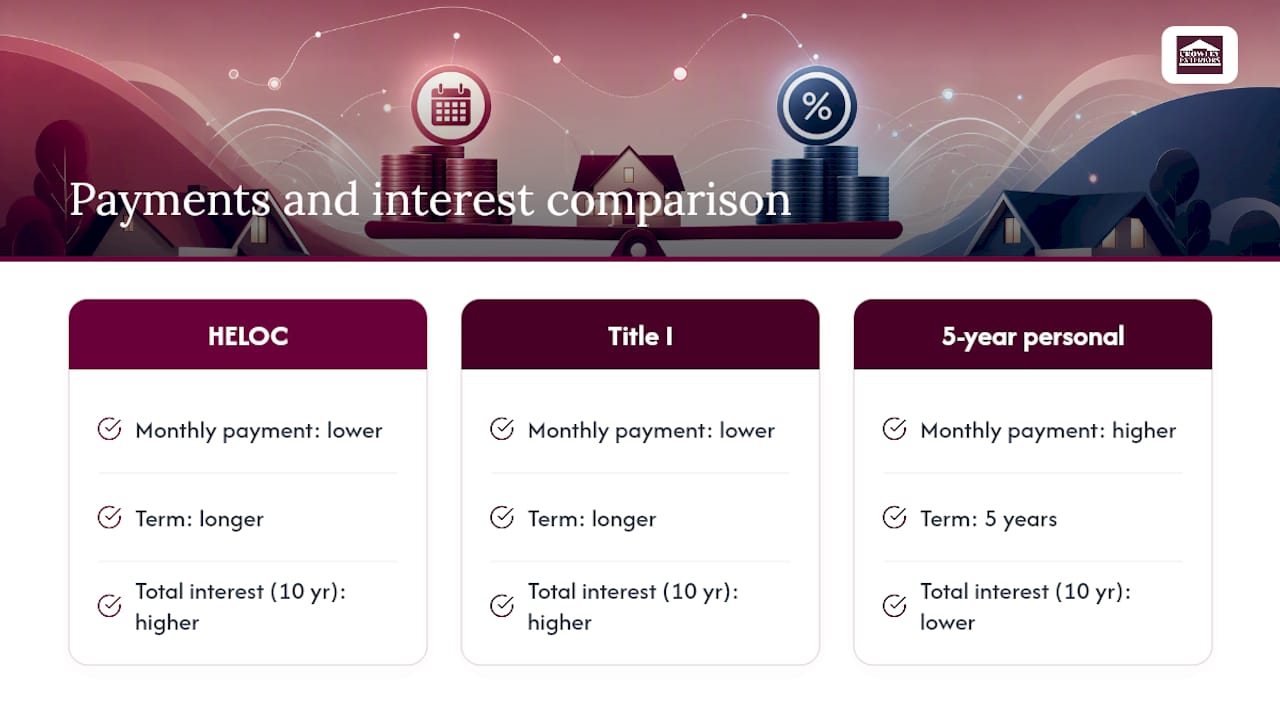
The HELOC and Title I options carry lower monthly payments over a longer term, but the total interest paid over 10 years is higher than a 5-year personal loan at a similar rate. Run the full amortization, not just the monthly number.
Tax implications
A new roof is not immediately tax-deductible. Roof replacement is a capital improvement that increases your home’s cost basis, which can reduce capital gains tax when you eventually sell. Interest on a home-secured loan may be deductible if the loan meets IRS requirements under IRS Publication P530 — but consult a tax professional before assuming any deduction applies to your situation.
Statistic: Many financing guides use $10,000–$12,000 as a representative single-family roof replacement cost. At a 10% APR over 5 years on a personal loan, that translates to roughly $255/month — a figure that makes the difference between a manageable payment and a financial strain largely a function of which financing route you choose.
A roofer’s honest take on financing decisions
Most homeowners come to us having already decided on a financing route before they know what the job actually costs. That’s the wrong order. A homeowner who borrows $15,000 based on a neighbor’s estimate — then gets a real scope showing the job is $9,500 — has taken on $5,500 in unnecessary debt. The reverse is worse: borrowing $8,000 for a job that turns out to need $13,000 means stopping mid-project or scrambling for a second loan.
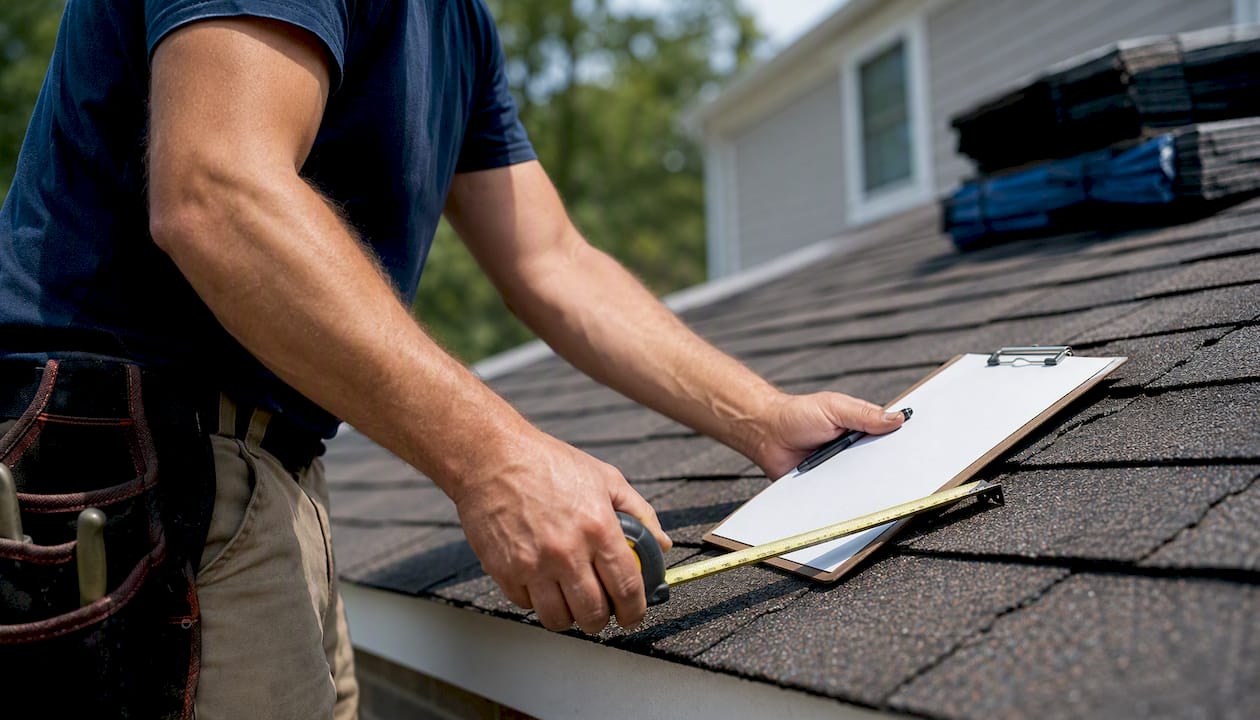
The estimate is the foundation of the financing decision, not an afterthought. At Crowleyexteriors, every homeowner in St. Charles County gets a free, no-obligation inspection and a written estimate before any financing conversation starts. That number is the one you bring to the lender.
Two other things worth saying plainly: First, contractor-arranged financing is convenient, but it’s not always the cheapest option. If you have equity or good credit, check your bank or a Title I lender before accepting the contractor’s offer. Second, the 25-year workmanship guarantee we provide on roof replacements matters to the financing decision — a roof that fails in year 8 and needs replacement is a second financing event you don’t want.
Get the estimate. Know the number. Then pick the financing route that fits.
Crowleyexteriors: start with a free estimate, then finance what you actually need
Financing a roof is straightforward once you know the real project cost. The options above — HELOCs, Title I loans, personal loans, contractor plans — all work better when the loan amount matches a verified, itemized scope of work.

Crowleyexteriors is a family-owned roofing contractor serving St. Charles County, Missouri, with over 25 years of experience replacing and repairing residential roofs built to handle Missouri’s weather. Every job starts with a free inspection and a written, no-obligation estimate — the exact document lenders ask for. The 25-year workmanship guarantee means the roof you finance today won’t become an unplanned expense a few years from now.
If you’re ready to get the number your lender needs, request your free estimate at Crowleyexteriors and have a written scope in hand before you apply.
Authoritative resources to verify lenders and check program rules
Before applying for any home improvement financing, check these official sources:
- HUD Title I lender list: Find HUD-approved Title I lenders in your area and confirm program eligibility requirements directly from the source.
- FDIC Property Improvement Loan Insurance guide: Covers maximum loan amounts, lien rules, and borrower criteria for Title I loans.
- IRS Publication P530: The authoritative source on home improvement tax rules, including when mortgage interest is deductible and how capital improvements affect your home’s basis.
- H&R Block: deducting a new roof: Plain-English explanation of why a roof replacement is a capital improvement, not an immediate deduction.
- DSIRE: The national database for state and local energy incentive programs, including PACE financing availability by state.
- NMLS Consumer Access: Verify any lender’s license and registration before signing a loan agreement.
This article is general information, not a substitute for advice from a qualified financial advisor. Consult a qualified financial professional about your own circumstances before acting on anything here.
Sources
- Hud
- Property Improvement Loan Insurance
- Roof Replacement Costs & Financing Options in 2026 – What You Need to Know – Credit Appraisals