


Some granule loss is normal on every asphalt shingle roof. Heavy loss, bald spots that show black asphalt, or granules piling up in your gutters year after year are not normal. They mean the roof is aging fast or has been hit by hail or wind, and a professional should look at it before the next big storm.
This guide shows you how to tell the difference from the ground, which causes matter in Missouri, what to do about missing shingles, and when repair stops making sense.
TL;DR
- A little grit in the gutters, especially on a new roof, is expected. Shingles are made with extra granules, and some loss is part of normal weathering.
- Worry when you see bare, dark patches, granules collecting in large amounts, or loss together with cracks, curling or leaks.
- Never climb up to check, never power wash, and never roll on a “rejuvenator” coating.
- Missing shingles after a storm need a temporary cover now and a permanent repair within weeks.
- We inspect roofs in St. Charles County for free and can tell you whether you have a repair or a replacement.
Table of Contents
- What roof granules do
- Normal granule loss versus a warning sign
- Is it really granule loss?
- Why shingles lose granules
- How to check your roof safely
- What not to do
- Missing shingles and blown-off shingles
- Repair or replace?
- Our perspective
- Get the roof looked at
- FAQ
- Sources
What roof granules do
Asphalt shingles are not just asphalt. The top surface is covered in ceramic-coated crushed rock. Those granules shield the asphalt underneath from UV light, which otherwise dries it out and makes it brittle. Granules also give the shingle its color and help it shed weather.
When granules wear away, the asphalt is exposed. The sun then oxidizes it faster, the shingle hardens, and it cracks, curls or lets go in the next windstorm. That is why granule loss is less a cosmetic problem than a clock running on the roof’s remaining life.
Normal granule loss versus a warning sign
The Asphalt Roofing Manufacturers Association (ARMA) explains that manufacturers apply more granules than a shingle needs, so some loose ones shed in the first weeks and months. That is why a new roof can leave a light dusting in the gutters after the first few rains.
There is no universal percentage that marks a failed roof. The Insurance Institute for Business & Home Safety (IBHS) uses granule loss as one damage mode in shingle testing, but it does not set a pass/fail line for homeowners. So the judgment comes from the whole picture, not one number.
| What you see | Likely meaning | What to do |
|---|---|---|
| A light sprinkle in gutters or at downspout exits, roof under a year old | Excess factory granules washing off | Nothing. Check again after a few months. |
| Light, steady grit on a roof 10 to 15 years old, shingles look uniform | Normal weathering | Add the roof to your yearly check list. |
| Handfuls of granules after each rain, roof is 15 to 20 years old | Advanced aging | Book an inspection and start budgeting. |
| Dark or shiny bare patches, especially on south and west slopes | Asphalt exposed to UV | Inspection soon. Repair or replacement. |
| Round, scattered bare spots with dents or bruises after a storm | Hail impact | Photograph, then inspect. Possibly an insurance claim. |
| Loss plus cracks, curling edges, or stains on ceilings | Shingles failing, water may be getting in | Treat as urgent. |
ARMA notes that asphalt shingles are generally considered for replacement after around 20 years of service. Real life varies with shingle grade, ventilation, and weather, so treat that as a rule of thumb rather than a deadline.
Is it really granule loss?
Homeowners sometimes mistake harmless appearance changes for damage. ARMA lists a few that fade by themselves:
- Fine backing particles from the underside of new shingles can transfer onto the surface of neighbors during installation and look like a defect.
- Excess asphalt can seep between granules and create shading that shifts with the light and the angle you view it from.
These typically weather away with rain and need no repair, and scrubbing them risks causing real damage. If your roof is only days or weeks old and you are unsure, ask your installer to look, and read ARMA’s page on color variations on new roofs.
Why shingles lose granules
Age and sun
The most common reason is simply time. Years of UV exposure, heat cycles and rain loosen the bond between granules and asphalt. Roofs in Missouri swing from humid, hot summers to freezing winters, and that expansion and contraction is hard on shingles.
Hail
Hail knocks granules off at the point of impact, leaving small bare spots, sometimes with a soft, bruised feel. Granule loss from hail is common, but it is not automatically an insurance claim or a reason to replace the roof without a professional assessment. If you had a storm, our guide on what to do about hail damage to your roof walks through the next steps.
Heat and poor ventilation
An attic that traps heat bakes shingles from below as the sun does from above. Loss that clusters around vents, exhaust pipes and chimneys, or on the slope facing the afternoon sun, often points here.
Foot traffic and cleaning
Walking on shingles scuffs granules loose, and so does a power washer or stiff brush. ARMA explicitly warns against both, because friction strips the protective layer. For algae streaks, ARMA’s technical bulletin on algae discoloration says a diluted bleach solution is the method manufacturers typically reference, with only a temporary effect. Working with chemicals on a sloped, wet surface is a fall risk, so leave it to a roofer.
Installation or product defects
Rarely, a batch of shingles sheds abnormally. If the roof is young and the loss is heavy, document it with photos and contact the installer and manufacturer, since a warranty may apply.
How to check your roof safely
You do not need to be on the roof to learn a lot.
- Look at the gutters and downspout exits. Scoop a handful of debris. A light layer of grit is one thing. Thick drifts that look like coarse black sand are another.
- Check the ground under the downspouts and the driveway. Granules wash out and collect there.
- Use binoculars from the yard. Look for shiny or dark patches, curling edges, cracks and missing tabs. Compare slopes, because the south and west sides age fastest.
- Look inside. Check the attic for daylight, damp decking or stains, and the ceilings for brown rings.
- Take dated photos. They help any warranty or insurance discussion, and they show how fast things are changing.
Stay on the ground. ARMA’s guidance and general roofing practice agree that climbing a roof is dangerous, and walking on an already worn roof can knock off more granules and damage shingles. A trained inspector has the equipment and footing to do this safely.
What not to do
Don’t apply a coating or rejuvenator. Products sold to extend roof life can sound like a cheap fix. ARMA strongly advises against field-applied coatings on asphalt shingles. They can shrink and cause curling, and can seal the gaps between shingles and trap moisture, which may lead to deck rot. Many shingle warranties are voided by such treatments, so check with the manufacturer before anyone touches the roof.
Don’t glue granules back. Once they are gone from the shingle, they do not come back, and there is no product that restores a worn surface.
Don’t ignore it because the roof isn’t leaking. Leaks are late-stage. By the time water shows up on a ceiling, the deck may already be damp. Our page on a roof leak emergency explains the immediate steps if you are already there.
Missing shingles and blown-off shingles
Many readers arrive after finding shingles in the yard. A missing shingle exposes the underlayment, and the next rain can reach the deck.
Cover it first
A temporary cover is a stop-gap, not a repair. FEMA’s Operation Blue Roof, run with the U.S. Army Corps of Engineers for eligible homeowners after disasters, installs reinforced plastic sheeting secured with wood strips, and FEMA says it is meant to last about 30 days while permanent repairs are arranged. The same FAQ says roofs with more than half of their structure damaged and some roof types, such as flat, clay or slate, often do not qualify.
For a tarp done safely, read our emergency roof tarping guide. In short: never go up in wind, rain or ice, and call a pro if the slope is steep.
Then get a permanent fix
Replacing a few blown-off shingles is usually a small repair if the surrounding shingles are still flexible and sealed. On an older roof, though, the neighbors are often brittle and lose their grip when disturbed, so a spot repair may not hold. Before work begins, it also helps to have the scope and price in writing. A simple roof repair authorization form can set out what you are approving, and the protection a tarp offers is temporary.
If the storm was recent, photograph everything within the first days. Our guides on wind damage roof signs and the first 72 hours after storm damage cover what to capture. Be careful with door-to-door storm chasers too: see our notes on roofing scams after storms.

Repair or replace?
Granule loss on its own does not settle the question. These factors do:
- Age. Past roughly 20 years with heavy loss, replacement is usually the better use of money.
- Extent. Loss isolated to one slope or a hail-hit area may be repairable. Loss across every slope is a system-wide problem.
- Shingle condition. If shingles crack or curl when lifted, patching will create new problems.
- Leaks and deck damage. Wet decking has to be fixed whichever route you choose.
Our 25 to 30% rule for repair or replacement gives a practical way to weigh this, and when to replace your roof covers timelines and costs. If you replace, ask about impact-resistant options. Industry coverage points to Class 4 impact-resistant and polymer-modified shingles as stronger choices in harsh weather, and our page on Class 4 shingle costs for Missouri homes lays out the added cost.
Our perspective
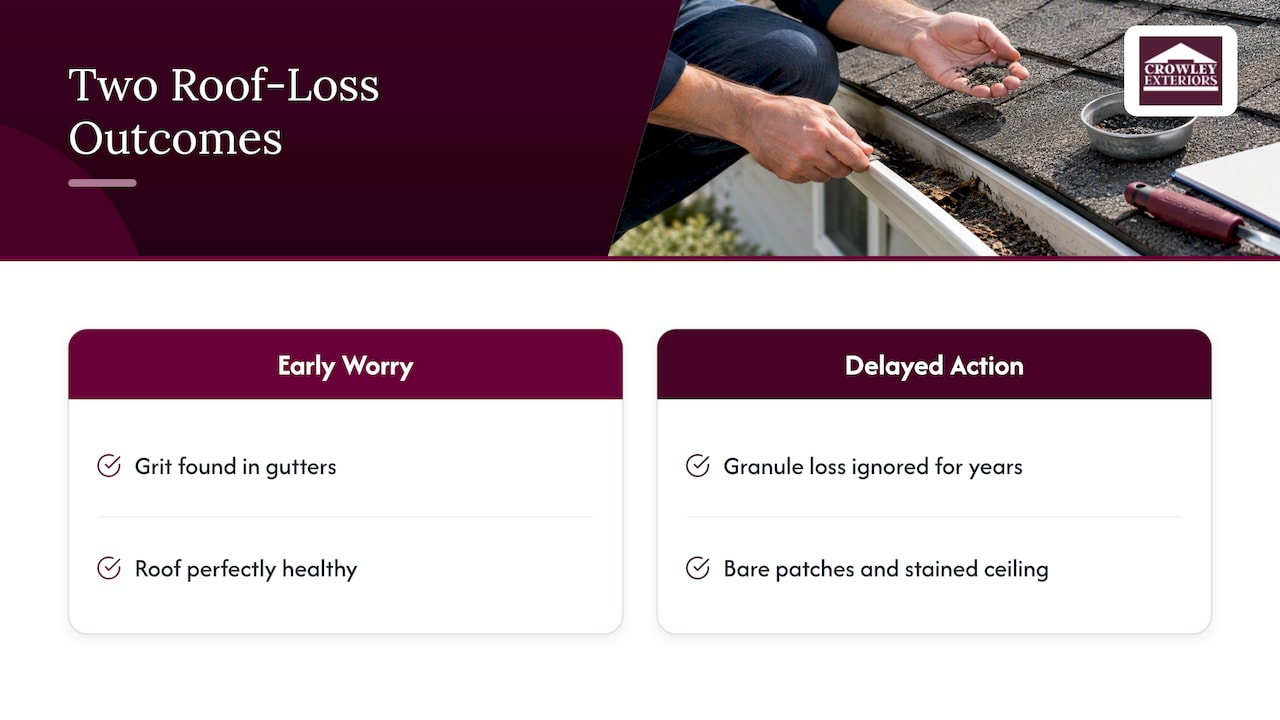
Most of the roofs we are called to for granule loss fall into two groups. The first is a homeowner who found grit in the gutters, worried, and has a perfectly healthy roof. The second is a homeowner who has seen it for years and put it off, and now has a roof with bare patches and a stained ceiling. The difference is almost always an inspection that came too late, not a roof that failed suddenly.
We have worked on roofs in St. Charles County for over 25 years, and Missouri weather is tough on shingles: hail in spring, strong summer sun, hard freezes. So we give an honest answer. If your roof is fine, we say so and tell you what to watch. If it needs a repair, we price the repair, not a whole new roof. If it is at the end of its life, we show you why with photos and an itemized estimate, so you can compare it with any other bid.
One firm piece of advice: skip the miracle coatings. They are cheaper than a roof, but they can cost you the warranty and trap moisture. Spend that money on an inspection and a plan.
— Mario
Get the roof looked at
If you are seeing granules in the gutters, bare patches or missing shingles, we offer free inspections and no-obligation estimates across St. Charles County. We check the shingles, flashing, and attic signs, tell you whether repair or replacement fits, and help with insurance claim paperwork when a storm is behind it. Our roofing work carries a 25-year guarantee. See our roof repair, inspection and storm damage services or our roof replacement page, or contact us to schedule a visit.
Buying a home? We also provide real estate roof inspection reports, so you know the roof’s condition before you close.
FAQ
Is it normal to find granules in my gutters?
A small amount is normal, particularly on a roof under a year old, because manufacturers apply extra granules and some wash off early. It becomes a concern when the amount grows, keeps returning after every rain, or comes with bare patches. If you are not sure, have the roof inspected.
Can I fix granule loss myself?
No. Lost granules cannot be put back, and coatings or rejuvenators can cause curling and trapped moisture and may void the warranty. Climbing up is also a safety risk. The practical options are monitoring a healthy roof, repairing isolated damage, or replacing a worn one.
How long can I leave missing shingles before repairing them?
As little time as possible. A tarp is a short-term measure, and FEMA’s Blue Roof program describes its cover as lasting about 30 days. Arrange a permanent repair within that window, sooner if rain is forecast.
Does hail granule loss mean I should file an insurance claim?
Not automatically. Granule loss from hail is common, but whether it qualifies depends on the extent of damage and your policy. Photograph the roof and have a roofer inspect it first, then talk to your insurer with that evidence.
Sources
- ARMA: Frequently Asked Questions for Professionals
- ARMA: Variations in Color Appearance on Newly Installed Asphalt Shingle Roofs
- ARMA: Algae Discoloration of Roofs technical bulletin
- ARMA: Application of Coatings or Rejuvenators on Asphalt Shingles After Installation
- IBHS: Impact Resistance Test Protocol for Asphalt Shingles
- FEMA: Frequently Asked Questions about Operation Blue Roof
- Roof repair authorization guide
Recommended
- Storm Damage Roof: What To Do In The First 72 Hours
- Attic Ventilation And Gutters: Roof Maintenance Schedule For Homeowners
- 25 To 30% Rule: When Homeowners Should Repair Or Replace A Roof
- What To Do About Hail Damage To Your Roof Right Now
This article was prepared with AI assistance for general information. For recommendations specific to your property, contact Crowley Exteriors. Call or text us at 314-839-3800.