


Most asphalt shingle roofs take 1–3 days of active installation on a standard 2,000–2,500 sq ft home. The full project window, from your first call to the final inspection, typically runs 3–8 weeks. That gap surprises almost every homeowner, and understanding it is the difference between a smooth job and a frustrating one.
Here’s how the numbers break down by material for a typical single-family home:
- Asphalt shingles: 1–3 active install days; 3–6 weeks total project window
- Metal (standing seam): 4–7 active install days; 6–10 weeks total
- Concrete or clay tile: 5–10 active install days; 8–14 weeks total
- Natural slate: 7–14 active install days; 10–16+ weeks total
The International Residential Code (IRC) governs overlay limits and deck requirements in most U.S. municipalities, so your local permit office has a say in how quickly work can begin. According to The Roofing Brief, permits and specialty material lead times alone commonly add 1–4 weeks to any project window.
Pro Tip: Choose a stocked material (standard asphalt shingles in a common color) and confirm your contractor has a permit relationship with your municipality before signing. Those two decisions alone can shave 2–4 weeks off your wait.
Key Takeaways
A roof replacement’s active installation takes 1–3 days for asphalt on a typical home, but the full project window from first call to final inspection runs 3–8 weeks once permits, material delivery, and contractor scheduling are counted.
| Point | Details |
|---|---|
| Active install vs. total timeline | Asphalt installs in 1–3 days; the full project typically takes 3–8 weeks from first call to final inspection. |
| Material choice drives lead time | Specialty materials like metal, tile, and slate add 2–12 weeks of lead time beyond the install itself. |
| Permits and booking are the biggest delays | Permit approval and contractor availability, not the physical work, are where most schedules slip. |
| Homeowner prep reduces day-of slowdowns | Clearing the driveway, moving vehicles, and photographing the roof before work starts keeps the crew on pace. |
| Crowley Exteriors | Offers a free inspection with a written timeline, permit assistance, and a 25-year workmanship guarantee for St. Charles County homeowners. |
Table of Contents
- How the roof replacement timeline unfolds, stage by stage
- How house size and roof complexity change your timeline
- How your choice of roofing material shifts the schedule
- What actually causes delays, and how long they add
- How to prepare your home and what to ask your contractor
- A real Crowley Exteriors project: what the timeline looks like
- What most homeowners get wrong about timing
- Crowley Exteriors offers a free inspection with a written timeline
- Sources
How the roof replacement timeline unfolds, stage by stage
The roof replacement process has two distinct phases: the administrative lead-up and the physical installation. Most homeowners fixate on the second phase, but the first one is where schedules slip.
Here’s the full sequence, with typical durations and who owns each step:
| Stage | Typical Duration | Responsible Party |
|---|---|---|
| Initial inspection and estimate | 1–3 days | Contractor |
| Contractor selection and contract signing | 3–7 days | Homeowner |
| Permit application and approval | 3–14 days | Contractor / Municipality |
| HOA approval (if applicable) | 5–14 days | Homeowner / HOA |
| Material ordering and delivery | 2–14 days | Contractor |
| Crew scheduling / booking window | 7–14 days | Contractor |
| Tear-off of existing roofing | 0.5–1.5 days | Contractor crew |
| Deck inspection and repairs | 0–3 days | Contractor crew |
| Underlayment and flashing installation | 0.5–1 day | Contractor crew |
| Field shingle / material installation | 1–3 days | Contractor crew |
| Cleanup and nail magnet sweep | Half day | Contractor crew |
| Final municipal inspection | Same day to 2 weeks | Municipality |
| Manufacturer warranty registration | Within 30 days of install | Contractor / Homeowner |
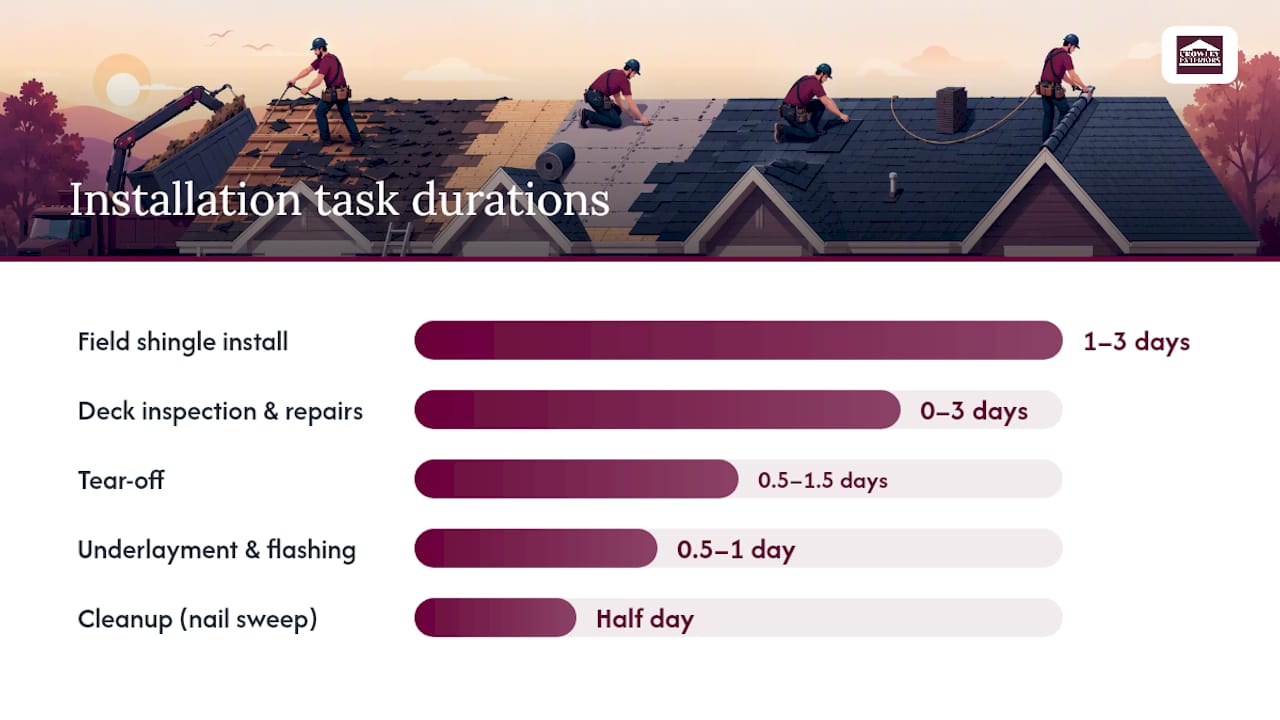
Per Joyland Roofing, contractors typically quote 3–5 days of active installation, but the total project from signing to completion usually runs 3–8 weeks once all administrative steps are counted. The Owens Corning step-by-step guide confirms that tear-off, deck inspection, underlayment, flashing, field installation, ridge work, cleanup, and final inspection are all distinct tasks, each requiring dedicated time.
What a 3-day asphalt reroof actually looks like:
- Day 1: Crew arrives, sets up dumpster and tarps, tears off old shingles (single layer), inspects decking, replaces any rotted boards, installs ice-and-water shield and synthetic underlayment
- Day 2: Installs drip edge, step and counter flashing around penetrations, lays field shingles from eave to ridge
- Day 3: Completes ridge cap, installs any remaining flashing details, performs full cleanup, runs magnetic nail sweep across yard and driveway, hauls dumpster
Pro Tip: On install morning, confirm three things with your crew lead: where the dumpster goes (protect the driveway with plywood if needed), which side of the house gets tarped for landscaping, and whether the magnet sweep covers the full perimeter. Get those answers before the first shingle comes off.
How house size and roof complexity change your timeline
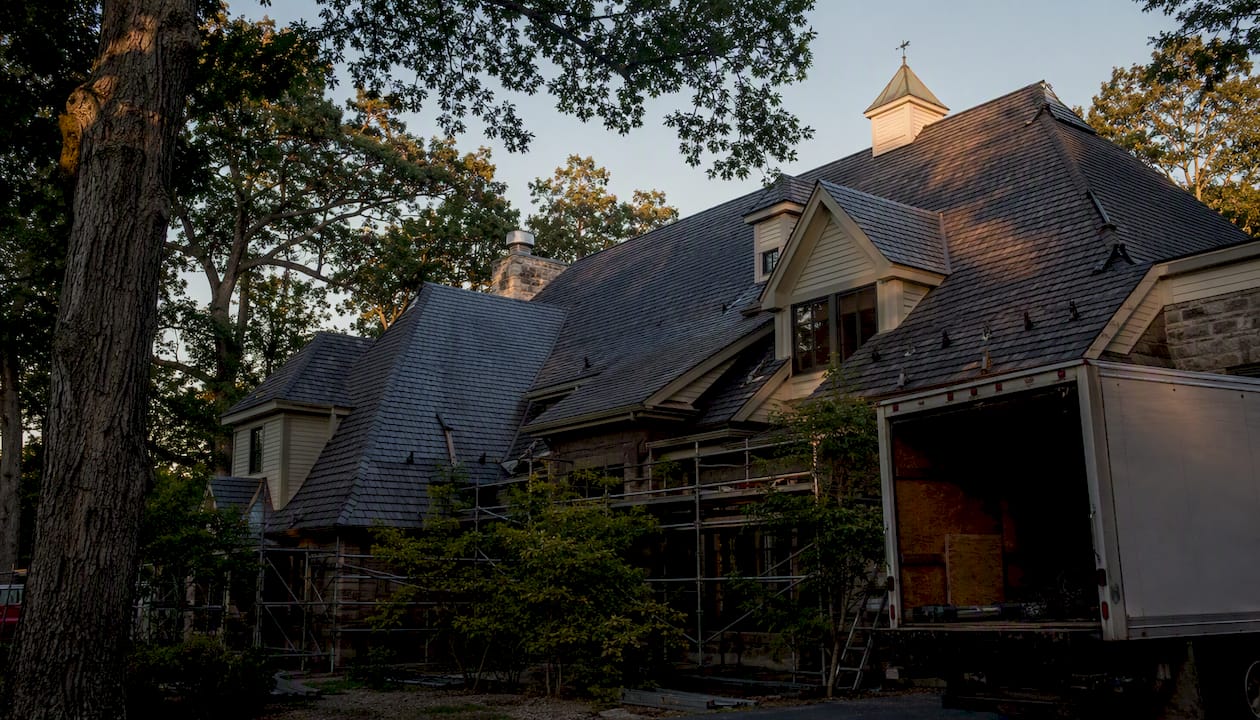
A simple ranch with a single-plane gable roof and a two-story colonial with six roof planes are not the same job, even at the same square footage. Complexity multiplies time at every stage.
- Small/simple ranch (under 1,500 sq ft, low slope, 1–2 planes): 1 active install day; total project 3–5 weeks
- Average two-story home (2,000–2,500 sq ft, moderate complexity, 3–5 planes): 2–3 active install days; total project 4–7 weeks
- Large or complex roof (3,000+ sq ft, steep pitch, 6+ planes, multiple valleys and dormers): 4–7+ active install days; total project 6–12 weeks
Hidden deck damage is the most common schedule disruptor on any size home. When a crew pulls shingles and finds rotted decking, every affected section needs to be cut out and replaced before underlayment goes down.
Crew size and site access shape daily output just as much as roof complexity. A 5-person crew on a straightforward ranch can complete tear-off and installation in a single long day. That same crew on a steep, multi-valley roof with limited driveway access for the dumpster truck might cover only half the squares per day. Narrow streets, mature trees overhanging the roofline, and second-story setbacks all slow the pace in ways that don’t show up in a square-footage estimate.
How your choice of roofing material shifts the schedule
Material selection is the single biggest variable homeowners control before signing a contract. Asphalt shingles are stocked at regional distributors and can often be delivered within 48 hours. Specialty materials are a different story entirely.
| Material | Active Install Days (2,500 sq ft) | Typical Lead Time | Total Project Window |
|---|---|---|---|
| Asphalt shingles | 1–3 days | 1–3 days | 3–6 weeks |
| Metal standing seam | 4–7 days | 2–8 weeks | 6–14 weeks |
| Concrete tile | 5–8 days | 2–6 weeks | 7–14 weeks |
| Clay tile | 6–10 days | 3–8 weeks | 8–16 weeks |
| Natural slate | 7–14 days | 4–12 weeks | 10–20 weeks |
| Synthetic slate/shake | 3–6 days | 2–6 weeks | 6–12 weeks |
The Roofing Brief’s material-by-material breakdown puts natural slate at 7–14 active install days, with specialty material lead times often stretching 2–6+ weeks beyond that. Metal standing seam panels are frequently roll-formed to the exact length of your roof planes, which means they can’t be ordered until measurements are finalized and can’t be rushed once the order is placed.
Tear-off method also matters. Removing a single layer of old shingles adds roughly 0.5–1.5 days compared to an overlay installation. Many municipalities permit only one overlay event under local code, so if your home already has a layer of shingles over the original, a full tear-off is likely required regardless of preference.
Pro Tip: If you’re considering a custom color or a specialty profile in metal or tile, ask your contractor for the manufacturer’s current lead time before you fall in love with the option. A 10-week lead time on panels means your project won’t start for nearly three months, even if the contractor has an opening next week.
For homeowners weighing regional climate and cost factors, material durability in your specific weather zone should factor into the decision alongside lead time.
What actually causes delays, and how long they add
The physical installation is the most predictable part of a roof replacement. The delays almost always come from outside the crew’s control.
Common delay causes:
- Rain, wind, or temperature extremes: Work stops under active precipitation, winds above 25–30 mph, and temperatures below roughly 40°F or above 95°F (asphalt adhesives won’t seal properly outside that range). Budget 1–3 weather days in spring and fall in the Midwest and Northeast; winter projects can absorb 3–7 additional weather days
- Permit approval windows: Municipal permit offices vary widely. Some approve same-day online; others take 2–3 weeks. In many St. Charles County municipalities, 5–10 business days is a realistic expectation
- HOA approvals: If your neighborhood has an HOA, material and color approvals can add 5–14 days before a permit application can even be filed
- Contractor booking depth: MrRemodel’s operational data shows that most projects require a 30-day planning window, with contractors often booked 3–4 weeks ahead during peak season
- Post-storm demand surges: After a major regional storm, contractor availability tightens for 9–14 months. Booking times extend and prices can rise 10–25% during that window
- Specialty material lead times: Custom metal panels, imported tile, and natural slate can take 2–8 weeks from order to delivery
For homeowners dealing with storm damage specifically, understanding how storm cycles affect contractor availability helps set realistic expectations before you start calling for quotes.
Pro Tip: The best seasons to schedule in the Midwest are late summer (August) and early fall (September through mid-October): temperatures are stable, rain is manageable, and most storm-surge demand from spring has cleared. Book at least 4–6 weeks ahead for those windows. Spring scheduling means competing with every homeowner whose roof took a winter beating.
How to prepare your home and what to ask your contractor
Good preparation on your end keeps the crew moving and protects your property. Skipping it doesn’t just create inconvenience; it can slow the job.
Homeowner pre-job checklist:
- Clear the driveway completely for dumpster placement and material delivery
- Move all vehicles away from the house (falling debris and nail scatter reach farther than most people expect)
- Cover or move patio furniture, grills, and potted plants within 10 feet of the house
- Protect landscaping beds with tarps if the crew hasn’t already planned for it
- Secure pets indoors for the full duration of each workday
- Photograph the roof and all exterior property before work begins (this creates a pre-job record for any insurance or warranty claim)
- Notify neighbors about dumpster placement and expected noise
Questions to ask your contractor before signing:
- Who pulls the permit, and what’s the expected approval window?
- How do you handle deck repairs discovered during tear-off, and what’s the per-sheet cost?
- What’s your nail cleanup process, and do you use a magnetic sweep?
- What workmanship warranty do you provide, and what does it cover?
- What’s your change-order policy if scope expands?
- How many active install days do you estimate, and what’s your weather-delay policy?
Red flags to watch for: A contractor who gives vague answers about permit responsibility (“we’ll figure it out”) or has no defined change-order process is telling you something important. Undefined change orders are how a $12,000 job becomes a $16,000 surprise. Vague permit answers often mean the homeowner ends up chasing the municipality themselves.
Homeowner preparation guidance consistently shows that photographing the roof before work and confirming cleanup responsibilities in writing are the two steps most often skipped and most often regretted.
Pro Tip: Put the agreed start window, expected install days, permit responsibility, and warranty terms in the contract before you sign. A verbal promise about a 2-day install means nothing if the crew shows up for one day and disappears for a week.

A real Crowley Exteriors project: what the timeline looks like
Here’s what a typical Crowley Exteriors asphalt shingle reroof on a 2,000–2,500 sq ft home in St. Charles County looks like from first call to finished roof.
Sample Crowley Exteriors project timeline (2,400 sq ft, two-story, asphalt shingles, single-layer tear-off):
Week 1: Free inspection completed; written estimate and material recommendations delivered within 24–48 hours.
Week 2: Homeowner selects materials and signs contract; Crowley Exteriors files permit application and orders materials.
Weeks 3–4: Permit approval and material delivery; crew scheduled for install window.
Day 1 of install: 5-person crew arrives, sets up dumpster and protective tarps, completes full tear-off of existing shingles, inspects decking, replaces any damaged boards, installs ice-and-water shield and synthetic underlayment.
Day 2 of install: Drip edge, step flashing, and counter flashing installed around all penetrations; field shingles laid from eave to ridge.
Day 3 of install (half day): Ridge cap completed, final flashing details finished, full cleanup performed, magnetic nail sweep run across yard and driveway, dumpster hauled.
Following week: Final municipal inspection scheduled and completed; manufacturer warranty registration filed by Crowley Exteriors.
A 5-person crew on a straightforward two-story home typically removes and replaces 20–25 squares per day under good conditions. Crowley Exteriors backs every reroof with a 25-year workmanship guarantee, and the free inspection includes a written scope so there are no surprises on material quantities or deck condition. With over 25 years serving St. Charles County, the team knows local permit offices and HOA processes well enough to keep the administrative phase moving.
Many homeowners also coordinate gutter replacement at the same time, since the fascia and drip edge work is already underway. Bundling avoids a second mobilization cost and keeps the exterior project on a single schedule.
What most homeowners get wrong about timing
The single most common mistake I see is treating the active install window as the whole timeline. A homeowner hears “two days” from a contractor and mentally schedules the project for two weeks from now. Then they’re surprised when the actual start date is six weeks out.
The install is the short part. Permits, material delivery, and contractor availability are where the calendar fills up. In peak season in the Midwest, a reputable contractor is often booked 4–6 weeks ahead before a single shingle is ordered. Add a permit approval window and a material lead time, and a project you decide on in May might not start until July.
The practical fix is simple: if you want your roof done before the first hard freeze, start the process in August at the latest. If you’re aiming for spring, call in February. The homeowners who get their preferred contractor and their preferred material are the ones who plan 6–8 weeks ahead, not 2.
Crowley Exteriors offers a free inspection with a written timeline
Knowing the roof replacement timeline in theory is one thing. Getting a written schedule tied to your specific home, your municipality’s permit process, and your chosen material is what actually keeps a project on track.

Crowley Exteriors provides a free, no-obligation inspection for St. Charles County homeowners, and every estimate comes with a written project timeline covering permit responsibilities, expected install days, and warranty terms. There’s no guessing about what the crew will and won’t do: cleanup, nail sweep, and dumpster hauling are all included. The 25-year workmanship guarantee is in writing before you sign. To request your free inspection and get a realistic schedule for your home, visit the Crowley Exteriors roof replacement page or call the team directly.
Sources
These are the primary sources used in this article. Each one is worth bookmarking if you want to verify a specific figure or read deeper on a particular stage.
- How Long Does a Roof Replacement Take? Real 2026 Timeline | The Roofing Brief
- MrRemodel | How Long Does a Roof Replacement Take? | True 2026 Timelines
- Roof Replacement: Complete 2026 Guide — Process, Materials, Cost & Timing
- Roofing Process Step by Step: What to Expect | Owens Corning Roofing