


A roof tune-up is a scheduled visit where a roofer walks your roof, looks closely at the weak points, and fixes small problems on the spot: a few worn shingles, a cracked pipe boot, a failing bead of sealant, clogged gutters. It sits between a plain inspection and a repair job. Nationally, a basic tune-up typically runs about $325 to $475, with a wider range of $250 to $650, depending on scope and local rates. It is worth buying when your roof is still sound but aging, and not worth buying when the roof is already failing.
Below: what a good tune-up includes, what to skip, how to tell a tune-up from a repair, and how often to schedule one in Missouri.
TL;DR
- A tune-up is a detailed roof walk plus minor fixes, typically 3 to 8 shingles, pipe boot and flashing resealing, and a gutter clear.
- Expect roughly $250 to $650 nationally for the visit. A standalone inspection alone usually costs $150 to $300.
- Skip rejuvenation sprays, power washing and spray-on coatings. Focus on flashing, seals and drainage.
- If the roofer finds widespread damage, the work should stop and become a separate, written repair quote.
- Roofs near the end of their life need a replacement conversation, not another tune-up.
Table of Contents
- What a roof tune-up actually is
- What a good tune-up includes
- What it costs in 2026
- Is a roof tune-up worth it?
- Add-ons to skip
- Where a tune-up ends and a repair begins
- When to schedule one in Missouri
- Who should be on your roof
- Our perspective: how we approach a tune-up
- Get your roof checked
- FAQ
- Sources
What a roof tune-up actually is
Think of it like servicing a car before winter. Nothing is broken yet, but a trained eye catches the cracked seal before it becomes a stained ceiling.
A roof tune-up differs from the two services around it:
- Inspection: looks and reports. A standalone visual assessment costs between $150 and $300, and you get findings, not fixes.
- Tune-up: inspection plus small repairs done during the same visit.
- Repair: a reactive job to fix a known leak or damage. Nationally, repairs average $1,174 and range from $395 to $1,968 in 2026.
People also search for “roof maintenance service,” and that is the same idea at a larger scale: a recurring plan of visits rather than a one-off. Ask any company you call what is included, because the words are used loosely.
What a good tune-up includes
A proper visit has a list. If a contractor cannot tell you what is on it before they climb up, keep looking.
- A full roof walk. Every slope, not a glance from the driveway. They look for cracked, curled, lifted or missing shingles and for granule loss.
- Flashing check. Flashing is the metal that seals the joints where the roof meets chimneys, walls, vents and skylights. The IBHS points to flashing around penetrations as a primary point of water infiltration, and stresses keeping the roof surface clear of debris so moisture does not sit. If you want to know what you are looking at, our guide to roof flashing types explains each one, and chimneys get their own treatment in chimney flashing leaks.
- Pipe boot and sealant work. The rubber collars around plumbing vents crack with age. Resealing or replacing them is one of the cheapest and most valuable fixes on a roof.
- Minor shingle replacement. Typically 3 to 8 shingles.
- Valleys. Where two slopes meet, water concentrates. Small problems here turn into ceiling stains fast, as we describe in roof valley leaks.
- Gutters and drainage. Clearing debris so water leaves the roof edge instead of backing up under shingles. Overflowing gutters are often a symptom worth diagnosing, and gutter overflow causes walks through the usual suspects.
- A written summary. Photos of what was found and what was done, plus anything that needs a separate quote.
Ask about the sealant
Many standard roof tar products fail within about three summers from UV breakdown. Professional crews often use one-part polyurethane sealants on pipe boots and flashing instead. It is a fair question to ask your roofer: what exactly are you putting on my roof, and how long should it last?
What it costs in 2026
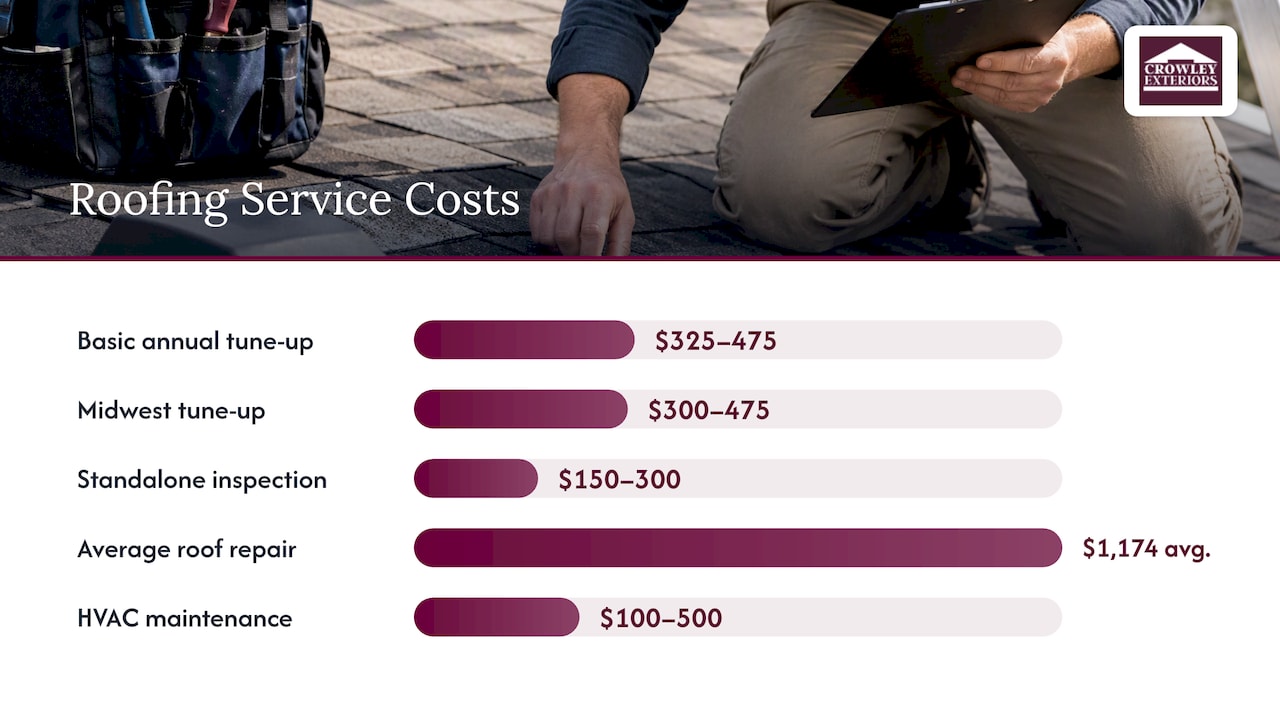
| Service | Typical national cost | Source |
|---|---|---|
| Basic annual tune-up | $325 to $475 (range $250 to $650) | The Roofing Brief |
| Midwest tune-up | $300 to $475 | The Roofing Brief |
| Standalone inspection | $150 to $300 | Angi |
| Average roof repair | $1,174 (range $395 to $1,968) | Angi |
What moves the price: roof pitch and height, number of penetrations, how many slopes, how many shingles need replacing, and whether gutter cleaning is bundled in. A steep, cut-up roof with three chimneys and two skylights costs more than a simple gable.
We do not publish a fixed tune-up price, because what your roof needs depends on what we find. What we do is give you a free inspection and a no-obligation, itemized estimate, so you see the number before you agree to anything.
It helps to think of annual upkeep the way you think of other home systems. For comparison, HVAC maintenance contracts are reported to cost $100 to $500 for homeowners, and nobody questions servicing a furnace. The roof protects everything underneath it and gets far less attention.
Is a roof tune-up worth it?
Often yes, with conditions.
The case for it: one industry estimate says spending about $400 a year can stretch an asphalt shingle roof from 20 years to more than 28, deferring a $9,500-plus replacement by nearly a decade. Treat that as an estimate from one publication, not a guarantee. Your results depend on the roof, the shingles, the installation and the weather.
The conditions:
- The roof has life left. A tune-up helps a roof in the middle or later part of its life, roughly the stage where sealants dry out and shingles start to wear. It does not rescue a roof that is worn out.
- You buy the right things. Money spent on flashing, seals and drainage works. Money spent on cosmetic treatments does not.
- You act on the report. A tune-up that finds a soft spot and gets ignored has saved you nothing.
If you are a first-time buyer, a tune-up is also a smart move right after closing, or better, a roof inspection report before. We do real estate roof inspection reports for homeowners and property managers, so you know what you are inheriting.
Add-ons to skip
Tune-up pitches sometimes arrive with extras. Experts quoted by The Roofing Brief advise skipping roof rejuvenation sprays, power washing and spray-on coatings. Power washing strips protective granules from shingles, and some of these treatments can void manufacturer warranties. Hands-on work at flashing and seals simply does more for the money.
A good rule: if the add-on is cosmetic or promises to make an old roof “like new,” ask for the manufacturer’s written approval before you pay.
Where a tune-up ends and a repair begins
A tune-up has a ceiling. The usual scope is a handful of shingles and some sealant. According to the same industry source, once a contractor finds more than about 15 damaged shingles, it is no longer a tune-up. It is a repair job and needs its own quote.
A reputable roofer will stop, show you photos, and explain. You should not pay maintenance rates for major repair work, and you should not feel pressured to approve it on the spot.
Patching extensive damage under a tune-up label is usually wasted money, and it often signals that the roof needs partial or full replacement. Two pages help you think that through:
When to schedule one in Missouri
Our roofs take a lot: freeze and thaw cycles, summer heat, wind and hail. Some roofing contractors elsewhere in Missouri recommend checks in spring and fall, and that rhythm makes sense here too.
- Fall, before winter. Fix what water and ice would exploit. Gutters should be clear before leaves finish falling. Ventilation matters for ice dams too: see roof ventilation types and ratios.
- Spring, after the thaw. Catch winter damage before storm season.
- After any major hail or wind event. Do this even if nothing looks wrong from the ground. Damage you cannot see can still be damage you can claim. Our pages on hail damage to your roof and the first 72 hours after a storm cover what to photograph and who to call. Be careful of door-to-door crews after a storm, too: storm roofing scams are real.
For a month-by-month approach that includes attic ventilation and gutters, use our roof maintenance schedule.
If you manage rental property, put the roof on the calendar. Simple recurring reminders for a few key maintenance tasks can cut emergencies, and a yearly roof visit fits right in.
Who should be on your roof
Keep other trades off it unsupervised. Plumbers, HVAC techs and satellite installers can dislodge shingles or leave equipment poorly secured, and new leaks follow. If anyone else works up there, have a roofer check afterward. The IBHS also advises removing debris and checking for loose or missing materials after any contractor works on the roof.
And please do not climb up with a tube of tar yourself if you are unsure. Roofs are slippery, falls are serious, and a bad patch can trap water.
Our perspective: how we approach a tune-up
We have been roofing in St. Charles County for over 25 years, and the pattern is consistent. The roofs that cause the most grief are not the old ones. They are the ones nobody looked at for a decade.
Here is how we think about it:
- The estimate comes first. We inspect for free and give you an itemized, no-obligation estimate. You should see what each line costs, and our 12-line roofing estimate breakdown and estimate checklist show exactly what to expect from any contractor.
- Honest about the ceiling. If a tune-up will not solve the problem, we say so. Selling you small repairs on a roof that needs replacing helps no one.
- Small work, done properly. A sealed boot that lasts is better than a tarred one that needs redoing in three summers.
- Missouri first. We build recommendations around local storms and temperature swings, not a national average.
We stand behind our roofing work with a 25-year guarantee on roofing services, and we respond quickly because a leak does not wait for a convenient week.
— Mario
Get your roof checked
If your roof is over 10 or 15 years old, or the last storm left you wondering, start with a free inspection. We will walk the roof, tell you plainly what we find, and give you an itemized estimate with no obligation. If it needs only small fixes, we will say that. If it needs more, you will get a separate written quote. See our roof repair, inspection and leak detection services, or contact us through our site.
FAQ
What is a roof tune-up?
It is a detailed professional inspection of your roof combined with minor repairs made during the same visit. That typically means resealing pipe boots and flashing, replacing a few shingles, clearing debris and gutters, and documenting the condition. It goes further than a basic inspection and is much smaller than a repair job.
How much does a roof tune-up cost?
Nationally, a basic tune-up usually falls between $250 and $650, with most visits at $325 to $475. Midwest rates tend to run $300 to $475. Your price depends on roof size, pitch, access and how much minor work is needed.
How often should I get one?
Annually is the common recommendation for asphalt shingle roofs that are aging. Add a check after severe hail or wind, whatever the calendar says. Newer roofs may need only an inspection until they pass the 10-year mark.
Can a tune-up fix a leaking roof?
It can fix a small leak caused by a cracked boot, failed sealant or a few damaged shingles. If the leak comes from widespread damage, a failing valley or an aged-out roof, you need a repair quote or a replacement discussion. For an active leak, follow our steps in roof leak emergency.
Does a tune-up make a roof last longer?
It can slow wear by catching small failures early, and one industry estimate suggests meaningful life extension for asphalt shingles. No one can promise a specific number of years, because installation quality, shingle type and weather all matter.
Sources
- Roof Maintenance Cost 2026: Annual Service & Inspection, The Roofing Brief
- Natural Weathering and Hazard Exposure, IBHS
- Building Maintenance guidance, IBHS
- How Much Does a Roof Inspection Cost? Angi
- Roof Maintenance Springfield MO, SRA Roofing & Gutters
Recommended
- Attic Ventilation And Gutters: Roof Maintenance Schedule For Homeowners
- When To Replace Your Roof: Signs, Timelines, And Costs
- 25 To 30% Rule: When Homeowners Should Repair Or Replace A Roof
- Roof Financing Options: Your Complete 2026 Guide
This article was prepared with AI assistance for general information. For recommendations specific to your property, contact Crowley Exteriors. Call or text us at 314-839-3800.