


Water behind siding is common, and it is not always a problem. Every siding system lets some rain past the outer layer, and a well-built wall is designed to catch that water and send it back outside. It becomes a problem when the wall can’t drain or dry: a missing barrier, bad flashing, a clogged gutter or a leak from the roof or a window. This guide explains why water gets there, how to tell harmless moisture from damage, what you can safely check yourself and when to bring in a contractor.
TL;DR
- Some water behind siding is normal. All siding can leak during its life, so the wall needs a drainage plane behind it to shed that water.
- The usual culprits are failed flashing around windows, doors, vents and roof edges, plus gutters that spill onto the wall.
- Soft spots, stains, warping, mildew and interior stains mean moisture is staying in the wall. Find and fix the source before any cosmetic repair.
- Standard homeowners policies tend to cover sudden events such as wind or hail, not slow leaks from neglected maintenance.
- A free inspection from a local siding contractor is the fastest way to find the leak path.
Table of Contents
- Is it normal for water to get behind siding?
- Why water is getting behind or under your siding
- Signs the water has done real damage
- How to check where the water is coming from
- What to do when you find water behind siding
- Perspective: why we start with the leak path, not the siding
- Prevention: how to keep water out of the wall
- Does homeowners insurance cover water behind siding?
- Get the leak path found by a local pro
- FAQ
- Sources
Is it normal for water to get behind siding?
Yes, to a degree. The Building America Solution Center, a U.S. Department of Energy program, says that all siding can leak during its life. Wind pressure and capillary action push rain through cracks, joints and tiny gaps, which is why completely sealing typical residential siding is impractical.
That is why builders don’t rely on the siding alone. The wall is meant to work as a layered system:
- Siding is the first line of defense and sheds most of the rain.
- A water-resistant barrier, such as housewrap or building paper, sits on the sheathing. The Department of Energy’s Building Science Education page says it should cover the entire house, with taped seams, as a continuous drainage plane behind the cladding.
- Flashing around openings directs water out of the wall rather than into it.
- An air gap behind the siding lets the wall dry. Pennsylvania Housing Research Center guidance notes that vinyl and aluminum siding profiles already include a rainscreen gap, while wood and fiber-cement siding can benefit from a separately installed one.
When all four layers work, water that gets behind the siding runs down the barrier, exits at the bottom and evaporates. You may never see it. The trouble starts when one layer is missing or broken and the water has nowhere to go.
Why water is getting behind or under your siding
If you can see water dripping from the bottom edge of the siding after a storm, the wall may be doing its job, or it may be overwhelmed. Look at where the water comes from.
Flashing failures at windows and doors
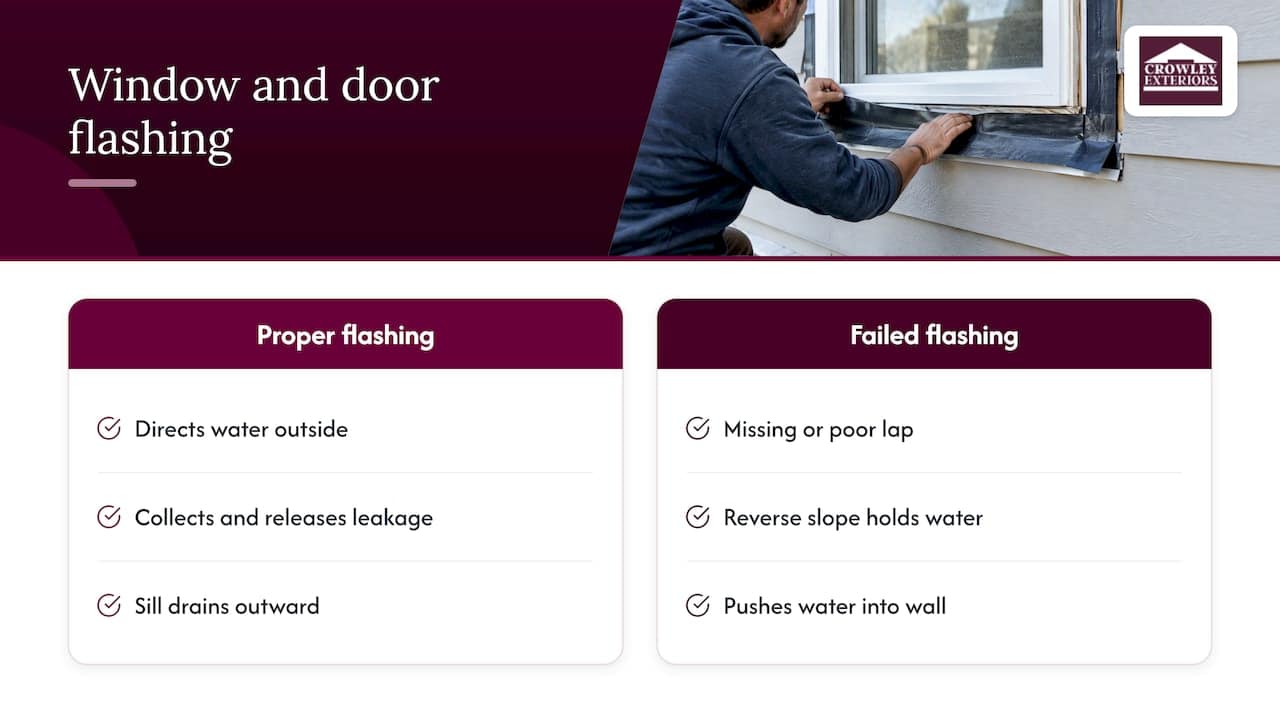
Windows and doors interrupt the drainage plane, which makes them the most vulnerable spots in the wall. The Department of Energy says properly installed flashing directs water out rather than into the wall cavity. Its pan-flashing guidance adds that a drained opening should collect leakage and send it outside, with the sill free to drain outward.
Two mistakes show up again and again. One is missing or poorly lapped flashing. The other is flashing that slopes the wrong way: the Department of Energy warns that reverse-sloped flashing can hold water and push it sideways or back into the wall. If water appears beside a patio door or under a window after rain, start your suspicion there. If those windows are old and failing, a window replacement done with proper flashing solves the leak and the draft together.
Trim, penetrations and wall intersections
The National Association of Home Builders lists the places where water commonly enters: where siding meets trim, window or door casing, wall penetrations, and roof or deck intersections. Hose bibs, dryer and bath exhaust vents, HVAC lines, light fixtures and exterior outlets all cut through the wall. Each needs to be sealed and flashed, with the drainage plane lapped over the flashing, as the Building America guidance recommends.
Caulk alone is a short-term answer. Building Science Corporation’s view, repeated on the same Building America page, is that a drainage plane is more practical than relying on caulk and sealants to keep water out. Caulk shrinks, cracks and peels, and then the opening is exposed again.
Roof edges, valleys and chimneys
Water that looks like a siding leak often starts on the roof. A roof meeting a sidewall, a chimney, or a valley that dumps water against the wall can all push a lot of water behind the siding at one point. If the stain is below a roofline, read up on roof flashing types, chimney flashing leaks and roof valley leaks before you assume the siding is the culprit.
Gutters that overflow onto the wall
A clogged or undersized gutter spills over the edge and runs down the face of the siding, soaking the lower courses and splashing into the joints. Seams that leak, or downspouts that dump water at the foundation, make it worse. Our guide to gutter overflow causes walks through the diagnosis, and downspout extensions are often a cheap way to move water away from the wall.
Missing or damaged housewrap
If there is no barrier behind the siding, or it was installed without taped seams or lapped like shingles, water reaches the sheathing directly. We cover this in detail in why you need house wrap under siding. Installation details matter too: the Department of Energy notes that siding installed directly against housewrap can retain water, and wood extractives can contaminate housewrap and cut its water repellency. That is one reason a gap behind the siding is so valuable.
Capillary action and wind-driven rain
Sometimes there is no obvious defect. Capillary action can draw rainwater up and behind lapped wood siding, wetting the back side, and wind drives rain sideways into joints. The NAHB notes that water can stay in siding temporarily before it evaporates. A short-lived damp patch after a wind-driven storm is different from moisture that is still there days later.
Storm damage
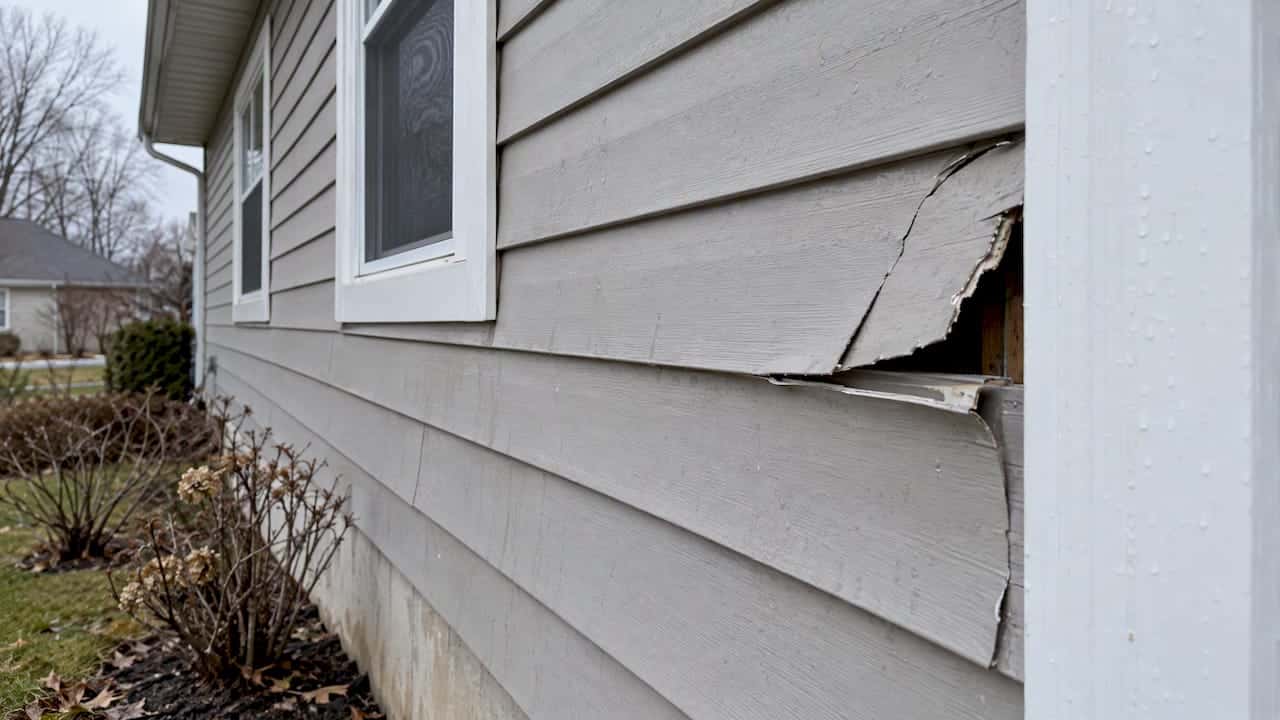
Hail, wind and falling limbs crack or dislodge panels and open paths for water. If a recent storm preceded the problem, document it quickly. Our guides on inspecting siding for hail damage within 72 hours and photographing wind damage explain what to record for a claim.
Signs the water has done real damage
Harmless moisture dries. Damaging moisture lingers. Watch for these signs, outside and in.
On the outside
- Siding that is warped, buckled, bubbling or has peeling paint
- Soft, spongy or crumbling trim, especially near the ground, windows and corners
- Dark streaks, mildew or algae that keeps returning in one area
- Panels that have lifted or separated at the seams
- Stains below windows, vents or roof junctions
On the inside
- Water stains, bubbling paint or peeling wallpaper on interior walls and ceilings, particularly near a window, door or vent
- A musty smell that doesn’t go away. A guide on finding moisture behind musty air vents shows how to trace smells like these back to a wet area
- Warped baseboards or flooring along an exterior wall
- Wet insulation or stains on the attic side of the roof deck
The Department of Energy’s homeowner repair guide says to look for wet or water-stained wall framing or sheathing when you open a wall. Rotted framing or sheathing is the point where a cosmetic problem becomes a structural one.
How to check where the water is coming from
You don’t need to pull siding off to start the investigation. Work from least to most invasive.
- Watch it rain. On a rainy day, look at where water appears and trace upward. Note whether it runs from a gutter, a roof edge or a window.
- Check the gutters and downspouts. Look for overflow marks, sagging runs and downspouts that end beside the foundation.
- Inspect the caulk and seals. Walk the house and look at joints around windows, doors and trim, along with hose bibs and vents. The Building America guide says to check exhaust vents for caulk that is cracked, peeling or shrinking, and to look for water stains on interior walls or ceilings near the vent. It also says flashing is preferable to caulk alone.
- Go into the attic. Check beneath roof vents for water stains or wet insulation, and look at the roof deck near the wall below the problem.
- Photograph everything. Date-stamped photos help a contractor and, if the cause is a storm, an insurer.
Stop short of cutting into the wall or prying off siding panels on a ladder. Removing vinyl or fiber cement the wrong way can crack the panels, and you can easily make a small leak bigger. The repair method depends on what you have: the Department of Energy notes that damaged panels can often be replaced by material type, but the technique differs for vinyl, fiber cement, metal, wood and shingles.
What to do when you find water behind siding
The order matters.
- Stop active water. If water is pouring in during a storm, a temporary cover or tarp on a roof or wall leak can buy time. Never work on a roof or ladder in wet or windy weather. If the source is the roof, our roof leak emergency guide covers what to do now.
- Find the source before repairing anything. The Department of Energy’s guidance is to identify and correct the source of pre-existing moisture before repairs, which also helps prevent mold and further deterioration. New siding over a wet, leaking wall just hides the problem.
- Let the wall dry. Wet sheathing and insulation should be dried or replaced, not covered.
- Repair or replace the damaged materials. That might mean new flashing, a patch of sheathing, resealed penetrations or a section of siding.
- Call an engineer if the structure is in question. If damage compromises the home’s structural integrity, the same guidance says to consult a professional engineer.
When to call a professional
Call a roofing and siding contractor when you see any of these: soft or rotted trim or sheathing, stains inside the house, recurring leaks in the same place after you have recaulked, damage after a storm, or a leak that might be coming from the roof. Water problems hide. A contractor who traces the full leak path, from roof to gutter to wall, will save you from patching the wrong spot twice.
Perspective: why we start with the leak path, not the siding
In St. Charles County, we see the same pattern often. A homeowner finds a stain or soft board, and the first instinct is to recaulk or swap a few panels. Sometimes that is enough. More often the water is entering somewhere higher: a flashing joint where the roof meets the wall, an overflowing gutter, or a window that was never flashed correctly. Missouri weather tests every one of those details, with heavy spring downpours, wind-driven storms, hail and freeze-thaw cycles that open small gaps.
So our approach is to look at the whole system before we quote a repair. That is why we offer free inspections and itemized, no-obligation estimates: you should see what is wrong, where, and what each part of the fix involves. We would rather tell you a small flashing repair is all you need than sell you a full siding job. When siding does need replacing, we stand behind it with the same family-owned care we bring to roofs, and a 25-year guarantee on our roofing services.
— Mario
Prevention: how to keep water out of the wall
Prevention is mostly about drainage and maintenance.
- A continuous drainage plane. The Department of Energy recommends a fully sealed, continuous drainage plane lapped over flashing around doors, windows, wall penetrations, and the top and base of walls. This is a job for the installer, so ask about it when you collect bids.
- A drainage gap. For wood and fiber-cement siding, Building America recommends furring strips or a drainable mat over the drainage plane, with at least a 1/16-inch gap behind lap siding. If a rainscreen has vents at the top and bottom, they can promote air circulation, and openings should be screened against insects and embers.
- Correctly sloped flashing at every opening, roof-to-wall junction and ledge.
- Clean, working gutters and downspouts that discharge well away from the house. See our page on seamless gutter installation if yours are failing.
- Annual walk-arounds. Check caulk, trim, and the joints around penetrations each spring and after major storms.
If you are already planning a siding project, consider insulated vinyl siding, and read our advice on comparing two to three siding bids so the proposals address the barrier, flashing and gaps, not just the panels.
Does homeowners insurance cover water behind siding?
It depends on the cause. The Insurance Information Institute says standard homeowners policies generally exclude flood and maintenance damage, while windstorm or hail, and certain sudden water losses, may be covered depending on your policy. In practice, that means:
- A storm that tore off siding or opened a path for rain is more likely to be a covered event.
- A slow leak from worn caulk, old flashing or a long-clogged gutter is usually treated as a maintenance issue.
Read your policy or ask your agent, and file promptly if a storm is the cause. Be cautious of anyone who knocks on your door offering to handle a claim after a storm; our guide to storm roofing scams explains what to watch for. If you need help documenting storm damage, see the first 72 hours after a storm.
Get the leak path found by a local pro
If you are in St. Charles County and suspect water behind your siding, we will inspect it for free. We look at the siding, the flashing, the gutters, the windows and the roof edges, then give you an itemized, no-obligation estimate that separates what is urgent from what can wait. You can see everything we do on our services page, or look at siding replacement if the wall needs more than a patch.
FAQ
Why is water dripping from behind my siding?
Usually because rain got past the outer layer and is draining down the barrier behind it, then exiting at the bottom. That can be normal after a hard storm. If it continues for days, or appears inside the house, the water is likely entering at failed flashing, a window or door, a roof junction or an overflowing gutter.
Is water behind vinyl siding a problem?
Not by itself. Vinyl siding is not waterproof, and its profile includes a built-in gap that lets water drain and the wall dry. The concern is moisture that stays, which can rot sheathing and framing and cause mold. Soft trim, stains, or musty smells are signs to have it inspected.
How do I waterproof behind siding?
You don’t seal it completely. You give water a path out: a taped water-resistant barrier, flashing lapped correctly at every opening, and a gap or drainable layer so the wall can dry. Sealing with caulk alone tends to fail. A contractor can check whether your wall has these layers.
Does homeowners insurance cover water leaks in walls?
Sometimes. Sudden losses and storm damage such as wind or hail may be covered depending on your policy, while damage from poor maintenance and flooding is generally excluded. Check your policy and talk with your insurer before you start repairs, and photograph the damage first.
Sources
- Moisture-, Impact-, Fire-, and Pest-Resistant Exterior Siding, Building America Solution Center
- Drainage Plane Behind Exterior Wall Cladding, Building America Solution Center
- Building Enclosure Science: Drainage Plane Behind Exterior Wall Cladding, U.S. Department of Energy
- Rainscreen Gaps in Exterior Walls, Pennsylvania Housing Research Center
- Window Flashing, Building Science Education
- Pan Flashing for Exterior Wall Openings, U.S. Department of Energy
- Water Management Residential, U.S. Department of Energy
- Building Science Introduction: Moisture Flow, Building America Solution Center
- Preventing Air and Water Infiltration: A Systems Approach, NAHB
- Repairing Windows and Doors: How To’s for the Handy Homeowner, U.S. Department of Energy
- Repairing Walls and Floors: How To’s for the Handy Homeowner, U.S. Department of Energy
- Flash and Air Seal around Kitchen and Bath Exhaust Fan, Building America Solution Center
- Which disasters are covered by homeowners insurance?, Insurance Information Institute
Recommended
- What To Do About A Roof Valley Leak Before It Wrecks Your Ceiling
- Homeowners: 8 Contractor Questions For Soffit And Fascia Damage
- Ice Dam Roof Damage: What To Do And How To Stop It
- Yes, You Need House Wrap Under Siding: 6 Checks For Homeowners
This article was prepared with AI assistance for general information. For recommendations specific to your property, contact Crowley Exteriors. Call or text us at 314-839-3800.