

The credit is nonrefundable, meaning it reduces your federal tax liability dollar-for-dollar but won’t generate a refund if it exceeds what you owe. Carryforward to a future year is generally not available for this credit, so your tax liability in the year of installation matters.
Three things to do right now:
- Verify your window model in the NFRC Certified Product Directory to confirm it meets ENERGY STAR Most Efficient criteria for your climate zone.
- Request the QMID (Qualified Manufacturer ID) or manufacturer’s written certification from your supplier or installer before final payment.
- Keep every invoice showing product cost, installation date, and installer contact — you’ll need these when you complete Form 5695 at tax time.
Key Takeaways
| Point | Details |
|---|---|
| Credit amount and cap | 30% of window product cost, capped at $600 per year for windows and skylights combined. |
| Eligibility requirement | Only ENERGY STAR Most Efficient windows verified in the NFRC Certified Product Directory for your climate zone qualify. |
| Documentation to keep | Retain QMID, NFRC listing, itemized invoice, and installation date — do not attach to return, but keep for audit. |
| Nonrefundable nature | The credit reduces tax liability only; consult a tax advisor if your annual liability is typically low. |
| Crowleyexteriors support | Crowleyexteriors provides itemized invoices, NFRC documentation, and QMID assistance for St. Charles County window installations. |
Table of Contents
- What changed between 2023 and 2026 — and why older guides may mislead you.
- Who can actually claim the window tax credit?
- Exactly how much can you claim in 2026?
- Which windows actually qualify?
- What paperwork to collect before, during, and after installation
- How to claim the credit on Form 5695, step by step
- Common mistakes that get credits disallowed
- Two worked examples showing the $600 cap in action
- What to ask your contractor before installation day
- Does the tax credit affect your home’s resale value or property taxes?
- What homeowners often underestimate about this credit
- Crowleyexteriors makes tax-ready window installation straightforward
- Sources
What changed between 2023 and 2026 — and why older guides may mislead you.
The rules governing the window tax credit shifted significantly starting in 2023, and guides written before that year can send you in the wrong direction fast.
The key timeline:
- Pre-2023 (old rules): The credit was a lifetime limit of $200 for windows — a one-time cap that applied across all years you owned the home.
- January 1, 2023 onward: The Inflation Reduction Act replaced the lifetime cap with an annual limit. Windows now qualify for 30% of product cost up to $600 per tax year, resetting each January 1.
- 2025 changes: The 2025 Instructions for Form 5695 reorganized how the Energy Efficient Home Improvement Credit is reported, separating it clearly from the Residential Clean Energy Credit and requiring taxpayers to report the manufacturer’s QMID when applicable.
- 2026 applicability: For windows placed in service during calendar year 2026, you file using Form 5695 with your 2026 tax return (due April 2027). The annual reset means you may have claimed the $600 window credit in 2025 and can claim it again in 2026 if you install additional qualifying windows.
Why this matters for your project:
- If you read a guide that mentions a “$200 lifetime limit,” it’s describing pre-2023 rules. Discard it.
- The annual cap structure means timing your installation within a specific tax year is now a real planning decision, not an afterthought.
- The QMID reporting requirement is new enough that many contractors and even some tax preparers aren’t aware of it yet.
For authoritative updates, go directly to the IRS Form 5695 instructions and the ENERGY STAR windows page — those two sources reflect the current program rules.
Who can actually claim the window tax credit?
The eligibility rules are tighter than most homeowners expect. Running through this checklist before you buy can save you from a disallowed credit.
You qualify if:
- You own the home where the windows are installed (renters cannot claim this credit, period).
- The home is your principal residence — your main U.S. home where you live most of the year. A vacation home or second property does not qualify.
- You are the original user of the improvement. Buying a home where the previous owner already installed qualifying windows does not entitle you to the credit.
- The windows are not part of new construction. The credit applies to improvements on existing homes only.
- The windows are reasonably expected to remain in use for at least five years.
- The home is located in the United States.
Hard exclusions:
- Rental properties, even if you own them.
- New construction, regardless of how energy-efficient the windows are.
- Windows installed in a home office or commercial space within the residence (only the residential portion qualifies).
- Any window that doesn’t meet ENERGY STAR Most Efficient criteria for your specific climate zone.
The credit is nonrefundable, which is a critical point the IRS guidance on the Energy Efficient Home Improvement Credit makes clear: if your total federal tax liability for the year is $400 and your calculated credit is $600, you get $400 of benefit — not a $200 refund. The remaining $200 is lost, not carried forward. If your tax liability is typically low, talk to a tax advisor before scheduling your installation.
Exactly how much can you claim in 2026?
The math is straightforward once you know the structure. Here’s how the numbers work under 26 USC §25C:
Installation labor does not count toward the calculation — only the cost of the windows themselves.
The $600 aggregate cap: No matter how many windows you install or how much they cost, the maximum credit for exterior windows and skylights combined is $600 per taxpayer per tax year.
How it fits into the broader annual limits:
The $600 window cap sits within the $1,200 home envelope limit, as detailed in the Form 5695 instructions. So if you also claim $800 for insulation in the same year, your envelope total is $1,400 — but the $1,200 envelope cap would limit that combined claim to $1,200, and the windows portion is still separately capped at $600 within that.
Quick calculation:
- Windows cost $1,800 (product only, no labor): 30% × $1,800 = $540 credit.
- Windows cost $3,000 (product only): 30% × $3,000 = $900, but the cap limits you to $600.
The Department of Energy’s home upgrades guidance notes that combining window replacements with insulation and HVAC upgrades in a coordinated plan often maximizes total credit value across categories — worth considering if you’re planning a larger renovation.
Which windows actually qualify?
This is where most homeowners get tripped up. Standard ENERGY STAR certification is not enough. The bar is higher.
The ENERGY STAR Most Efficient requirement
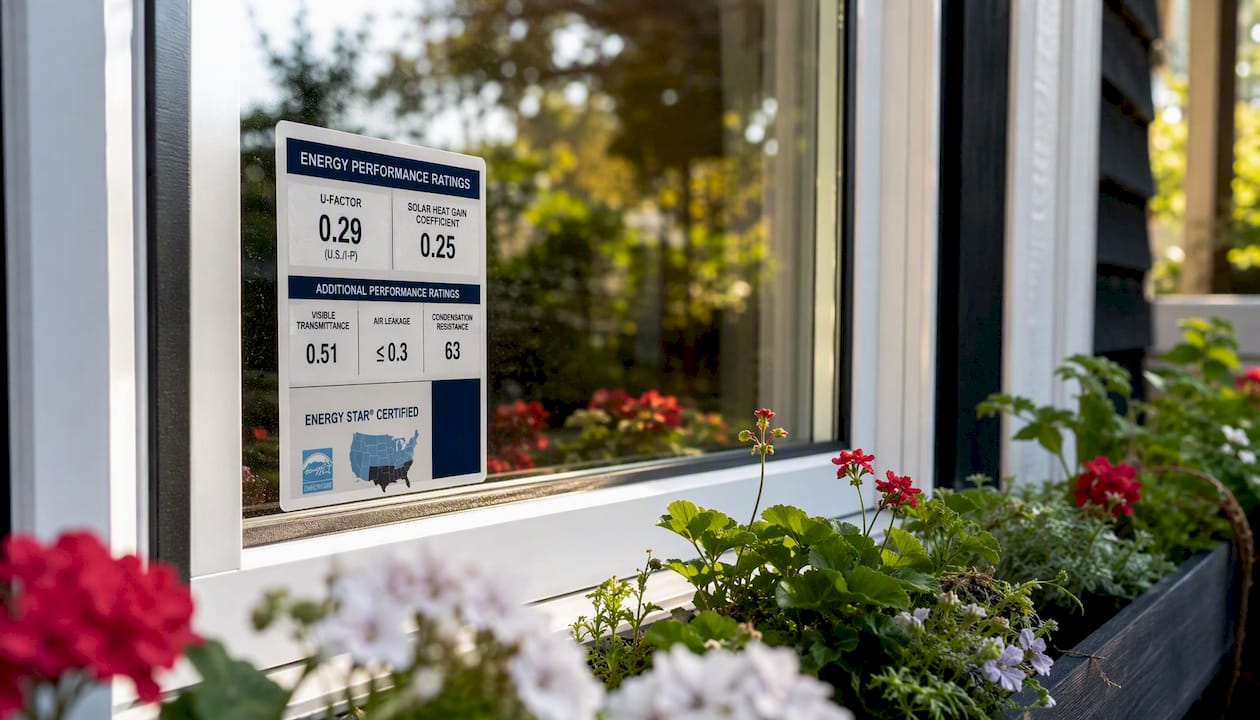
To qualify for the credit, windows must meet ENERGY STAR Most Efficient criteria — a designation that goes beyond the standard ENERGY STAR label. Most Efficient products must hit more stringent U-factor and Solar Heat Gain Coefficient (SHGC) thresholds that vary by climate zone. A window that carries a standard ENERGY STAR sticker but not the Most Efficient designation does not qualify.
Verifying eligibility in the NFRC Certified Product Directory
The National Fenestration Rating Council (NFRC) Certified Product Directory is the lookup tool that confirms whether a specific window model qualifies for your climate zone. Products listed with green shading in the directory meet the Most Efficient criteria for that zone. Before you buy:
- Go to the NFRC Certified Product Directory.
- Search by manufacturer and model number.
- Confirm the product shows as eligible (green) for your climate zone.
- Screenshot and save the result with the date.
Understanding QMID and manufacturer certification
The QMID (Qualified Manufacturer ID) is a code the IRS uses to identify manufacturers whose products have been certified as meeting the credit’s requirements. When you file Form 5695, you may be required to report the QMID for the windows you installed. The manufacturer’s written certification — a document stating the product meets §25C requirements — serves as your substantiation.
Where to find it: The QMID typically appears on the manufacturer’s website, the product spec sheet, or a certification letter the manufacturer provides upon request. Your installer should be able to get this for you.
What to do with it: Keep it in your records. The IRS does not require you to attach it to your return, but you must be able to produce it if questioned.
A note on window films: Low-E window films can improve energy performance, but they are not the same as qualifying sealed glazed window units. Films applied to existing windows generally do not meet the NFRC/ENERGY STAR Most Efficient criteria required for the §25C credit. Similarly, ceramic window film products, while technically advanced, do not qualify as replacement windows under the credit’s product standards.
Step-by-step verification checklist before you buy:
- Confirm the window model is listed in the NFRC Certified Product Directory.
- Check that the listing shows Most Efficient eligibility (green shading) for your specific climate zone.
- Ask the manufacturer or supplier for the QMID and written certification.
- Confirm the product is a sealed glazed unit (not a film or add-on treatment).
- Get the model number in writing on your purchase order.
What paperwork to collect before, during, and after installation
Good recordkeeping is the difference between a smooth credit claim and a disallowed one. The IRS guidance on claiming the credit is explicit: you don’t attach manufacturer certifications to your return, but you must retain them.
Documents to collect and keep:
- Itemized invoice showing the product cost of the windows separately from installation labor, the installation date, and the installer’s name and contact information.
- NFRC label or product spec sheet for each window model installed.
- Manufacturer’s written certification or QMID statement confirming the product meets §25C requirements.
- Screenshot of the NFRC Certified Product Directory listing for your model, dated at the time of purchase.
- Any state or utility rebate paperwork — keep these separate so you don’t accidentally double-count them against your product cost.
- Your Form 5695 once completed, along with the supporting worksheet.
How long to keep records: The IRS generally has three years from your filing date to audit a return, but six years if income is substantially underreported. Keeping window tax credit documentation for at least six years from the filing date is a reasonable standard.
Pro Tip: Create a single folder — physical or digital — labeled with the tax year and “Window Credit Documentation.” Drop every item above into it the day you receive it. Hunting for a manufacturer certification letter two years after installation, when the IRS sends a notice, is far harder than filing it once.

How to claim the credit on Form 5695, step by step
The IRS Form 5695 is the only form used to calculate and claim the Energy Efficient Home Improvement Credit. Here’s the exact sequence:
-
Confirm the placed-in-service year. The credit applies to the tax year the windows were installed and placed in service — not when you ordered them or paid the deposit. If your windows were installed in December 2026, you claim the credit on your 2026 return.
-
Gather your QMID and invoices. You’ll need the product cost (labor excluded), the QMID, and the installation date before you sit down to complete the form.
-
Download the current Form 5695. Get it directly from the IRS Form 5695 page to confirm you have the version that applies to your tax year.
-
Complete Part II of Form 5695 (Energy Efficient Home Improvement Credit).
- Enter the product cost of qualifying windows on the windows/skylights line.
- The form calculates 30% of that amount automatically.
- The $600 cap is applied on the form — if your 30% calculation exceeds $600, the form limits the credit to $600.
- Enter the QMID in the designated field when required.
-
Transfer the credit to Form 1040. The total from Form 5695 flows to Schedule 3 (Additional Credits and Payments), Line 5, and from there to your Form 1040.
-
Retain all supporting documentation. Do not attach manufacturer certifications or NFRC listings to your return. File them in your records.
What the form lines look like in practice:
- Line for windows/skylights: Enter total qualifying product cost.
- 30% calculation line: Form multiplies your entry by 0.30.
- Limitation line: Form applies the $600 cap if needed.
- QMID field: Enter the manufacturer’s QMID code.
The IRS FAQ on qualifying expenditures confirms that installation labor costs are excluded from the calculation — only the cost of the windows themselves counts toward the 30%.
Common mistakes that get credits disallowed
Most disallowed window credits trace back to a handful of avoidable errors.
Mistakes homeowners make most often:
- Claiming standard ENERGY STAR windows. The credit requires Most Efficient certification. A standard ENERGY STAR label is not sufficient — this is the single most common disqualification.
- Missing or incorrect QMID. Leaving the QMID field blank or entering an incorrect code flags the return for review.
- Including installation labor in the cost calculation. Only product cost counts. Labor is explicitly excluded under §25C.
- Claiming the credit on a rental property or second home. The principal residence requirement is firm.
- Claiming the credit for new construction. The credit applies only to improvements on existing homes.
- Poor recordkeeping. The IRS doesn’t require you to attach certifications, but if you can’t produce them during an audit, the credit is disallowed.
- Double-counting state or utility rebates. If you received a rebate that reduced your out-of-pocket product cost, your credit calculation should reflect the net cost, not the gross.
If you discover an error after filing:
- Obtain the manufacturer’s written certification retroactively if you didn’t get it at the time of purchase — most manufacturers will provide one upon request.
- File an amended return (Form 1040-X) if you overclaimed or underclaimed the credit.
- Document the correction with the same level of detail as the original claim.
On state and utility rebates: These don’t disqualify you from the federal credit, but they do affect the calculation. Keep the rebate documentation separate from your federal credit records.
Two worked examples showing the $600 cap in action
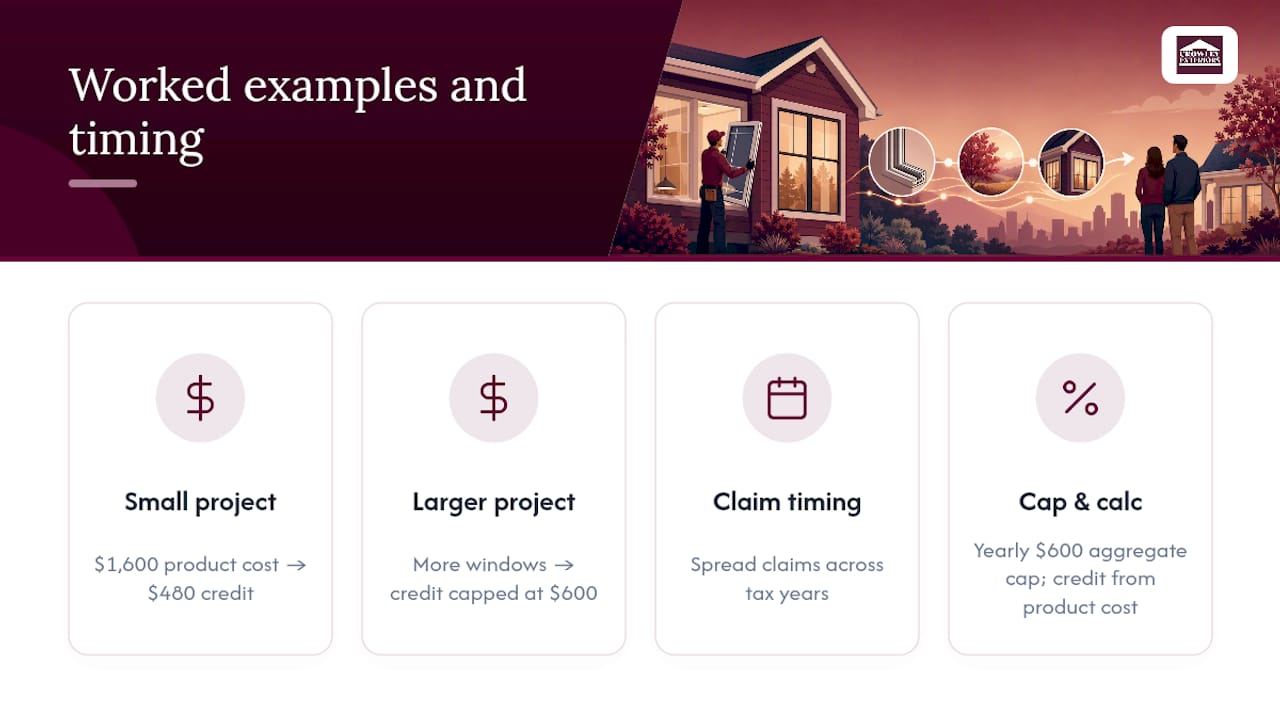
Example A: Smaller project, credit under the cap
A homeowner replaces four windows. The product cost (windows only, no labor) is $1,600.
The homeowner claims $480 on Form 5695.
Example B: Larger project, cap limits the credit
A homeowner replaces twelve windows. Product cost is $4,200.
- Calculate 30%: $4,200 × 0.30 = $1,260
- Apply the $600 aggregate cap: $1,260 exceeds $600, so the credit is limited to $600
- Report $600 on Form 5695 — the remaining $660 is not carried forward
The homeowner claims $600 regardless of how many additional qualifying windows were installed.
On splitting projects across tax years: Because the $600 cap resets annually, a homeowner planning to replace twelve windows could install six in late 2026 and six in early 2027. This only works if the tax liability in each year is sufficient to absorb the credit. The ENERGY STAR federal tax credits overview notes that spreading improvements across years is a recognized strategy for maximizing annual credits.
What to ask your contractor before installation day
A reputable contractor makes the tax credit paperwork straightforward. Here’s exactly what to request — and what a contractor like Crowleyexteriors should deliver without hesitation.
Request these items from your installer before final payment:
- The manufacturer QMID for each window model installed.
- Copies of NFRC labels or the product spec sheet showing U-factor and SHGC ratings.
- Model numbers in writing, matching the NFRC Certified Product Directory listing.
- A written statement confirming the windows meet ENERGY STAR Most Efficient criteria for your climate zone.
- The exact installation completion date (placed-in-service date for Form 5695).
What a complete contractor documentation package looks like:
- Itemized invoice separating product cost from labor.
- NFRC Certified Product Directory reference or label copy.
- Signed installation completion certificate with date.
- Manufacturer warranty documentation.
- QMID or manufacturer certification letter.
Crowleyexteriors provides itemized invoices that separate product and labor costs, supplies NFRC documentation, and can confirm installation dates in writing — the specific details the IRS expects you to retain. If you’re planning a window replacement in St. Charles County and want the paperwork done right from day one, coordinate the documentation request before the crew arrives, not after.
Pro Tip: Ask your contractor in writing, before signing the contract, to provide the QMID and a manufacturer certification letter as part of project closeout. Making it a contract deliverable means you won’t be chasing paperwork months later when you sit down to file.
Does the tax credit affect your home’s resale value or property taxes?
The federal window tax credit itself does not directly increase your home’s assessed value or trigger a property tax reassessment. The credit is a federal income tax benefit — it reduces what you owe the IRS for the year of installation, nothing more.
That said, the underlying improvement does matter for resale. Energy-efficient windows are a recognized selling point in most U.S. markets, and buyers increasingly ask about utility costs and efficiency ratings. A home with documented ENERGY STAR Most Efficient windows, complete with NFRC certifications and warranty paperwork, is easier to market than one where the seller can’t produce any product documentation. The same records you keep for the IRS serve double duty as disclosure documents when you sell.
On property taxes: most states do not reassess a home solely because of window replacements, and many states offer property tax exemptions specifically for energy-efficiency improvements. Missouri, for example, has programs that may limit reassessment for qualifying upgrades — but these are state-level rules entirely separate from the federal §25C credit. Check with your county assessor’s office for the rules that apply to your property.
The practical takeaway is that the credit lowers your upfront cost, the windows lower your energy bills over time, and the documentation you generate for the IRS also protects you at resale. Three benefits from one paper trail.
What homeowners often underestimate about this credit
The $600 cap sounds modest, and it is. But the bigger risk isn’t the dollar limit — it’s the eligibility gap between what homeowners assume qualifies and what actually does.
Walk into almost any home improvement store and you’ll find windows labeled ENERGY STAR. Most of them don’t qualify for this credit. The Most Efficient designation covers a fraction of the ENERGY STAR product universe, and climate-zone matching adds another filter on top of that. A window that qualifies in Miami may not qualify in St. Louis. That’s not a technicality — it’s a hard disqualification.
The documentation requirement is the other underestimated piece. The IRS doesn’t ask you to attach anything to your return, which gives homeowners a false sense of security. The audit risk is real, and the only defense is a complete paper trail: QMID, NFRC listing, itemized invoice, installation date. Homeowners who skip this step because “the IRS didn’t ask for it” are the ones who end up with disallowed credits two years later.
One more thing worth saying plainly: the nonrefundable nature of this credit means it works best for homeowners with meaningful federal tax liability. If you typically owe very little or get a large refund, the credit may deliver less value than you expect. Running the numbers with a tax advisor before you schedule installation is a 30-minute conversation that can change the timing of a $10,000 project.
Crowleyexteriors makes tax-ready window installation straightforward
Getting the credit right starts with the installation paperwork, and that’s where most homeowners run into trouble. Crowleyexteriors handles window replacement in St. Charles County with the documentation discipline the IRS expects: itemized invoices separating product cost from labor, NFRC label copies, QMID assistance, written installation completion dates, and manufacturer warranty documentation — everything you need to complete Form 5695 without scrambling at tax time.

With over 25 years serving Missouri homeowners and a free, no-obligation estimate process, Crowleyexteriors gives you a clear project cost before you commit — and the paperwork package to back your credit claim after. Request your estimate at Crowleyexteriors before your installation date, and ask specifically for the tax-credit documentation package at contract signing.
Sources
These are the primary references every homeowner should consult directly — not third-party summaries.
- Windows & Skylights Tax Credit | ENERGY STAR
- About Form 5695, Residential Energy Credits | Internal Revenue Service
- 26 USC 25C: Energy efficient home improvement credit
This article provides general information about federal tax credits and is not a substitute for advice from a qualified tax professional. Consult a CPA or tax advisor to confirm how these rules apply to your specific situation, and verify current guidance directly with the IRS before filing.