

If your roof is older than 15–20 years or you’re seeing widespread granule loss, multiple leaks, or sagging, plan for replacement within the next few years. A single missing shingle after a storm is a repair. Systemic deterioration across the whole slope is a different conversation entirely.
Here’s a fast read on where you stand:
- Repair now: Roof under 15 years old, isolated damage (one or two shingles, a single flashing failure), no interior leaks, deck intact.
- Plan replacement soon: Roof 15–20 years old, granule loss spreading across multiple slopes, two or more leak locations, or your insurer is asking questions about age.
- Replace now: Roof over 20 years old with visible sagging, daylight through the deck. Widespread shingle failure or active interior water damage.
If you’re unsure which category fits, a free professional inspection is the fastest way to know. The rest of this article gives you the evidence behind each threshold so you can walk into that conversation informed.
Key Takeaways
Replacing your roof at the right time protects your home’s structure, keeps your insurance valid, and almost always costs less than waiting for catastrophic failure.
| Point | Details |
|---|---|
| The 15–20 year rule | Roofs past 15–20 years with systemic signs should move toward replacement, not repeated repair. |
| Scope beats severity | Multiple leaks or widespread granule loss signals system failure; one localized spot usually does not. |
| Missouri climate shortens life | Freeze-thaw cycles and hail mean local asphalt roofs often reach end-of-life earlier than national averages suggest. |
| Delay compounds cost | Water infiltration leads to deck rot, mold, and structural repairs that routinely exceed the cost of timely replacement. |
| Crowleyexteriors next step | Schedule a free inspection with Crowleyexteriors in St. Charles County — includes photo documentation, written scope, and ventilation calculation. |
Table of Contents
- What exterior signs tell you it’s time to replace your roof
- Interior and structural warning signs you might be overlooking
- How long do roofs last by material?
- How do you decide whether to repair or replace?
- What does a roof inspection cost, and how long does replacement take?
- How to vet a roofing contractor before you sign
- Simple maintenance habits that extend your roof’s life
- What a professional roof inspection actually evaluates
- Sustainable and environmentally conscious roofing options
- What happens if you delay replacing your roof?
- How Missouri’s climate affects your roof’s lifespan
- A local contractor’s honest take on timing and common mistakes
- Crowley Exteriors offers free inspections and local replacement expertise
- Sources
What exterior signs tell you it’s time to replace your roof
The most reliable indicators for roof replacement are visible from the ground or a ladder, if you know what to look for. Most homeowners notice a missing shingle but miss the subtler signals that point to system-wide failure.
Shingle condition
- Curling or cupping edges: Shingles that curl upward at the edges (cupping) or fold back at the center (clawing) have lost their flexibility. This is a moisture and age problem, not a cosmetic one.
- Missing shingles: One or two after a windstorm is a repair. A pattern of missing shingles across multiple areas suggests the adhesive strips have failed broadly.
- Bald spots and granule loss: Asphalt shingles shed granules as they age. When you can see the dark mat underneath, UV protection is gone and the shingle is near end-of-life.
- Cracking or brittleness: Shingles that crack when flexed slightly are past their service life, regardless of how they look from the street.
Flashing, valleys, and penetrations
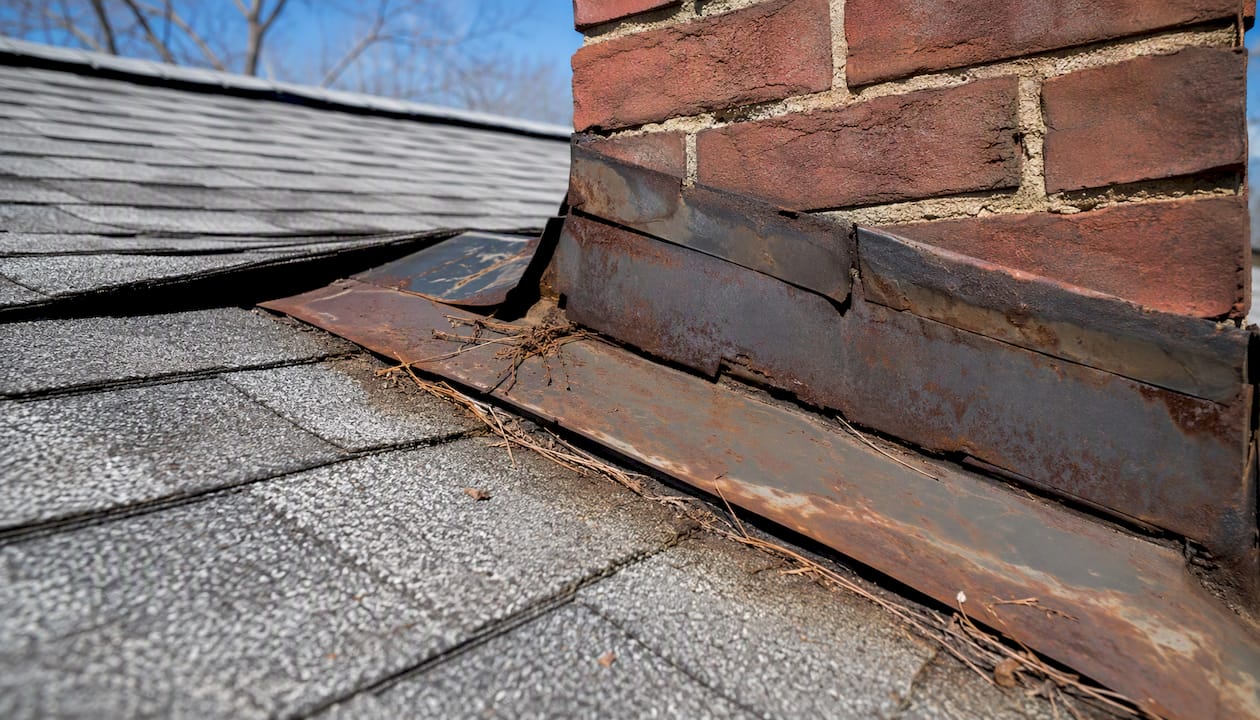
Damaged or lifted flashing around chimneys, skylights, and pipe boots is one of the most common sources of interior leaks. Rusted valleys, where two roof planes meet, channel enormous volumes of water and fail faster than flat surfaces. Missing or lifted ridge caps leave the roof’s spine exposed. These are not minor repairs on an aging roof; they signal that the whole assembly is deteriorating.
Moss, algae, and debris
Black streaking is algae and is mostly cosmetic, though it holds moisture against the shingle surface. Thick moss is more serious. Moss roots lift shingle edges and accelerate granule loss. Large patches of granules collecting in your gutters after rain are one of the clearest signs that asphalt shingles are shedding their protective layer at scale.
Sagging
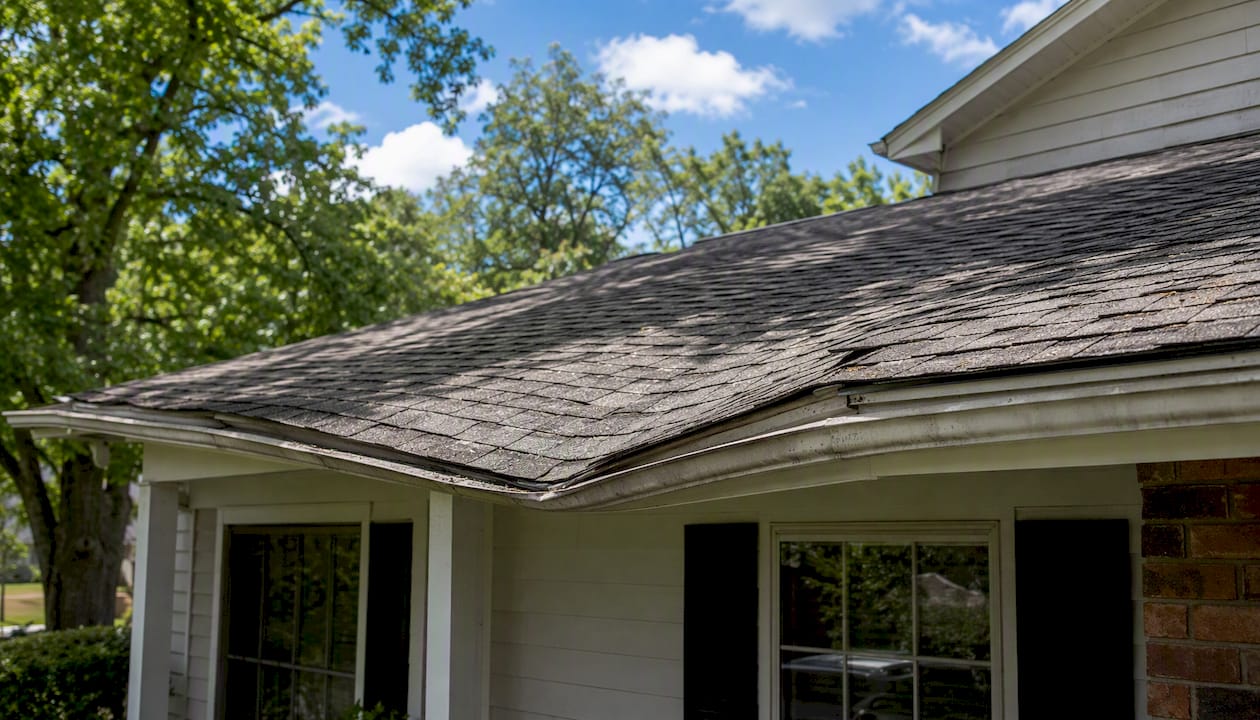
Any visible sag or wave in the roofline, whether on a slope or at the ridge, points to deck or structural damage. This is a replace-now situation.
According to FORTIFIED Home’s homeowner checklist, visible damage after severe weather and deteriorated underlayment are among the most reliable triggers for calling a professional.
Pro Tip: Before calling a contractor, photograph every problem area from the ground and from the eave line if you can safely reach it. Get close-up shots of granule loss, lifted flashing, and any cracked shingles. Those photos matter for insurance estimates and give a contractor a baseline before they get on the roof. Never walk on an aging asphalt roof yourself — brittle shingles crack under foot traffic and inspectors miss damage they cause.
Interior and structural warning signs you might be overlooking
A lot of roof failures announce themselves from inside the house before they become visible outside. The attic is the first place to check.
Attic warning signs
- Daylight through the roof deck: Any pinhole or beam of light visible from inside the attic means the deck has a gap. Water follows the same path.
- Damp or compressed insulation: Wet insulation loses its R-value and breeds mold. If it’s wet near the eaves or under a valley, the roof above it is failing.
- Mold or mildew on rafters or sheathing: Active mold growth in the attic usually means moisture has been entering for months, not days.
- Soft or spongy decking: If the sheathing feels soft when pressed, it’s rotting. Rotted decking cannot hold fasteners and must be replaced before new shingles go down.
Interior signs
- Water stains on ceilings or walls: A single stain after a heavy storm might be a flashing issue. Stains in multiple rooms, or stains that reappear after a repair, point to systemic failure.
- Sagging ceilings: Drywall that bows or sags has absorbed significant moisture. This is a structural concern, not just a cosmetic one.
- Repeated leaks in different locations: One leak is a repair. Two or three leaks in different spots on the same roof is the roof telling you it’s done.
When to stop the DIY and call a pro
If you find mold covering more than a small area, or if the ceiling is sagging, stop. Mold remediation and structural assessment require professionals. Electrical wiring runs through attic spaces, and wet insulation near junction boxes is a fire risk. A professional roof inspection will confirm whether the deck damage is localized or widespread, which is the single most important factor in the repair-versus-replace decision.
Pro Tip: Check your attic on a bright day with the lights off. Daylight through the deck is easier to spot than you’d expect. Do this twice a year — once in spring after freeze-thaw season and once in fall before winter.
How long do roofs last by material?
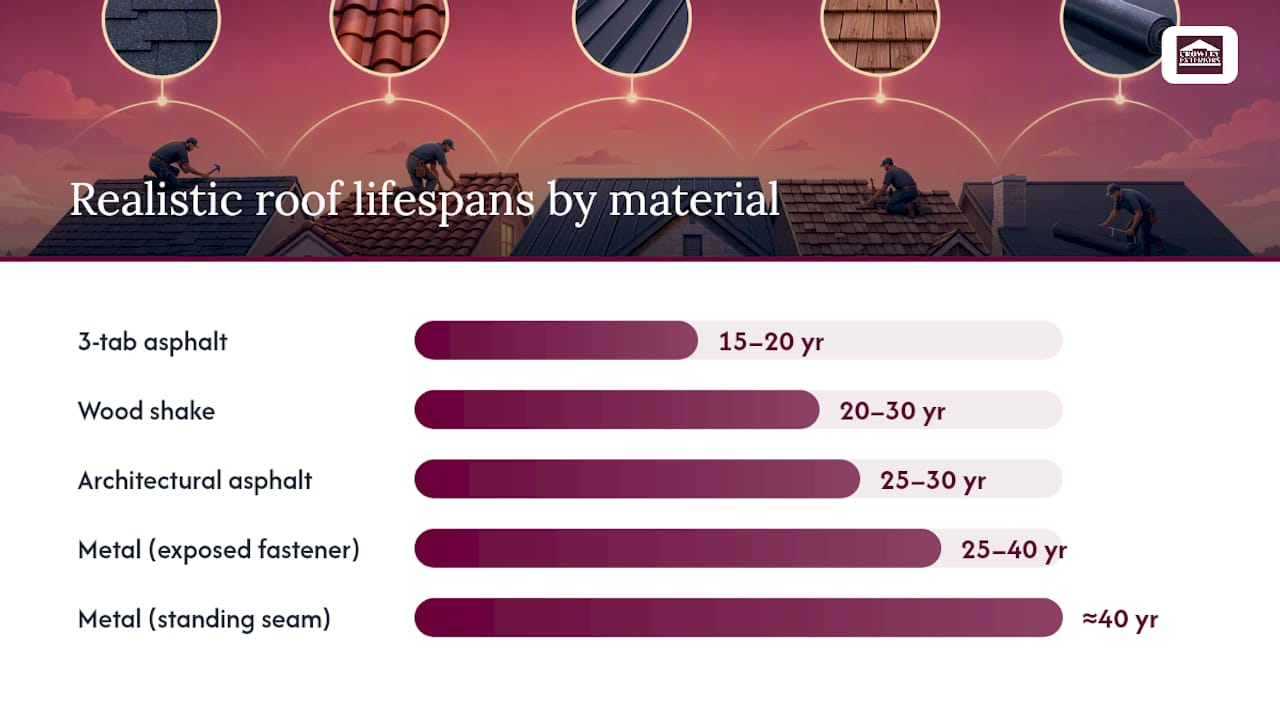
Realistic service life varies more than most manufacturers’ marketing suggests. The table below reflects field estimates from industry sources, not warranty marketing claims.
| Material | Realistic Service Life | Notes |
|---|---|---|
| 3-tab asphalt shingles | roughly 15 to 20 years | Thinner profile; most vulnerable to wind and hail |
| Architectural asphalt | about 25 to 30 years | Better wind resistance; most common U.S. residential choice |
| Metal (standing seam) | several decades, commonly within 40 years range | Longevity depends heavily on installation quality |
| Metal (exposed fastener) | about 25 to 40 years | Fastener gaskets require periodic inspection |
| Wood shake | approximately 20 to 30 years | Requires maintenance; fire risk in dry climates |
| Clay or concrete tile | 40–60 years | Underlayment often fails before the tile; budget for underlayment replacement |
| Slate (natural) | long-lasting, often several decades to a century or more | Underlayment and flashing replacement needed mid-life |
| TPO/EPDM (low-slope) | commonly 15 to 30 years | Seam integrity and UV exposure are the key variables |
Field data from The Roofing Brief places 3-tab asphalt near a 20-year central service life and architectural asphalt nearer 28–30 years, consistent with what This Old House reports for common residential materials.
The warranty-versus-service-life gap
A “30-year shingle” is a product tier designation, not a promise that your roof lasts 30 years. Manufacturer warranties prorate steeply after the first 10 years, meaning a shingle failure at year 22 on a “30-year” product may yield little or no reimbursement. Industry technical guidance is clear that warranty proration makes the marketing label financially meaningful only in the early years of the roof’s life.
Key caveats that change the math
- Climate: Freeze-thaw cycles, hail frequency, and UV intensity all shorten service life relative to the manufacturer’s test conditions.
- Ventilation: Poor attic ventilation traps heat and moisture against the shingle underside, cutting years off asphalt life.
- Installation quality: Nail placement, ice-and-water shield coverage, and ventilation balance often control real-world service life more than the product tier.
- Tile and slate: These coverings routinely outlast their underlayment. Budget for underlayment and flashing replacement even when the tile itself looks intact.
The 15-year insurance planning threshold matters here too. Many carriers begin applying stricter depreciation or shift to actual cash value (ACV) coverage around the 10–15 year mark, which pushes some homeowners to replace proactively to retain full replacement-cost coverage.
How do you decide whether to repair or replace?
The answer almost always comes down to three factors: age, scope of damage, and repair cost as a percentage of replacement cost. Work through these steps in order.
Step 1: Establish the roof’s age. Pull your closing documents or ask the previous owner. If you can’t find records, a contractor can estimate age from shingle condition and granule loss patterns.
Step 2: Apply the 15–20 year rule. GAF’s guidance is consistent with industry consensus: roofs under 15 years with minor, localized issues are usually worth repairing. Once a roof passes 15–20 years, the economics shift toward replacement because the remaining service life shrinks faster than repair costs do.
Step 3: Assess the scope of damage. This is the most important step. According to RoofDecisionGuide, widespread granule loss, multiple leaks, or deck exposure is a stronger driver for replacement than any single localized failure. A storm can break thermal-seal strips across an entire slope even when only a few shingles appear missing from the street — which is exactly why a close-up professional inspection matters after any significant weather event.
Step 4: Tally your repair history. How many times has this roof been patched in the last three to five years? Repeated small repairs on a brittle, aging roof frequently mask systemic deck or underlayment failure underneath.
You’re spending real money to extend a failing system by a few years at most.
Two quick scenarios
Scenario A: A 12-year-old architectural shingle roof loses three shingles in a windstorm. No interior leaks, deck is solid, granule loss is minimal. Repair it. The roof has years of service life remaining.
Scenario B: An 18-year-old 3-tab roof has granule loss on two slopes, a second leak appeared this spring, and the contractor found soft decking near the valley. Replace it. You’re past the 15-year threshold, the damage is systemic, and the next repair won’t be the last.
Pro Tip: The “patch-re-patch” trap is real. If you’ve had the same area repaired twice and it’s leaking again, the problem is almost certainly below the shingles — in the underlayment or deck. A third patch buys you months, not years, and the water damage accumulating underneath costs more the longer you wait.
What does a roof inspection cost, and how long does replacement take?
What a professional inspection covers
A thorough inspection goes well beyond a visual scan from the driveway. Expect a qualified inspector to check:
- Shingle condition across all slopes (granule loss, cracking, lifting)
- Flashing integrity at all penetrations, valleys, and eaves
- Underlayment condition where visible at edges and penetrations
- Deck condition (soft spots, rot, delamination)
- Fastener pattern and nail placement
- Attic ventilation balance (intake vs. exhaust)
- Attic moisture, mold, and insulation condition
- Chimney, skylight, and pipe boot condition
- Photo documentation of all findings
Typical replacement costs for a 2,000 sq ft home
Cost varies by material, tear-off complexity, local labor rates, and deck condition. These ranges reflect U.S. residential averages for a standard 2,000 sq ft single-story home with architectural asphalt shingles:
| Scenario | Estimated Cost Range |
|---|---|
| Basic replacement (architectural asphalt, good deck) | $10,000–$12,000 |
| Mid-range (architectural asphalt, some deck repair) | $12,000–$15,000 |
| Premium (metal or impact-resistant shingles) | $20,000+ |
These figures assume a complete tear-off of existing shingles, new underlayment, and standard ventilation. Partial deck replacement, steep pitch, or multiple layers of existing shingles add cost.
Timeline from inspection to completion
- Free inspection and photo documentation: 1–2 hours
- Written estimate and scope review: several days
- Permit pulled (required in many Missouri jurisdictions): a few days to a week
- Tear-off and installation: typically a few days for a standard residential roof
- Final inspection and cleanup: same day or next day
Most homeowners go from initial inspection to a finished roof in two to three weeks, weather permitting. Always get at least two written estimates with identical scope before signing anything.
Pro Tip: Ask every contractor for a line-item written scope, not just a total price. The scope should specify underlayment type, ice-and-water shield coverage, ventilation product, nail pattern, and who pulls the permit. Contractors who resist this level of detail are telling you something important.
How to vet a roofing contractor before you sign
The roofing industry has a higher rate of storm-chasing fraud than most home services. A few targeted questions separate legitimate contractors from the ones who disappear after the check clears.
Questions to ask every contractor
- Are you licensed and insured in Missouri? Ask for the certificate of insurance directly — not a photocopy, the actual certificate with the issuing agent’s contact.
- Do you carry workers’ compensation? If a worker is injured on your property and the contractor has no workers’ comp, you may be liable.
- Can you provide three local references from jobs completed in the last 12 months?
- Who pulls the permit, and is it included in the price?
- What underlayment and ice-and-water shield are you specifying, and where does the ice-and-water shield run?
- What is the nail pattern, and will you provide photo documentation before the shingles go down?
- What does the manufacturer’s warranty cover, and what does your workmanship warranty cover? How does the workmanship warranty prorate?
- Will this be a complete tear-off or an overlay?
Red flags to walk away from
- Cash-only payment or a request for full payment upfront
- Pressure to sign the same day, especially after a storm
- No physical business address or only a P.O. box
- Unwillingness to provide proof of insurance
- A bid significantly lower than every other estimate with no explanation
- Offering to “work with your insurance” without having seen the adjuster’s report
What to verify on the written estimate
- Complete tear-off specified (overlays void most manufacturer warranties and hide deck problems)
- Underlayment type and weight
- Ice-and-water shield at eaves, valleys, and penetrations
- Ventilation product and calculation
- Permit responsibility clearly assigned
- Payment schedule tied to milestones, not calendar dates
For a broader red flags checklist, reviewing one before you start getting estimates is worth 10 minutes of your time.
Pro Tip: Check the IBHS FORTIFIED program standards when evaluating bids. Contractors familiar with FORTIFIED Home requirements understand nail patterns, sealed decks, and impact-resistant materials at a level that goes beyond minimum code — and that knowledge shows up in how they write a scope.
Simple maintenance habits that extend your roof’s life
Most roofs fail faster than they should because of neglected maintenance, not material defects. A consistent seasonal routine adds years to any roof system.
Seasonal maintenance checklist
- Spring: Inspect shingles after freeze-thaw season. Check attic for moisture or mold. Clean gutters of winter debris. Look for lifted flashing at chimneys and pipe boots.
- Summer: Trim any branches overhanging the roof by at least six feet. Check attic ventilation — a hot attic in July is cooking your shingles from below.
- Fall: Clean gutters before leaf season peaks. Clear debris from valleys and around penetrations. Schedule your annual roof inspection before winter.
- After any severe storm: Walk the perimeter and look for granules in gutters, missing shingles, or lifted ridge caps. If you had hail or winds above 60 mph, call for a professional inspection — storm damage is often invisible from the street.
Ventilation is the most underrated maintenance factor
An unbalanced attic — too little intake at the soffits, too little exhaust at the ridge — traps heat and moisture against the shingle underside. This accelerates granule loss and shingle brittleness faster than almost any other variable. If your attic is consistently hot in summer or shows frost in winter, ventilation is the problem. Fixing it is far cheaper than an early roof replacement.
Pro Tip: Targeted flashing replacement and a ventilation correction are the two maintenance investments most likely to postpone a full replacement by three to five years. Neither is glamorous, but both address the root causes of premature failure rather than the symptoms.
What a professional roof inspection actually evaluates
Knowing what a qualified inspector checks helps you judge whether the report you receive is thorough or superficial. A credible inspection covers every item below.
| Inspection Item | What the Inspector Evaluates |
|---|---|
| Decking condition | Soft spots, rot, delamination, previous patch repairs |
| Flashings | Integrity at chimneys, skylights, pipe boots, walls, and eaves |
| Valleys | Rust, open seams, granule accumulation, flashing type |
| Underlayment | Visible condition at edges and penetrations; age estimate |
| Fasteners and nail pattern | Correct placement, overdriven or underdriven nails, nail-through failures |
| Ventilation balance | Intake (soffit) vs. exhaust (ridge/power) calculation; signs of heat or moisture buildup |
| Attic moisture and mold | Active moisture, staining on rafters, mold on sheathing |
| Chimney and penetrations | Cap condition, crown integrity, flashing seal, pipe boot condition |
| Evidence photos | Close-up documentation of all deficiencies for insurance and scope purposes |
Documentation to request and keep
Ask for the full photo set from the inspection, not just a summary. Photos of deck rot, granule loss patterns, and flashing failures are what insurance adjusters and subsequent contractors need to verify scope. A contractor who won’t provide photos is a contractor who doesn’t want you comparing their findings to anyone else’s.
Pro Tip: Request the ventilation calculation in writing. A reputable contractor will calculate the net free area of your intake and exhaust and show you whether your attic meets the 1:150 or 1:300 ratio required by most building codes. If they can’t produce that number, they haven’t done the calculation.
Sustainable and environmentally conscious roofing options
Roofing choices have a measurable environmental footprint, and the options available to Missouri homeowners have expanded considerably.
Material longevity is the most sustainable choice
The greenest roof is one that doesn’t need replacing for 50 years. Metal roofing, clay tile, and natural slate all have dramatically lower lifetime environmental impact than asphalt shingles replaced every 20–25 years, even accounting for higher upfront energy in manufacturing. Architectural asphalt shingles with a recycled content designation are a middle-ground option for homeowners who want a lower upfront cost with a reduced footprint.
Recycled and reclaimed materials
Recycled rubber and plastic composite shingles (products like those made from reclaimed tires and plastic) are gaining traction as a durable, low-maintenance alternative. They typically carry 40–50 year warranties and are impact-resistant, which matters in Missouri’s hail corridor.
Shingle recycling at end of life
Old asphalt shingles are recyclable into road paving material. Ask your contractor whether they use a recycling facility for tear-off material rather than sending it to a landfill. This is a simple question that costs nothing and keeps several tons of material out of the waste stream.
Cool roofing and solar compatibility
Light-colored or reflective roofing materials reduce attic heat gain, which lowers cooling loads in summer. If solar panels are part of your long-term plan, replace the roof before installation. Removing and reinstalling panels for a roof replacement adds significant cost.
What happens if you delay replacing your roof?
Waiting too long to replace a failing roof is one of the more expensive decisions a homeowner can make. The consequences compound quickly.
Structural damage
Water that enters through a failing roof doesn’t stop at the ceiling. It saturates insulation, rots rafters and sheathing, and eventually reaches wall framing and subfloor. What starts as a $12,000 roof replacement can become a $20,000–$30,000 project once structural repairs are added. GAF’s guidance is direct on this point: waiting for full failure routinely leads to greater structural repairs and insurance complications.
Mold and air quality
Chronic moisture in the attic creates mold within 24–48 hours of saturation. Mold remediation in an attic runs $1,500–$6,000 or more depending on extent, and it’s a cost that insurance often disputes when the underlying cause is deferred maintenance.
Insurance eligibility
Many carriers will not renew or will non-renew a policy on a roof past a certain age, typically 20–25 years for asphalt shingles. Some require a roof inspection before renewal. If your roof is flagged during an inspection and you delay replacement, you risk losing coverage entirely — which means a subsequent storm loss comes entirely out of pocket.
Home sale complications
A roof flagged during a buyer’s inspection either kills the sale or forces a price reduction that typically exceeds the cost of replacement. Replacing the roof before listing almost always nets a better outcome.
How Missouri’s climate affects your roof’s lifespan
Missouri sits in a weather corridor that is genuinely hard on roofing materials. Understanding the local pattern helps you plan replacement timing more accurately than national averages suggest.
Freeze-thaw cycles
St. Charles County and the broader Missouri region experience dozens of freeze-thaw cycles each winter. Water that infiltrates even a small crack in a shingle or flashing joint expands when it freezes, widening the gap. Over several winters, this mechanical action accelerates shingle cracking and flashing failure faster than the same roof would age in a milder climate.
Hail
Missouri is on the western edge of the Midwest hail corridor. Hail impacts bruise asphalt shingles, breaking the granule bond and accelerating granule loss even when the shingle isn’t visibly cracked. A hail event that looks minor from the ground can shorten a roof’s remaining service life by three to five years. This is why a professional inspection after any hail event is worth scheduling, regardless of how the roof looks from the driveway.
Heat and UV
Missouri summers are hot and humid. Attic temperatures in an under-ventilated home can reach 150°F or higher, which degrades asphalt shingles from below at the same time UV exposure degrades them from above. The combination is why Missouri asphalt roofs often reach end-of-life at the lower end of the national service-life range.
Practical implication for replacement timing
If you’re in St. Charles County and your architectural shingle roof is approaching 20 years, don’t use the national 25–30 year average as your planning benchmark. Local climate conditions, particularly freeze-thaw and hail exposure, mean the realistic local service life for how long roofs last in Missouri is often shorter than what the manufacturer’s marketing suggests.
A local contractor’s honest take on timing and common mistakes
Most homeowners who call us for a replacement waited longer than they should have. That’s not a criticism — it’s a pattern. Roofs fail gradually, and the signs are easy to rationalize until the ceiling is wet.
The Missouri-specific issue I see most often is attic ventilation neglect. A homeowner replaces their roof, the new shingles go down, and nobody addresses the fact that the attic has been running 20°F hotter than it should for a decade. The new shingles start degrading faster than expected, and the homeowner assumes they got a bad product. Usually, they got a ventilation problem that nobody fixed.
The second most common mistake is misreading warranty terms. A “30-year shingle” does not mean the manufacturer will replace your roof at year 28. The proration schedule typically means the warranty is nearly worthless after year 10–12 in practical financial terms. Plan your replacement budget around realistic service life, not the marketing label on the package.
On timing: schedule your inspection in late summer or early fall, before the busy season peaks and before winter makes access difficult. If your roof is 15 years or older, do it before your insurance renewal date. Some carriers are now requiring inspections as a condition of renewal, and knowing your roof’s condition before that conversation gives you options.
Crowley Exteriors offers free inspections and local replacement expertise
When your roof is showing the signs covered in this article, the next step is a professional assessment from someone who knows Missouri weather and what it does to roofing systems. Crowleyexteriors has served St. Charles County homeowners for over 25 years, and every job starts with a free inspection that includes photo documentation, a written scope, and a ventilation calculation — no obligation, no pressure.

The free roof inspection covers everything on the professional checklist above: deck condition, flashing integrity, granule loss assessment, attic ventilation balance, and full photo documentation you can use for an insurance claim or a second opinion. Crowleyexteriors also handles insurance-claim support directly, which matters when hail or wind damage is involved. The workmanship warranty runs 25 years. Schedule your free inspection at Crowleyexteriors and know exactly where your roof stands before winter arrives.
Sources
The following sources informed the guidance in this article. Homeowners will find the FORTIFIED checklist and GAF repair-vs-replace guidance most immediately useful; contractors and inspectors should review the NRCA-aligned material at The Roofing Brief.
- Roof lifespan by material
- Understanding residential roof repairs: How do I know if my roof needs to be replaced?
- Repair vs replace
- How long does a roof last?
- 8 Ways to Know If You Need a New Roof – FORTIFIED Home