

Insulated vinyl siding delivers modest, measurable energy savings plus real gains in comfort, noise reduction, and panel durability. For most homeowners, it earns its premium if the walls are under-insulated, the house sits in a cold or mixed climate, and the ownership horizon runs long.
- Energy: Field studies show average heating and cooling savings around 5.5%, backed by ENERGY STAR whole-wall guidance.
- Comfort and noise: Foam backing quiets rattle and dampens outside sound noticeably.
- Durability and looks: Rigid panels resist dents and smooth out wavy old sheathing.
It suits older, drafty homes more than newer, well-insulated ones, and an installer like Crowleyexteriors can confirm which category yours falls into.
Key Takeaways
| Point | Details |
|---|---|
| Energy savings are modest | Field studies show average savings of 5.5%, ranging from 1% to 11% depending on climate and existing insulation. |
| R-value adds up over the whole wall | R-2 to R-2.7 continuous insulation closes thermal bridging gaps that cavity insulation alone misses. |
| Installation quality decides outcomes | Tight foam joints, taped WRB, and sealed flashing determine whether you get the advertised performance. |
| Payback depends on your house | Costs run $2,400 to $3,600 more with $50 to $350 in annual savings; an energy audit sharpens the estimate. |
| Crowleyexteriors offers a local starting point | Free inspections, no-obligation estimates, and a 25-year workmanship guarantee support due diligence before signing. |
Table of Contents
- Insulated Siding Benefits Explained: Energy Performance and R-Value
- Durability, Curb Appeal, and Everyday Comfort Wins
- Moisture, Air Sealing, and Why the Installer Matters More Than the Product
- What Insulated Siding Costs and When It Pays Back
- When Insulated Siding Is Worth the Money (and When It Isn’t)
- The Trade-Offs Nobody Puts in the Brochure
- The Bottom Line on Insulated Siding
- Why the Energy-Savings Pitch Misses the Real Story
- Get a Local Read on Your Home’s Siding Needs
- Frequently Asked Questions
- Sources
Insulated Siding Benefits Explained: Energy Performance and R-Value
Insulated siding is foam-backed vinyl cladding, usually rigid polystyrene laminated to the panel’s back. That foam layer adds continuous insulation across the entire wall, not just between studs, which is exactly where standard hollow vinyl falls short. Hollow vinyl siding offers essentially zero R-value on its own. Insulated panels typically add R-2 to R-2.7, with some premium products reaching higher, according to industry cost analyses.
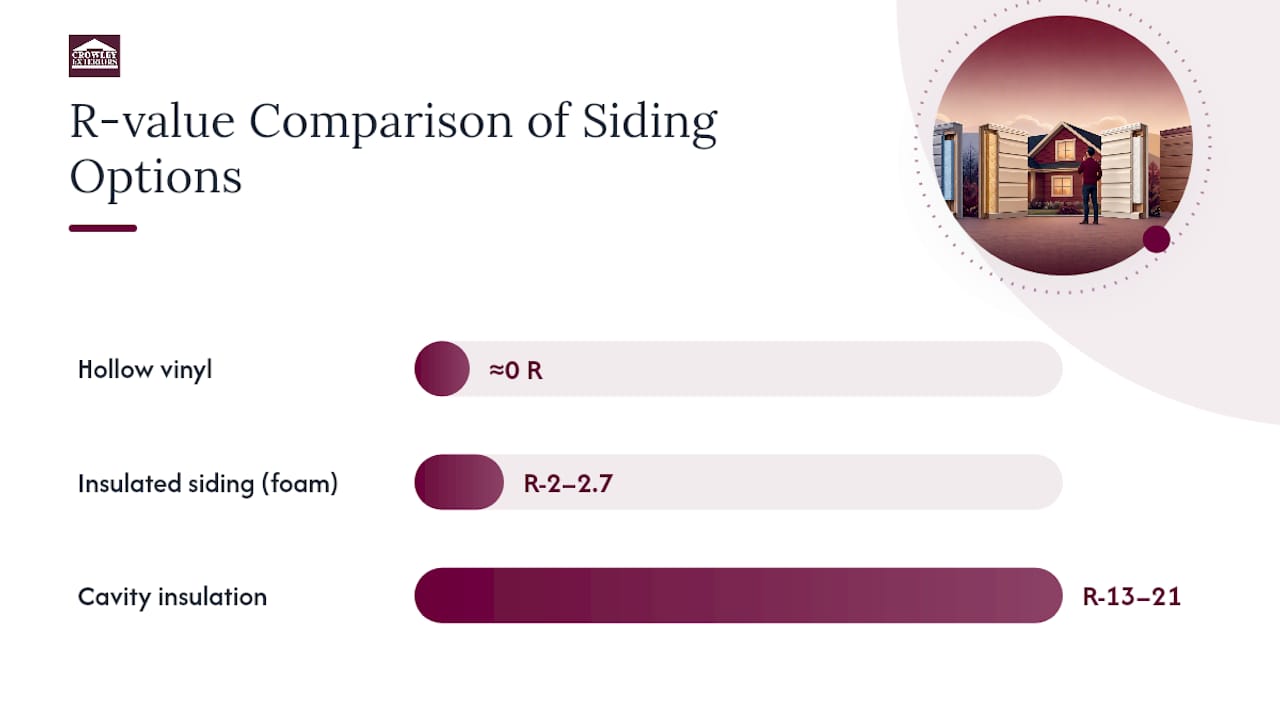
That number sounds small next to the R-13 or R-21 you’d expect from cavity insulation, and it is small, but similarly, new interior doors improve energy efficiency in older Portland homes by addressing thermal leaks at interior boundaries. But continuous insulation matters because it interrupts thermal bridging, the heat loss that happens right through wood studs regardless of how well the cavities between them are insulated. A wall with good batt insulation but no continuous layer still leaks heat through every stud, every 16 inches. Closing that gap is what moves the needle on whole-wall performance, which is why ENERGY STAR and IECC guidance recognize continuous insulation as a distinct compliance path from cavity R-value alone.
The field numbers back this up, within reason. A multi-site study from Building America and PNNL found insulated siding cut heating and cooling energy use by an average of 5.5% across test homes, with individual sites ranging from 1% to 11% depending on climate and the home’s starting condition. Airtightness improved by roughly 11% in some retrofits. A separate cold-climate retrofit on a 1960s house, documented in an NLR/OSTI field evaluation, showed a 9.5% airtightness gain and an 8% drop in normalized heating energy after installing R-2.7 insulated siding alongside air sealing.
Two things drive that variability:
- Climate severity: colder zones see bigger absolute savings than mild ones.
- Existing wall insulation: a home with empty stud cavities gains far more than one already insulated to code.
None of those gains show up automatically. Pair the siding with air sealing and a proper house wrap, or you’re leaving most of the measured benefit on the table.
Durability, Curb Appeal, and Everyday Comfort Wins
The foam backing does more than insulate. It stiffens the panel, which means less flexing, fewer dents from hail or a stray baseball, and none of the oil-canning waviness that plagues thin standard vinyl in direct sun. On older homes with uneven sheathing, that rigid foam layer also flattens out cosmetic imperfections without the expense of replacing sheathing just to fix appearance.
Homeowners tend to notice the quieter interior first. Foam backing dampens sound transmission, so traffic noise, rain, and neighborhood commotion register less indoors.
- Manufacturer warranties commonly run 25 to 50 years, though terms vary by brand and installer.
- Rigid panels tend to hold their look longer than standard vinyl, supporting resale curb appeal.
- Compared to fiber cement, insulated vinyl needs less maintenance but carries less of a premium “custom” look.
Moisture, Air Sealing, and Why the Installer Matters More Than the Product
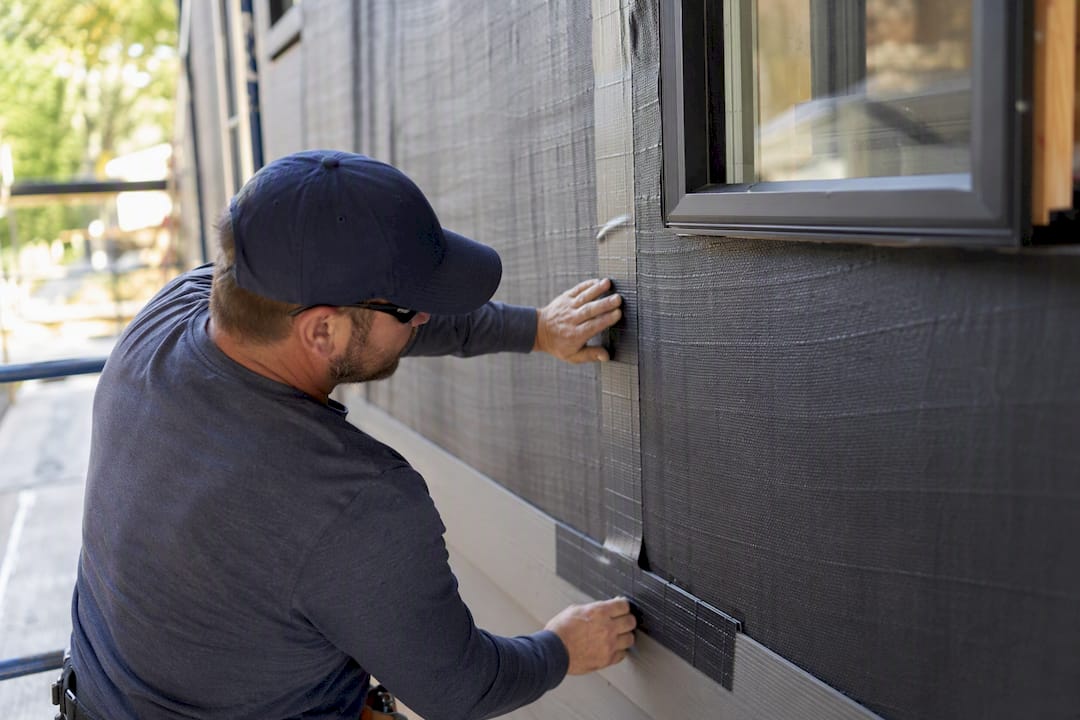
Insulated siding is not a waterproof shell. It’s cladding with a foam layer bonded to the back, and water management still depends entirely on what’s underneath: the water-resistive barrier (WRB), flashing, and sealed penetrations around windows and doors. Skip those, and no amount of R-value will fix a leak.
The good news from field research is reassuring on drying capacity. Comparative testing summarized by BuildingGreen found insulated siding didn’t meaningfully reduce a wall’s ability to dry out, and it performed especially well in non-wetting conditions, since the foam keeps sheathing slightly warmer and less prone to condensation. After a wetting event, though, some tests showed conventional siding dried marginally faster. That nuance matters more to an installer than to a homeowner picking a product off a brochure.
Before signing a contract, require:
- Tight-fitting foam joints with no visible gaps at seams or corners.
- A taped, continuous WRB installed before the siding goes up.
- Sealed flashing and penetrations at every window, door, and utility line.
- Proper venting where the wall assembly calls for it.
Pro Tip: Ask for photos of the WRB and flashing before the siding covers it up. A contractor with nothing to hide will already have this documented. Crowleyexteriors backs its siding installations with a free inspection, a no-obligation estimate, and a 25-year workmanship guarantee, which gives homeowners a paper trail if something goes wrong later.
What Insulated Siding Costs and When It Pays Back
Insulated siding typically runs 20% to 40% more than standard vinyl, which on an average project translates to roughly $2,400 to $3,600 in added upfront cost, according to industry pricing data. Local labor rates and panel thickness swing that range in either direction.
Annual energy savings vary with climate, existing insulation, and home size, generally resulting in modest reductions in heating and cooling costs.
- Homes in colder climates with high heating bills sit at the top of the range.
- Homes with little or no existing wall insulation see bigger jumps than already-insulated ones.
- Mild climates and small, efficient homes tend to land near the bottom.
The payback math is simple: divide the added cost by your expected annual savings. A $3,000 premium against $200 in yearly savings pencils out to a 15-year payback. If you’re planning to sell in five years, that math looks a lot less appealing than if you’re staying for 20. Before committing, a home energy audit or HERS score gives you a house-specific number instead of a national average.
When Insulated Siding Is Worth the Money (and When It Isn’t)
Run through this before you sign anything:
- Check your wall insulation first. Older homes with empty or thin stud cavities see the biggest gains from adding continuous insulation.
- Consider your climate. Cold and mixed climates return more energy savings than mild ones, per the field studies above.
- Weigh your timeline. A 10-plus-year payback only makes sense if you’re not selling soon.
- Compare it to cheaper fixes first. Attic insulation and air sealing usually deliver faster payback than siding alone. If those are already done, siding becomes the next logical step.
- When unsure, get an audit. A home energy assessment tells you exactly where your walls stand before you spend on cladding.
Skip it if your walls are already well-insulated, your climate is mild, or you’re moving within a couple of years. The comfort and durability upgrades still apply, but the energy math won’t favor you.
The Trade-Offs Nobody Puts in the Brochure
Insulated siding isn’t a free upgrade, and it doesn’t replace real wall insulation.
- The cost premium doesn’t fully return at resale; it’s a comfort and durability investment more than a flip strategy.
- R-2 to R-2.7 supplements cavity insulation, it doesn’t substitute for it.
- Foam backing is PVC and EPS, so factor in warranty fine print and end-of-life disposal when comparing claddings.
- Reduce the risk by hiring an experienced installer, confirming manufacturer warranty terms in writing, and pursuing a broader retrofit if you need bigger energy cuts.
The Bottom Line on Insulated Siding
Insulated siding delivers real but modest energy savings, alongside clear wins in comfort, noise reduction, and panel durability that most homeowners notice faster than their utility bill. It fits older, under-insulated homes in colder climates and owners planning to stay put best.
Next steps:
- Get a home energy audit or HERS score before you commit.
- Collect 2 to 3 installer estimates and compare warranty terms line by line.
- Confirm the installation checklist: tight joints, taped WRB, sealed flashing.
- If you’re in Crowleyexteriors’ service area, a free inspection is a low-risk way to get house-specific numbers instead of national averages.
Why the Energy-Savings Pitch Misses the Real Story
Most siding marketing leans hard on energy savings because it’s the easiest number to advertise, even though the field data puts that figure in single digits for most homes. That’s not a knock on insulated siding. It’s a correction to how it gets sold.
What the research actually supports is a different priority order than most homeowners start with. Comfort, noise reduction, and panel rigidity show up immediately and consistently, while energy savings depend heavily on variables specific to your house, your climate, and your existing insulation. Chasing utility bill promises without checking your wall cavity insulation first is how homeowners end up disappointed.
The conventional advice skips something more important: installation quality determines almost everything. A perfectly rated product with sloppy seams and an untaped house wrap will underperform a mid-tier product installed correctly. If you take one thing from this guide, make it this: interrogate the installation checklist before you interrogate the R-value spec sheet. The panel is only half the equation.
Get a Local Read on Your Home’s Siding Needs
Insulated siding pays off differently on every house, which is exactly why a generic online calculator can’t tell you what your wall assembly, climate exposure, and existing insulation actually add up to. Crowleyexteriors has spent over 25 years assessing homes across St. Charles County, and that local, boots-on-the-roof experience is the difference between a guess and a real number.

If you’re weighing insulated vinyl against standard siding, or your current siding is showing dents, waviness, or drafts, a free inspection gets you a no-obligation estimate built around your actual wall condition, not a national average. Crowleyexteriors backs every installation with a 25-year workmanship guarantee, so you’re covered long after the crew leaves. Reach out through Crowleyexteriors’ services page to schedule your inspection and get real numbers for your home.
Frequently Asked Questions
Is insulated siding worth it for every home?
No. It’s worth it mainly for older, under-insulated homes in cold or mixed climates where owners plan to stay long term. Well-insulated homes in mild climates see less return.
What R-value does insulated siding actually add?
Most products add R-2 to R-2.7 as continuous insulation, with some premium panels rated higher. That supplements cavity insulation rather than replacing it.
How much does insulated siding cost compared to regular vinyl siding?
Expect a 20% to 40% premium over standard vinyl, which often works out to an added $2,400 to $3,600 on an average project, depending on local labor and materials.
Does insulated siding cause moisture problems?
Not when installed correctly. Field testing shows it doesn’t significantly hurt drying capacity, but the water-resistive barrier, flashing, and sealed penetrations still do the real waterproofing work.
How long does insulated siding last?
Manufacturer warranties commonly range from 25 to 50 years, though actual lifespan depends on installation quality and climate exposure.
Sources
- Vinyl siding integrated rigid foam resource guide — Building America / PNNL
- Insulated siding retrofit field evaluation — NLR/OSTI report
- Insulation R-values — ENERGY STAR
- Insulated siding vs non-insulated: Is the upgrade worth it? — Siding Quotes Near Me