
A legitimate roofing estimate is not one number on a page. It’s an itemized document listing roughly 12 distinct line items with quantities, named brands, and unit prices, plus permit fees, tax, and payment terms spelled out. The homeowner rule is simple: if a bid does not name the shingle brand, the number of decking sheets included, and who pulls the permit, do not sign it. Expect all-in costs to land somewhere between $4 and $11 per square foot depending on material.
TL;DR:
- An accurate roofing estimate must include 12 specific line items, such as shingle brand, deck inspection allowance, and permit fees, with detailed measurements and costs.
- Material costs depend on roof size, layer count, and chosen materials, often averaging $4 to $11 per square foot across common residential options.
- Comparing bids requires verifying identical scope, material quality, and waste factors, with warning signs including vague estimates or missing product details.
- An allowance for decking replacement should specify sheet count and price to avoid surprise costs or change orders during the project.
- Require an itemized estimate, clear warranty language, and confirm who pulls permits to ensure transparency and protect your investment.
Table of Contents
- Quick Checklist: 12 Line Items Every Roofing Estimate Should Include
- Line-by-Line Decode: What Each Item Covers and What It Should Cost
- Typical Cost Math and a Worked Example
- How to Compare Estimates Fairly (and Red Flags to Walk Away From)
- Timeline and Payments: What to Expect Once You Sign
- How Crowley Exteriors Builds Estimates You Can Actually Read
- Why Most Estimate Advice Gets This Backward
- Get a Free, Itemized Roofing Estimate
- Sources
Quick Checklist: 12 Line Items Every Roofing Estimate Should Include
Before you compare a single price, check whether the document even has the right bones. A complete estimate breaks into 12 line items, and if a bid skips half of them, you’re not looking at a real bid, you’re looking at a guess with a signature line.
Here’s the core list:
- Roof measurement in squares (100 square feet = 1 square)
- Tear-off and disposal, including layer count
- Decking inspection allowance, with per-sheet pricing
- Drip edge, priced by linear foot
- Underlayment (synthetic or felt), by square
- Ice and water shield, by square, at eaves and valleys
- Starter strip shingles
- Field shingles, named by brand and product line
- Hip and ridge cap shingles
- Flashing (step, counter, and pipe boots)
- Ventilation components (ridge vents, intake vents, baffles)
- Permit fee, subtotal, tax, and payment schedule
Every material line needs a named product and a quantity, not just a dollar figure. “Shingles: $6,200” tells you nothing.
Line-by-Line Decode: What Each Item Covers and What It Should Cost
Tear-off and disposal. This line covers stripping old shingles, underlayment, and sometimes multiple layers down to bare decking. Layer count matters. A single-layer tear-off runs faster and cheaper than pulling two or three layers of old roofing, and dumpster or haul-away fees usually get bundled in here. Expect this line to run somewhere in the low hundreds per square, scaling with layer count and roof height.
Decking allowance. This is the line most homeowners skip past, and it’s the one that causes the most mid-project arguments. Estimators can’t know exactly how much rotted or delaminated decking they’ll find until the old roof comes off, so a solid bid includes an allowance covering a set number of 4×8 sheets at a stated per-sheet installed price. Decking replacement is the single most common source of change orders, which is exactly why the allowance needs a number attached, not a vague “as needed” note.
Underlayment and ice and water shield. Synthetic underlayment covers the whole deck; ice and water shield is a self-adhered membrane required at eaves, valleys, and around penetrations in colder climates. Both should be priced per square, with total coverage area listed.
Shingles, starter, and hip and ridge cap. These three lines together typically make up the largest material cost. The bid should name the exact product, the number of squares or bundles, and the waste factor applied. A 10% waste factor is a reasonable baseline for a simple gable roof, but a cut-up roof with multiple valleys and dormers should carry a higher percentage.
Flashing and pipe boots. Step flashing and counter flashing around chimneys and walls should specify new material, not reused pieces. Pipe boots degrade faster than shingles and are cheap to replace during a reroof, so their absence from a bid is worth asking about.
Ventilation. A balanced system needs intake at the eaves and exhaust at the ridge. If the estimate only mentions a ridge vent with no intake component, the attic will not breathe properly no matter how good the shingles are.
Labor. Labor typically represents 35% to 50% of the total, and pitch or access difficulty pushes that percentage higher through per-square multipliers built into the installed rate.
Permits. Nearly every jurisdiction requires a permit for a full roof replacement, and the contractor usually pulls it and folds the fee into the estimate.
Typical Cost Math and a Worked Example
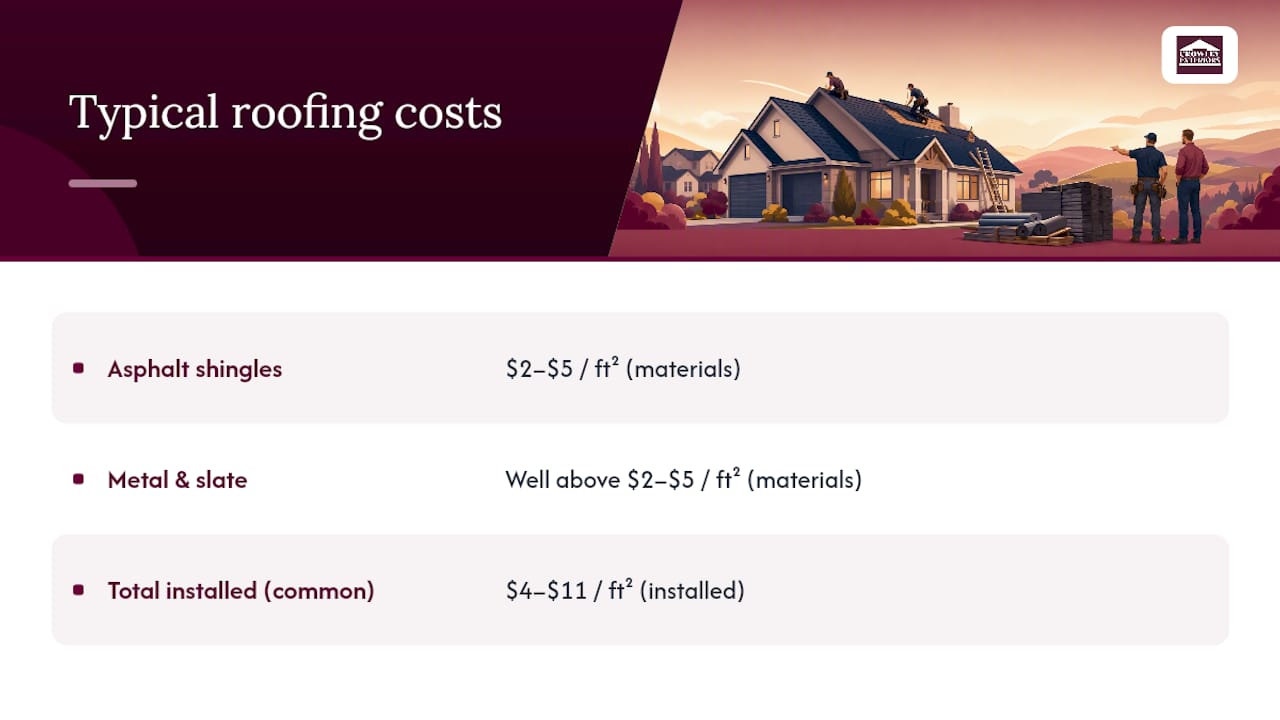
Material costs vary widely by roof type. Asphalt shingles run roughly $2 to $5 per square foot in materials, while metal and slate run well above that. Layer in labor, disposal, and permits, and total installed costs average $4 to $11 per square foot across common residential materials.
Here’s what that looks like on a 24-square asphalt reroof (2,400 square feet):
Waste factor gets baked into the shingle quantity before this table is built. A 24-square roof measured at true area might get ordered as 26.4 squares once a 10% waste factor is applied, and that inflated number, not the raw measurement, is what should appear on the material line.
How to Compare Estimates Fairly (and Red Flags to Walk Away From)
Comparing three bids side by side only works if you’re comparing the same scope. Here’s the method:
- Line up each bid’s items in the same order and mark anything missing.
- Compare unit prices for identical materials, not just bottom-line totals.
- Check that shingle brands and product lines are actually equivalent, not one contractor quoting architectural shingles against another quoting basic three-tab.
- Reconcile waste factors. A 10% difference in waste factor on a 24-square job can shift material cost by hundreds of dollars.
Four things should send you running: no itemization at all, no named manufacturer or product line, a decking allowance with no sheet count or price attached, and a bid sitting noticeably below the regional median with no explanation for the gap.
Pro Tip: Ask every contractor the same three questions: who pulls the permit, is the crew employed directly or subcontracted, and what triggers a change order. The answers reveal more about reliability than the price does.
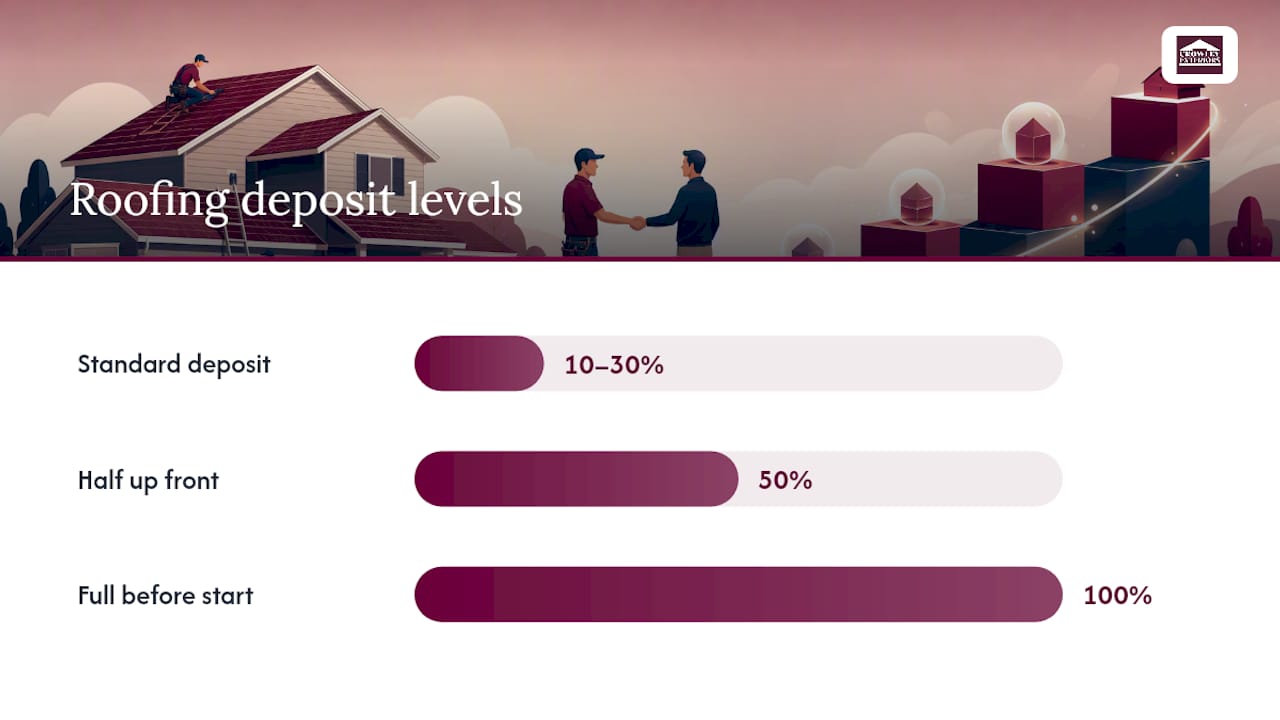
Deposits in the 10% to 30% range are standard. Anything demanding half the job cost upfront, or full payment before work starts, is worth questioning.
Timeline and Payments: What to Expect Once You Sign
Most residential reroofs run one to three days for tear-off and install, weather permitting, with permit approval sometimes adding a week or two before work starts. A typical payment schedule runs a deposit at signing, a progress payment once tear-off begins or materials are delivered, and a final payment at completion, and inspection.
Decking overages should require your sign-off before work continues, priced at the per-sheet rate already listed in the estimate. That’s the whole point of stating the price upfront: no surprise math after the fact.
How Crowley Exteriors Builds Estimates You Can Actually Read
Mario has spent years analyzing how roofing contractors structure bids and where homeowners get burned by vague paperwork. Estimates that are clear include a stated decking allowance, itemized material lines with named products, and clear workmanship warranty language rather than a single rolled-up number. Every inspection is free and comes with a no-obligation estimate, so there’s no pressure to sign before you’ve had a chance to compare it line by line against another bid. For a deeper look at what should appear on your own estimate, the roof estimate checklist page walks through it step by step.
Why Most Estimate Advice Gets This Backward
Most guides tell homeowners to shop for the lowest price. That’s backward. The number that matters is whether two bids are pricing the same job. A $16,000 bid and a $21,000 bid on the same roof are not competing offers if one skips ice and water shield and quotes a builder-grade shingle while the other doesn’t.
The conventional advice to “get three quotes and pick the middle one” falls apart the moment those three quotes aren’t itemized the same way. You end up averaging apples against oranges and calling it due diligence.
What actually protects homeowners is insisting on the decking allowance with a real per-sheet number attached, because that’s the line contractors use to pad margin when they know a buyer isn’t reading closely. Get that number nailed down first. Everything else on the bid, from shingle brand to labor rate, is easier to verify once the vague line is gone.
— Mario
Get a Free, Itemized Roofing Estimate
Some companies give homeowners exactly the kind of estimate this article describes: itemized line items, a stated decking allowance, named shingle brands, and a workmanship warranty spelled out before you sign anything.

Before requesting an inspection, have your roof’s approximate age, any known leak locations, and a rough sense of your budget range ready. That lets the inspector give you a more accurate itemized number on the first visit instead of a rough guess. Inspections are free and come with no obligation to book, whether you’re comparing bids after storm damage or just planning ahead for a roof replacement. If you’re weighing whether to repair or fully replace, the roof replacement signs and cost guide is worth a look first. Ready to see your own numbers in writing? Request a free inspection and itemized estimate through Crowley Exteriors today.
Sources
- How to Read a New Roof Estimate: 12 Line Items & Red Flags | The Roofing Brief
- Roofing Estimate Checklist: 12 Items Every Bid Should Include | Federal Estimating