

Your roof deductible is the amount you pay out of pocket before your homeowners policy covers the rest of a roof loss, and it can be a flat dollar figure or a percentage of your home’s insured value. Storm, wind, or hail damage often carries a separate, larger deductible than other claims. On top of that, whether your policy pays replacement cost or actual cash value changes your final bill.
TL;DR:
- Storm, wind, or hail damage often involves higher storm-specific deductibles calculated as a percentage of your insured value, which can significantly increase out-of-pocket costs.
- Confirm whether your deductible applies per claim or annually, and verify the exact amount on your policy’s declarations page to avoid surprises.
- Replacement cost value policies typically cover more than actual cash value ones, especially for older roofs, reducing your depreciation-related expenses.
- Filing a claim for damages near or below your deductible usually isn’t worthwhile, as you may pay more in premiums over time without significant insurance payout.
- Signing an assignment of benefits can transfer claim control to contractors, so always verify licenses, insurance, and written estimates before authorizing repairs.
Table of Contents
- What is a roof deductible and where do you find it
- Types of roof deductibles: flat, percentage, and storm-specific
- How to calculate your roof deductible with real numbers
- How RCV versus ACV changes what you actually pocket
- Deciding whether to file a claim or pay out of pocket
- Assignment of benefits and contractor safeguards you need to know
- A practical checklist for the days after roof damage
- What homeowners get wrong after a roof claim
- How Crowley Exteriors helps with deductibles and claims
- Sources
- FAQ
What is a roof deductible and where do you find it
A roof deductible is the portion of a covered roof loss you’re responsible for before your insurer pays anything. It’s not a separate fee, it’s subtracted directly from the claim payout. You’ll find your exact deductible amounts on your policy’s declarations page, usually listed alongside coverage limits and any separate wind, hail, or named-storm language.
Say a storm causes $10,000 in roof damage and your policy has a $1,000 flat deductible. Your insurer pays $9,000 and you cover the remaining $1,000.
- Check the declarations page first, not your memory of what you signed up for.
- Look for separate line items labeled “wind/hail” or “named storm.”
- Confirm whether the deductible applies per claim or per year.
The declarations page is the single source of truth for your deductible. It lists the exact dollar or percentage figure your insurer will apply, which is more reliable than any contractor’s estimate of what you “probably” owe.
Types of roof deductibles: flat, percentage, and storm-specific
Not every deductible works the same way, and knowing which type applies to your policy changes how you plan for a claim.
- Flat-dollar deductible: a fixed amount, typically a few hundred to a couple thousand dollars, subtracted from any covered claim.
- Percentage-based deductible: calculated as a percentage of your home’s insured value rather than a flat number.
- Wind/hail or named-storm deductible: a separate, often higher, deductible that applies specifically to storm-driven roof damage.
Wind and hail deductibles commonly run between 1% and 10% of the insured value, while standard deductibles for other perils are usually flat dollar amounts. That gap matters most in states prone to hail and wind events, where insurers frequently carve out a separate storm deductible rather than applying the standard flat one. Some insurers also vary deductible structure by state or by roof age, so the same policy language can play out differently depending on where you live.
How to calculate your roof deductible with real numbers
Once you know your deductible type, the math is straightforward if you have two numbers: the deductible itself and your insured value or claim total.
- For a flat deductible: subtract the flat amount from the total covered claim. A $1,500 deductible on a $12,000 claim leaves the insurer paying $10,500.
- For a percentage deductible: multiply your insured value by the percentage, then subtract that figure from the claim. On a $250,000 insured value with a 2% wind/hail deductible, that’s $5,000 owed before coverage starts.
- Small repair scenario: a $1,200 repair against a $1,000 flat deductible means the insurer covers just $200, often not worth filing.
- Full replacement scenario: a $16,000 replacement against a $2,500 deductible means substantial insurer coverage, usually worth pursuing.
A roof replacement with a flat deductible leaves the homeowner responsible for that deductible amount, regardless of how much the total repair costs. Always pull your actual insured value and deductible percentage from your declarations page before running these numbers, since contractor estimates won’t reflect your policy’s specific terms. Always pull your actual insured value and deductible percentage from your declarations page before running these numbers, since contractor estimates won’t reflect your policy’s specific terms.
How RCV versus ACV changes what you actually pocket
Your deductible is only half the equation. How your policy calculates the payout, replacement cost value or actual cash value, determines what lands in your pocket after that deductible is subtracted.
- Replacement Cost Value (RCV) pays to replace your damaged roof with new materials of similar quality, with no deduction for age or wear.
- Actual Cash Value (ACV) subtracts depreciation for age and wear before paying out, which can leave you covering both the deductible and the depreciated difference.
- On an older roof, ACV depreciation can add thousands to your out-of-pocket cost beyond the deductible alone.
- RCV and ACV interact with your deductible independently: the deductible comes off first, then depreciation (if ACV) reduces what’s left.
A homeowner with an ACV policy and an aging roof often pays more overall than the deductible suggests, since depreciation stacks on top of it rather than replacing it.
Deciding whether to file a claim or pay out of pocket
Not every roof problem belongs on an insurance claim, and filing the wrong one can cost you more over time than the repair itself.
If your repair estimate sits near or below your deductible, paying out of pocket usually makes more sense than filing, since the insurer would pay little to nothing anyway. Frequent claims can also affect your premium or, in some cases, your insurability going forward, so a habit of filing small claims can work against you even when each individual payout seems reasonable.
Get an independent inspection and written estimate before deciding either way. A professional assessment tells you whether the damage is significant enough to justify the deductible and the claims-history tradeoff, or minor enough to handle directly. For the procedural steps once you decide to move forward, our guide to filing a roof insurance claim walks through what to expect from adjuster visits to settlement.
- Compare your repair estimate to your deductible before calling your insurer.
- Ask an independent contractor for a written estimate, separate from any insurance adjuster’s number.
Pro Tip: Photograph the damage before getting any repair quotes, since insurers and adjusters both rely on dated evidence of the loss.
Assignment of benefits and contractor safeguards you need to know
Handing off your claim to a contractor through an Assignment of Benefits (AOB) can feel convenient, but it comes with real tradeoffs. An AOB lets a third party act on your behalf and collect payment directly from your insurer, and signing one can shift control of your claim away from you, sometimes enabling that party to pursue legal action against your insurer without your direct involvement.
Before you sign anything related to a roof claim, vet the contractor properly.
- Confirm an active business license and request a copy of their insurance certificate.
- Insist on a written, itemized estimate before any work begins, not a verbal quote.
- Verify proof of liability insurance and workers’ compensation coverage, since an uninsured crew can leave you liable for injuries on your property.
- Never sign a blank or incomplete contract, even under pressure to “lock in” a repair slot.
Read the assignment of benefits agreement carefully before signing, since it can transfer your right to negotiate directly with your insurer.
If you carry a mortgage, your insurer’s check for structural damage may be made payable to both you and your lender, and the lender may hold funds in escrow, releasing them in stages as repairs progress. That staged release can affect how quickly you’re able to pay a contractor up front, so it’s worth asking your lender about their process before work starts.
A practical checklist for the days after roof damage
Once you notice roof damage, a few steps in the right order protect both your claim and your timeline.
- Locate your declarations page and confirm your exact deductible, flat or percentage, and whether a separate storm deductible applies.
- Photograph and video the damage from multiple angles, and note the date and any relevant weather event.
- Call a licensed local contractor for an inspection before or alongside contacting your insurer.
- If you have a mortgage, ask your lender how they’ll handle any claim check tied to structural repairs.
- Keep every estimate, invoice, and communication in one folder for reference during settlement.
Our 72-hour storm damage checklist covers the documentation steps in more detail if you’re dealing with wind or hail damage specifically.
What homeowners get wrong after a roof claim
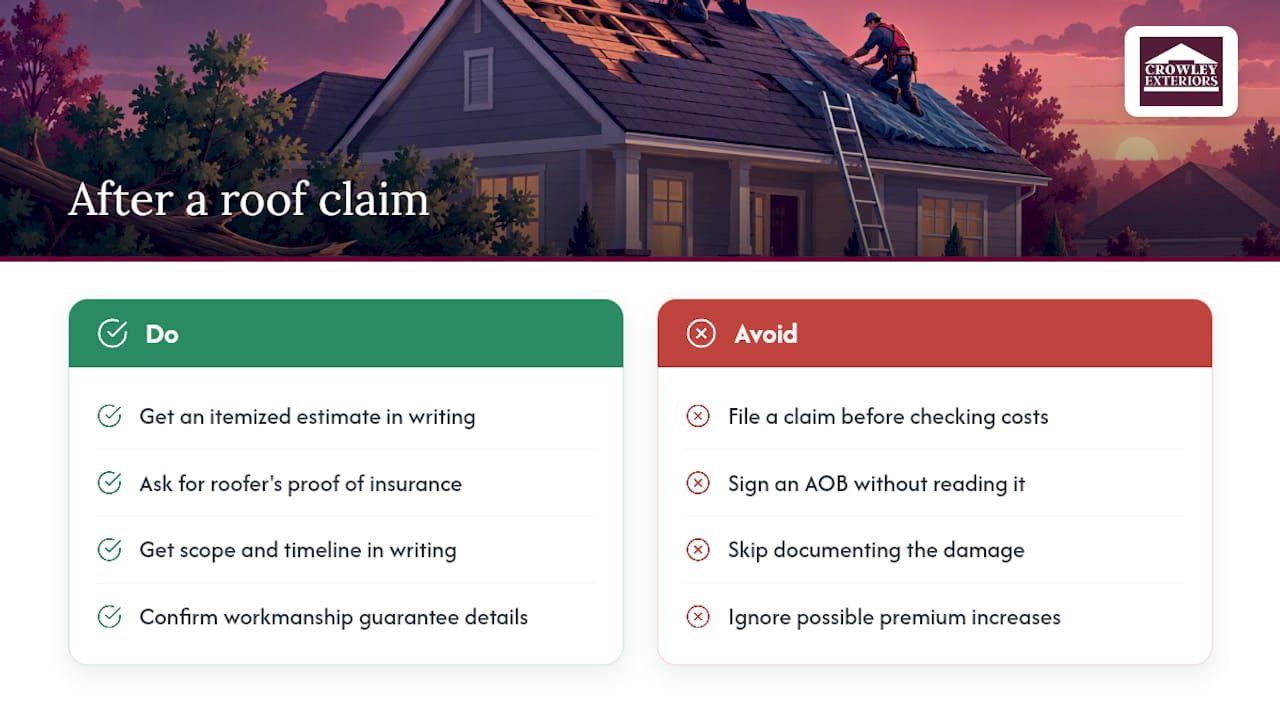
The most common mistake we see is homeowners filing a claim before they understand what it will actually cost them, either through a deductible they didn’t check or a premium increase they didn’t anticipate. Signing an AOB without reading it, or skipping documentation because “the damage is obvious,” both tend to backfire during settlement.
A reputable roofer gives you an itemized estimate, shows proof of insurance without being asked twice, and puts a clear scope and timeline in writing. Whether you repair or replace, the workmanship guarantee behind the job matters as much as the repair itself.
— Mario
How Crowley Exteriors helps with deductibles and claims
Understanding your deductible is one thing, getting a fair, accurate number to plug into that math is another. Some local companies offer free inspections and no-obligation estimates to help you understand your actual repair cost before deciding whether filing a claim makes sense against your deductible.
- Roof inspections with itemized, transparent estimates may be available.
- Insurance claim assistance services can help you document damage and communicate with adjusters.
- Some roofing work includes long-term workmanship guarantees.
If your roof damage in St. Charles County needs a second opinion or a full roof replacement after your claim settles, visit our services page or reach out through our contact page to schedule your free inspection.
Sources
For deeper detail, see NAIC guidance on Assignment of Benefits, NAIC contractor-scam prevention tips, CFPB guidance on insurer claim payouts, and RCV versus ACV explained by Allstate. For homeowners weighing repair against selling, this quick numbers worksheet offers useful context.
- Homeowners insurance deductible – Rocket Mortgage
- Actual Cash Value vs Replacement Cost – Allstate
- Assignment of Benefits: Consumer beware – NAIC
- How do home insurance companies pay out claims? – CFPB
FAQ
How does a deductible work for a roof?
Your roof deductible is subtracted from the total covered claim amount before your insurer pays the remainder. If your deductible is a flat dollar figure, it’s a fixed subtraction, but if it’s percentage-based, it’s calculated against your home’s insured value, so the payout math differs by policy type.
What is the 25% rule in roofing?
Definitions vary, but this rule generally refers to guidance some jurisdictions or insurers use for deciding when a roof needs full replacement versus a partial repair, often tied to the percentage of the roof surface that’s damaged. Check with your specific insurer or local building code, since the threshold isn’t standardized nationwide.
Is it better to have a $500 deductible or $1,000 deductible?
A lower deductible means less out-of-pocket cost when you file a claim, but it typically comes with a higher premium, while a higher deductible lowers your premium but increases what you pay before coverage starts. The better choice depends on how much you can comfortably pay upfront if a large roof loss occurs.
What is a typical deductible for roof replacement?
Standard deductibles are often flat-dollar amounts, while wind, hail, or named-storm deductibles are commonly set as a percentage of insured value, typically 1% to 10%. The exact figure depends on your policy and state, so always confirm the number on your declarations page rather than assuming a standard rate applies.
Does filing a roof claim raise my insurance premium?
Filing a claim can affect your premium or claims history, particularly if you file multiple claims over a short period, and insurers may factor that history into future pricing or renewal decisions. For damage close to your deductible amount, paying out of pocket often avoids that risk while still getting the repair done.
Recommended
- Avoid An $8,000 Shock: Calculate Your Roof Deductible In Missouri
- Class 4 Shingles Cost For Missouri Homes: $150–$300 More Per Square
- How To File A Roof Insurance Claim: A Homeowner’s Guide
- What Should Be On Your Roof Estimate Checklist?
This article was prepared with AI assistance for general information. For recommendations specific to your property, contact Crowley Exteriors. Call or text us at 314-839-3800.