

A manufacturer warranty covers the roofing materials if they fail because of a factory defect. A workmanship warranty covers the installation, meaning mistakes your contractor makes while putting those materials on your home. They protect against different problems, they are written by different companies, and a roof that leaks can fall into the gap between them. This guide explains where that gap is and how to close it before you sign anything.
TL;DR
- Manufacturer warranty: the maker stands behind the product against defects. It does not cover bad installation.
- Workmanship warranty: the contractor stands behind the labor. It is only as good as the contractor’s ability to be around when you call.
- Most roof failures are argued over. Each side can blame the other, so you want both promises in writing, with names, terms and exclusions.
- Length is not the whole story. Ask who honors the warranty, what voids it, and whether it transfers if you sell.
- Hold your final payment until the written warranty documents are in your hands.
Table of Contents
- The difference in one table
- What a manufacturer warranty really covers
- What a workmanship warranty really covers
- The blame game, and how to avoid it
- What federal law says about warranty promises
- How long should a workmanship warranty be?
- Clauses that quietly void coverage
- Missouri notes for St. Charles County homeowners
- Our perspective: the warranty is the company
- A checklist before you sign a roofing contract
- If you are weighing a repair or a replacement
- Get a roof inspection and a written estimate
- FAQ
- Sources
The difference in one table
| Manufacturer warranty | Workmanship warranty | |
|---|---|---|
| Who gives it | The shingle or material maker | The roofing contractor |
| What it covers | Defects in the product itself | Errors in installation: flashing, nailing, sealing, underlayment |
| Typical trouble spot | Strict conditions, exclusions and rules about who installed it | Only valuable if the contractor is still in business |
| What can void it | Unapproved materials, unapproved repairs, added equipment, poor maintenance | Work by other trades, ignored maintenance, damage from storms (usually excluded) |
| Who you call | The manufacturer’s claims line, usually through the contractor | The contractor who did the job |
The exact terms vary from one product line and one contractor to the next, so treat the table as a map and your own documents as the territory.
What a manufacturer warranty really covers
A manufacturer warranty is a promise about the product. If shingles crack, delaminate or lose granules because of how they were made, the maker agrees to a remedy. Many headline numbers are impressive, but the fine print decides what you actually receive: how long the full-value period lasts, what happens after that, and whether labor to tear off and replace is included or only the price of the new shingles.
The Asphalt Roofing Manufacturers Association (ARMA) tells owners that a roof warranty is a legal contract and that the terms and conditions of a manufacturer’s or contractor’s warranty need to be read and understood. ARMA also points out that using incompatible or unauthorized materials in a repair, or having work done by a contractor the manufacturer does not authorize, can put the product warranty at risk.
Three habits protect a manufacturer warranty:
- Keep the paperwork. Save the warranty certificate, the product names and the receipt or contract that lists them.
- Call before you modify the roof. Mounting new equipment, a satellite dish or solar hardware can create a dispute. ARMA’s guidance notes that homeowners often assume a roof warranty stays active however the roof surface changes, and it does not always.
- Use compatible materials for repairs. A patch with the wrong product can be used as a reason to deny a claim later.
What a workmanship warranty really covers
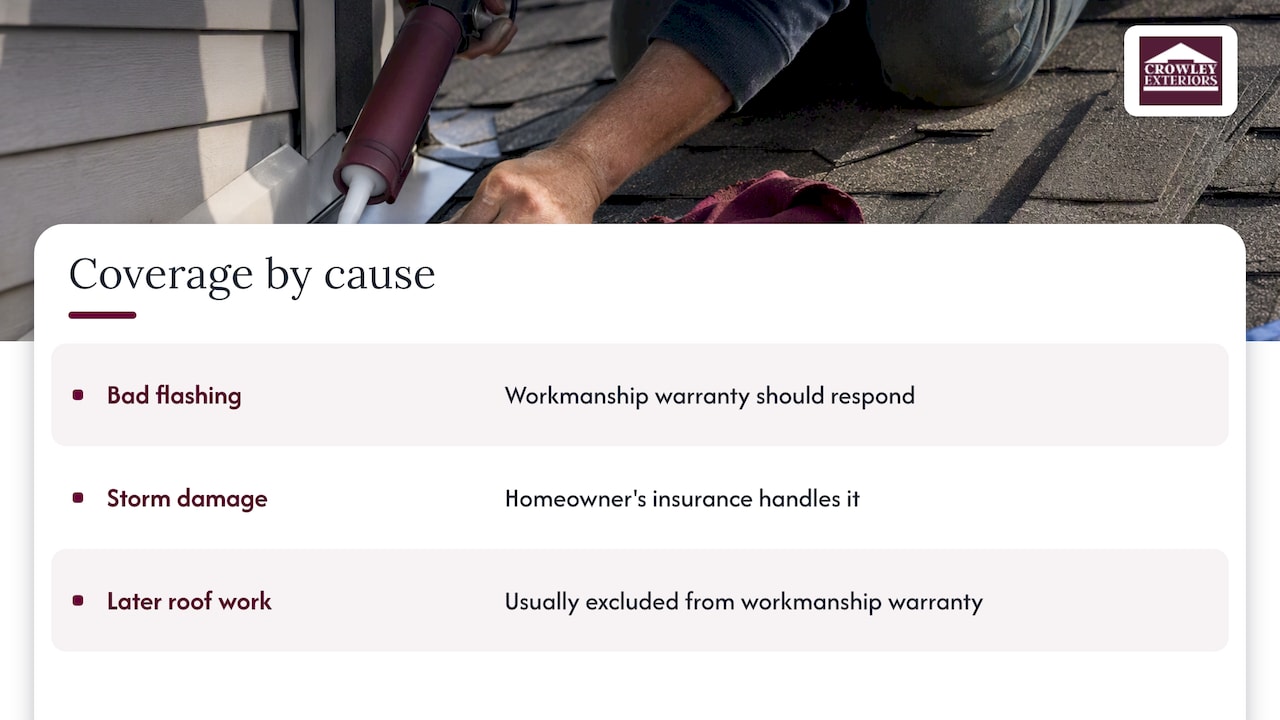
A workmanship warranty is the contractor’s promise that the installation meets a standard. If a leak appears around a chimney because the flashing was set badly, or shingles blow off because they were under-nailed, this is the warranty that should respond. It rarely covers storm damage, which is the job of your homeowner’s insurance, and it usually excludes problems caused by other people working on the roof afterward.
This is where the number of years on the page can mislead. Federal consumer guidance puts it plainly: a long-term warranty means little if the company is not around to honor it. The advice is to check a company’s history, look for complaints, and confirm its license and insurance instead of fixating on the term.
For context on how short some promises are, the FTC notes that on new home construction, builder warranties for workmanship and materials typically run one year, with longer terms for major systems and, in some cases, up to ten years for major structural defects. A roofing contractor’s multi-year workmanship promise is a different document, but the comparison shows why you should read the number alongside the fine print.
The blame game, and how to avoid it
Here is the situation that sends homeowners searching for this topic. Your roof leaks in year six. You call the contractor, who says the shingles were defective. You call the manufacturer, who says the installer made mistakes. Nobody is lying necessarily, and you are stuck in the middle.
ARMA’s guidance describes the practical answer: keep a paper trail that includes the product warranty and a separate written workmanship warranty from the contractor. With both on file, you have leverage when one side points at the other. With only one, you may have none.
A few things make that dispute easier to win:
- Photos at completion. Flashing, valleys, vents and the ridge, taken the week the job ends.
- A written scope. The contract should list the materials by product name and the installation steps included.
- Dated records of every call, email and inspection after a problem appears.
- Prompt reporting. Most warranties expect you to notify the warrantor within a set time after discovering a problem.
What federal law says about warranty promises
No business has to offer a written warranty. But under the Magnuson-Moss Warranty Act, if one is offered on a consumer product it must clearly disclose coverage, duration and who the warrantor is. The act does not apply to oral promises, and standalone service contracts for labor are generally outside it unless they also include parts replacement. In plain terms: a verbal “we stand behind our work” gives you very little, and a labor-only warranty may not carry the federal disclosure protections you assume. Get it on paper, and make sure the paper names the company responsible.
How long should a workmanship warranty be?
There is no legal standard. Contractors offer anything from one year to decades, and the number alone says little. Judge it on four questions:
- Who is the warrantor, and how long has that business existed?
- What is excluded? Ask specifically about storm damage, ponding, foot traffic, and work by others.
- What is the remedy? Repair at no charge is the usual one. Ask whether it includes materials and labor, and whether you pay any service fee.
- Does it transfer to a buyer? This matters if you may sell the house, and it matters even more to buyers and their agents reading a roof report.
A 25-year promise from a company that has operated for decades in your area is worth more than a 50-year promise from one that opened last spring. Our own roof warranty explained and roof warranty coverage pages walk through what to expect from each type in more detail.
Clauses that quietly void coverage
Read these before you sign, not after a leak.
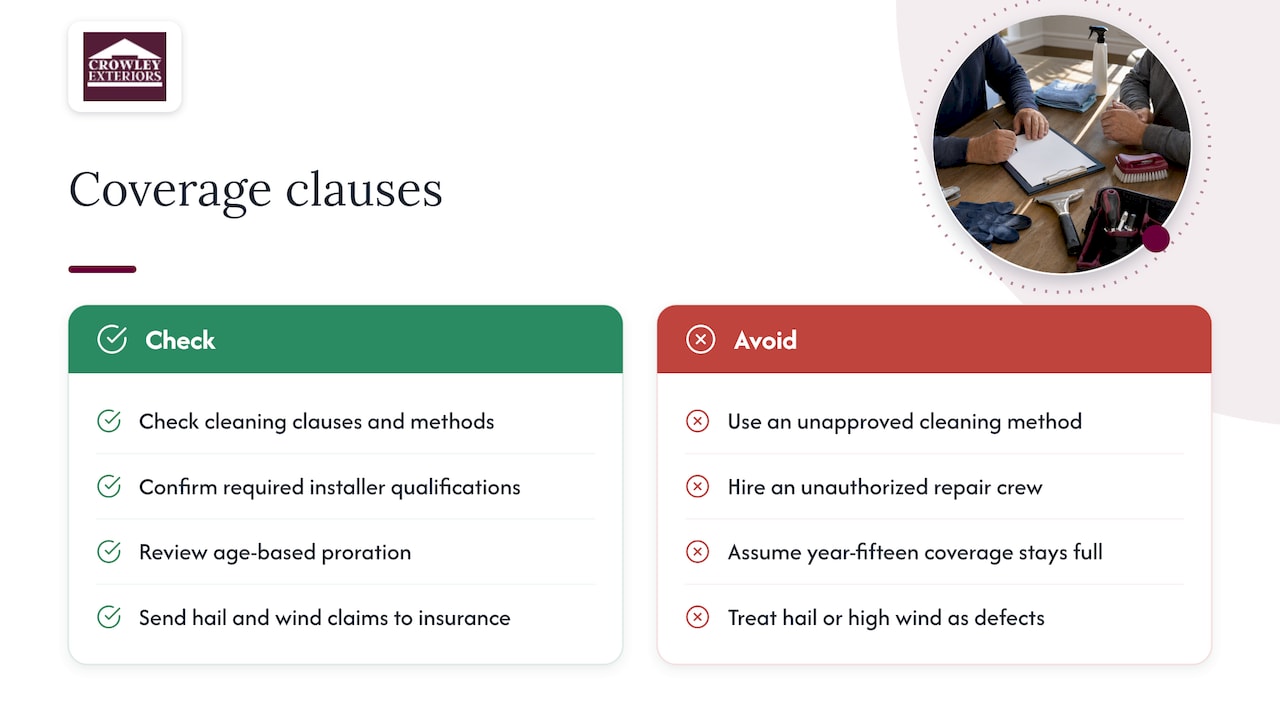
Maintenance and cleaning clauses. Some warranties require periodic cleaning or specific cleaning methods, and the wrong approach can become grounds for denial. One exterior cleaning company explains what a roof warranty cleaning clause means for homeowners, which is worth a read before you hire anyone to wash your roof.
Authorized-installer language. If a manufacturer’s enhanced warranty requires a specific type of installer, a handyman’s repair or an unqualified crew can undo it.
Proration. Coverage often declines as the roof ages, so the benefit in year fifteen is a fraction of the benefit in year two.
Exclusions for weather. Hail and high wind are usually not defects and not workmanship. They belong to your homeowner’s policy. If you suspect storm damage, see our guide on how to file a roof insurance claim and what to do in the first 72 hours after storm damage.
The same logic applies across the trades. A painter’s explanation of how workmanship coverage differs from product coverage shows how common this split is on every exterior project, not just roofs.
Missouri notes for St. Charles County homeowners
Missouri’s hail and wind make claims common, which is why the line between warranty and insurance matters here. Two points from state law are worth knowing. Missouri SB 101, effective August 28, 2011, bars home exterior contractors from paying or rebating your insurance deductible as a sales incentive, and it gives you the right to cancel a contract within five business days of notice if your insurer denies coverage for part of the work. A contractor who offers to “cover your deductible” is breaking that law, and you should not count on that company to honor a warranty either.
The Missouri Department of Insurance also advises caution with contractors who present themselves as claims specialists or promise to negotiate on your behalf. Their consumer information is the place to check. A good roofer documents damage and does the repair well. Your insurer decides coverage.
Our perspective: the warranty is the company
We are a family-owned roofing, siding and gutter company in St. Charles County with more than 25 years of experience, and we back our roofing services with a 25-year guarantee. People sometimes ask whether that number is the reason to hire us. We would say it is a reason to ask us hard questions.
A warranty is a promise about the future, so the real test is whether the people behind it will still answer the phone. That is why we are comfortable with homeowners checking our history, our local references and our paperwork before anything is signed. It is also why we give a free inspection and an itemized, no-obligation estimate: you should see what is being done, with which materials, before you agree to anything.
Our advice is simple. Do not choose between a workmanship warranty and a manufacturer warranty. Insist on both, in writing, with the warrantor’s name on each. Ask who comes out when something fails. Keep the documents somewhere you can find them in ten years. And do not release the final payment until the paperwork and the cleanup are done. The FTC’s guide to hiring a contractor says the same thing about final sign-off: once the check is cashed, your leverage drops.
— Mario
A checklist before you sign a roofing contract
- Get the product warranty in writing, with the product line named, and ask what the manufacturer requires for it to stay valid.
- Get a separate written workmanship warranty with the contractor’s legal name, term, remedy and exclusions.
- Confirm the license and insurance and read any complaints. Our three quick checks to choose a roofer take about ten minutes.
- Ask if the warranty transfers to a future owner and what that costs.
- Make sure the contract lists change orders in writing. The FTC’s hiring guide explains that a change order is a written authorization to alter the original scope and can affect cost and schedule.
- Photograph the finished roof and hold the final payment until you have the documents.
If you are weighing a repair or a replacement
Warranty questions come up most often right before a replacement. If your roof has an existing manufacturer warranty, a repair with the wrong materials can complicate it, and a patchwork of repairs can complicate a new one. Our guide to the 25 to 30% rule for repair versus replacement explains how to decide, and our Missouri roof replacement cost guide shows what homeowners here typically pay.
Get a roof inspection and a written estimate
If you are comparing contractors, or you want to know whether your current roof still has coverage worth protecting, we offer free inspections and no-obligation, itemized estimates across St. Charles County. We will show you what we find, explain the warranty terms in plain language and put them in writing. See our roof replacement service or all of our services.
FAQ
What does workmanship mean in a warranty?
It refers to the quality of the installation labor. A workmanship warranty promises that the contractor installed the product correctly, and it covers defects that come from how the work was done rather than from the materials.
Can a manufacturer warranty be voided?
Yes. Unauthorized materials, repairs by a non-authorized contractor, and changes to the roof can all cause problems, according to the Asphalt Roofing Manufacturers Association. Read the conditions in your certificate and call the manufacturer or your roofer before altering the roof.
Which is more important, the workmanship or the manufacturer warranty?
Neither alone. The product warranty protects you from factory defects, and the workmanship warranty protects you from installation errors, which are a common cause of leaks. Having both in writing keeps you from being caught between the two when something fails.
Does a workmanship warranty cover storm damage?
Usually not. Hail and wind damage are normally handled through your homeowner’s insurance. A workmanship warranty typically addresses installation mistakes, so check the exclusions in your contract.
Is a written warranty required by law?
Not under federal law. The FTC explains that a business does not have to offer a written warranty, but if it does, the terms and the identity of the warrantor must be clearly disclosed. Ask for yours on paper.
Sources
- Asphalt Roofing Manufacturers Association: A Maintenance Program to Last
- Asphalt Roofing Manufacturers Association: Anatomy of an Asphalt Roofing System
- FTC: Businessperson’s Guide to Federal Warranty Law
- FTC Consumer Advice: Warranties
- FTC Consumer Advice: Warranties for New Homes
- FTC: Hiring a Contractor
- Missouri Senate: SB 101, home exterior contractor requirements
- Missouri Department of Insurance
Recommended
- How To File A Roof Insurance Claim: A Homeowner’s Guide
- Roof Warranty Coverage: What Homeowners Need To Know
This article was prepared with AI assistance for general information. For recommendations specific to your property, contact Crowley Exteriors. Call or text us at 314-839-3800.