


A gutter corner that drips during every rain is almost always one of three things: a failed seal, a clog that is pushing water where it should not go, or a gutter that has sagged out of line. If the metal is sound, you can usually clean the joint, let it dry and reseal it. If the metal is corroded, gapped or has already been resealed and failed, the section should be replaced. Below is how to tell which one you have, how to test it, and what a lasting repair looks like.
TL;DR
- Most gutter leaks show up at seams and end caps, because that is where separate pieces meet and the sealant ages first.
- Run water through the gutter to find the exact leak point before you buy anything. Clean the joint to bare metal and never seal over old sealant.
- A corner with sound metal can be resealed. Corrosion, a crooked or gapped joint, or a seal that has already failed once means replacement.
- Water running down the board behind the gutter is a different problem, and caulk will not fix it.
- Ladder work is the real danger here. If the corner is on a second story or the fascia is soft, call a pro.
Table of Contents
- Why gutter corners and seams leak
- Find the exact leak before you fix it
- Stay safe on the ladder
- How to reseal a leaking gutter corner
- Repair or replace: how to decide
- Water running behind the gutter is a different problem
- Keep the corner from leaking again
- Our perspective: fix the cause, not the drip
- Get a free gutter inspection in St. Charles County
- FAQ
- Sources
Why gutter corners and seams leak
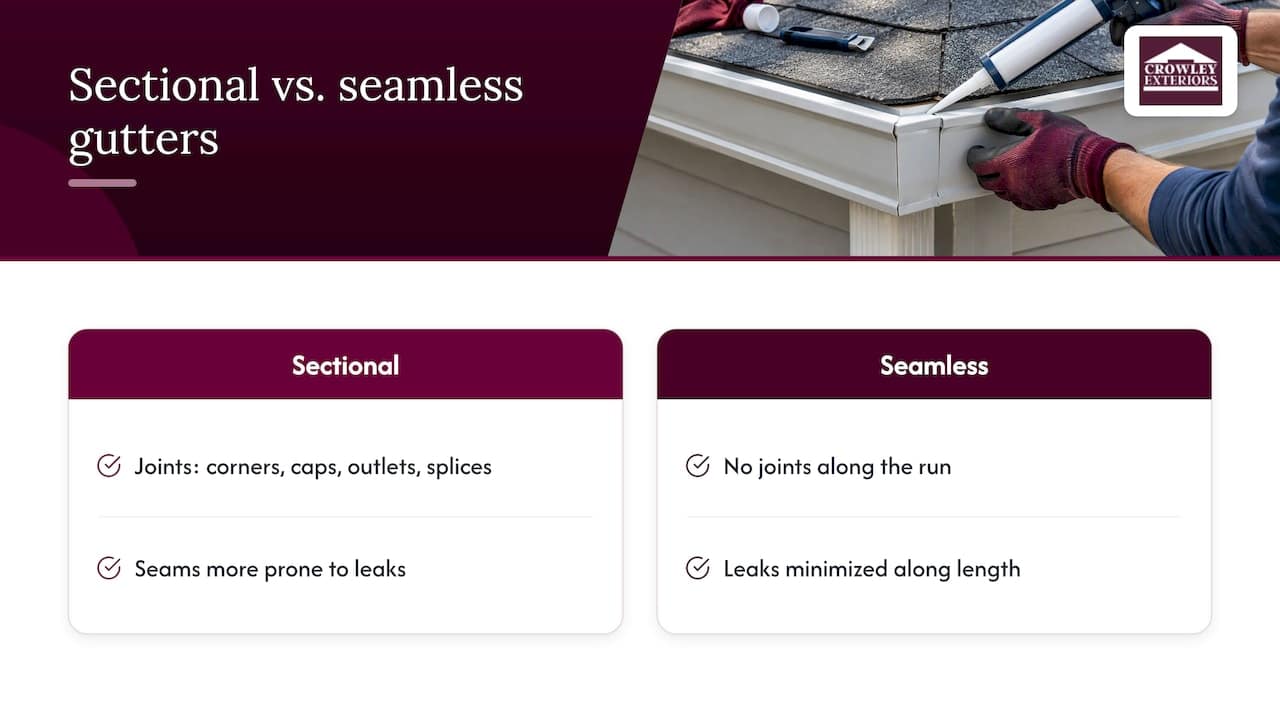
A gutter run is a series of pieces joined at corners, end caps, outlets and splices. Each joint depends on sealant, and sealant is the first thing to give out. The Home Depot notes that the most common leaks tend to occur at seams and end caps. This Old House adds that sectional gutters are more prone to leaks at seams, while seamless gutters minimize leaks along their lengths, since there are no joints along the run.
In our experience across St. Charles County, the joint itself is rarely the whole story. The seal fails because something is stressing it. The usual stressors:
Debris and standing water
Leaves and twigs restrict flow and create small dams. This Old House explains that debris also adds weight, which can make gutters sag and overflow. Water that sits in a corner for days works on the sealant, freezes in winter and expands the joint.
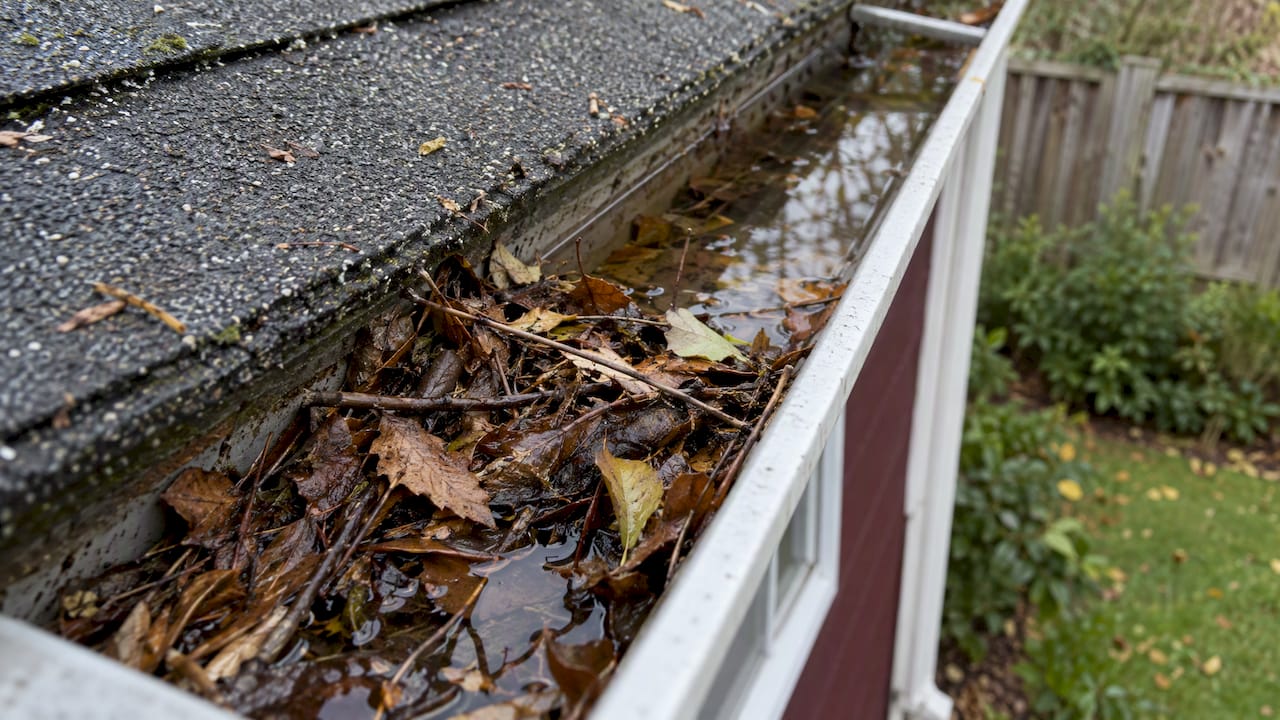
Water that cannot move has to go somewhere. The same principle drives stormwater management on larger properties: blocked flow paths push water into places they were never meant to go. On a house, that place is the weakest joint in the gutter.
Sagging and poor slope
Gutters need a slight pitch toward the downspout. This Old House reports that sagging commonly results from trapped water and debris, inadequate hanger spacing or fasteners, improper installation, and weather or aging. Once a section sags, water pools instead of draining, and the pooled water finds the corner.
The Home Depot’s installation guidance says to check for loose brackets or fasteners, misalignment, sagging and standing water when leaks or overflow occur. If you see pooling after a rain, you have a slope or hanger problem, and resealing alone will not last.
Age, weather and impact
Missouri puts gutters through freeze and thaw, summer heat, hail and wind. Metal expands and contracts, and the sealant is pulled back and forth every day. Falling branches and ladder leaning also loosen sections. This Old House lists loose or damaged seams, cracks and holes, corrosion and improper installation among the common causes of leaks.
Installation shortcuts
This Old House expert Tommy Silva’s view, in the same guide, is that poor installation is a root cause: joints should be clean before they are sealed and fastened, and poorly hung gutters are more likely to leak at seams or pull away from the fascia. A corner that leaks within a few years of being installed usually points here.
Find the exact leak before you fix it
Water often travels along the underside of a gutter before it drips, so the drip is not always where the leak is. A quick test saves a lot of wasted caulk:
- Clear the run of leaves and debris first, including the downspout opening.
- Plug the downspout outlet or work from the high end of the run.
- Run a garden hose at the high end and watch the water as it passes through the corner or seam.
- Mark the spot where water actually escapes with a pencil or a piece of tape.
- Check the downspout too. The Home Depot says a clog in the downspout may be the cause when a leak occurs at the gutter elbow or outlet.
Also watch what the water does after it escapes. If it drips from the underside of the corner, the joint has failed. If it spills over the front lip, you have an overflow problem; our guide to gutter overflow causes walks through that diagnosis. If it runs down the back, read the section on water behind the gutter below.
Stay safe on the ladder
Falls are the real hazard in a gutter repair, not the leak. The Consumer Product Safety Commission’s outdoor repair checklist says to set the ladder on stable ground, have a helper stabilize it, and never stand on its top rung.
West Virginia University Extension advises wearing protective gloves and safety glasses when cleaning gutters for inspection or repair, because of debris, screws and sharp metal edges.
If the corner is above the first floor, sits over a porch roof or a steep slope, or the ladder would rest on a gutter that is already sagging, stop there. That is a job for someone with the equipment and the insurance to do it.
How to reseal a leaking gutter corner
If the metal is sound, resealing is a reasonable afternoon repair. The steps matter more than the brand of tube.
- Remove the old sealant. Sealant does not bond to old sealant. Scrape and wipe the joint until you reach bare, clean metal. A wire brush or a plastic scraper works well on aluminum.
- Clean and dry the joint. Use a rag and a cleaner that will not leave residue. The surface must be completely dry, so pick a dry day with no rain in the forecast.
- Choose the right sealant. Loctite recommends a permanently flexible, water-resistant sealant for lap seams in aluminum or vinyl gutters and downspouts. Flexibility matters because the joint moves with the temperature.
- Apply it to the inside of the joint. Work a continuous bead along the seam and over the corner, pressing it into the gap. Smooth it with a gloved finger or a putty knife.
- Let it cure fully. Follow the cure time on the tube before you run water through it.
- Retest. Run the hose again and check the underside of the joint.
If screws or rivets hold the corner together, check that they are tight. A loose fastener lets the joint flex, and the new bead will crack along the same line.
What about Flex Seal?
Homeowners ask about this a lot. The manufacturer’s own instructions call for cleaning, drying and taping off the area, applying the product, letting it dry, and repeating until the holes are filled. That can work as a stopgap on a small hole in sound metal. On a moving corner joint it tends to be a short-term patch, and a surface coated in rubberized spray is harder to clean and reseal properly later. If you have already tried several products on the same corner, the problem is probably not the product.
Repair or replace: how to decide
Here is the practical rule we use. A corner can be resealed if the metal is sound. Replace it if the metal is corroded, the joint is crooked or gapped, or resealing has already failed.
| What you see | Likely call |
|---|---|
| Dry, clean joint with a cracked or dried-out bead | Reseal |
| Loose screws or rivets, otherwise sound metal | Tighten, then reseal |
| Pinholes, flaking or rust at the corner | Replace the section |
| Corner pulled apart, gap you can see daylight through | Replace the section |
| Sealed more than once, still leaking | Replace the section |
| Sagging run with water pooling | Re-hang, fix pitch, then reseal or replace |
| Several corners leaking along a sectional run | Consider seamless gutters |
Can you replace just the corner? Often, yes. Corner pieces (called miters) and short sections can be swapped on sectional systems. On seamless gutters, corners are typically formed and joined on site, so a repair means cutting out and re-joining a section. Either way, a mismatched or patched run on an older gutter can leak at the new joints, so look at the whole side of the house, not just the one drip.
The cost depends on access, material, the extent of damage, and whether the repair also requires correcting slope, hangers, fascia or drainage. Forbes Home covers repairing a section of gutter and does not offer a firm figure we can rely on, and we would rather not quote you a number that is not ours to give. A free, itemized estimate from a local contractor will tell you more than any national average.
If you are weighing a larger project, seamless gutter installation removes most of the joints that fail in the first place, leaving only corners and outlets.
Water running behind the gutter is a different problem
Sometimes the drip is not at a seam at all. If water runs down the board behind the gutter, the usual causes are a missing drip edge or a gutter hung too low. Sealant will not fix that, and caulking the gap can trap water against the wood, which speeds up rot.
Signs to look for:
- Water stains or peeling paint on the fascia board
- Soft or dark wood where the gutter meets the board
- Water dripping from the back edge of the gutter rather than the corner
- Staining under the eaves or on soffits
The fix is at the roof edge, not the corner. Our drip edge checklist explains what should be there and why. If the fascia is already soft, the board needs repair before the gutter goes back up.
It also helps to rule out the roof. Water at a gutter corner that sits below a roof valley, a chimney or a wall junction may be roof runoff, not a gutter failure. Read about a roof valley leak and chimney flashing leaks if the pattern matches. If you already see a stain inside, see what a ceiling water stain means.
Keep the corner from leaking again
A repair holds when the cause is gone. These habits protect the corner:
- Clean the gutters at least twice a year, and after big storms. Spring and late fall suit Missouri trees well. Pay attention to corners, where debris collects.
- Check the downspouts. A blocked downspout backs water up to the nearest joint. Make sure downspout extensions carry water well away from the foundation.
- Look for sagging after a winter with heavy ice or snow. Water should not pool in any section after a rain.
- Replace loose hangers and fasteners before the gutter drops.
- Consider gutter guards if your yard has heavy tree cover, so debris stays out of the corners.
Our perspective: fix the cause, not the drip
We have been working on St. Charles County roofs, siding and gutters for over 25 years, and the pattern is consistent. A corner leak is a symptom. The homeowner who calls us after resealing the same joint three times usually has a pitch problem, a clogged outlet or a run that was hung with too few hangers.
Here is what we tell people. If the metal is sound and the gutter is level, reseal it properly and move on. If you have patched the same spot repeatedly, stop patching. A new section costs less over time than another weekend on a ladder. And do not ignore a leak that sits near the fascia: water at the roof edge can lead to rotted wood and then a roof repair that was never part of the plan.
We would also rather you know what you are paying for. That is why our estimates are free, itemized and without obligation, so you can see what is a gutter fix and what is a bigger issue.
— Mario
Get a free gutter inspection in St. Charles County
If your gutter corners keep leaking, or you are not sure whether it is the seal, the slope or the roof edge, we can look at it. Crowley Exteriors is a family-owned company serving St. Charles County, and we offer free inspections and no-obligation estimates for gutter installation and repair, as well as roofing, siding and windows.

We will find the source of the leak, tell you whether it is a reseal or a replacement, and put it in writing. You can see all our roofing, gutter and storm services or start from our home page.
FAQ
My gutters are leaking at the seams. What can I do to fix this?
Clean the gutter, run water through it to find the exact leak, then scrape off the old sealant down to bare metal. Dry the joint and apply a flexible, water-resistant gutter sealant, then let it cure before retesting. If the metal is corroded or the joint is gapped, replace the section instead.
Does Flex Seal work for gutters?
The manufacturer gives instructions for using it on gutters, and it can plug small holes in sound metal as a temporary fix. It is less suited to a moving corner joint, where a flexible gutter sealant applied to clean bare metal gives a more durable repair. If several products have failed on the same corner, look for slope, hanger or clog problems.
How much does it cost to fix a leaking gutter?
There is no reliable national figure for a single corner or seam, because cost depends on access, material, the damage, and whether slope, hangers, fascia or drainage also need work. A resealing job is far cheaper than replacing a run. Get a local, itemized estimate before you decide.
Why is water dripping behind my rain gutters?
Water running down the board behind the gutter usually comes from a missing drip edge or a gutter hung too low. Caulk will not solve it and can trap moisture against the wood. Have the roof edge and fascia checked.
Can I replace just the leaking corners?
Often yes, especially on sectional gutters where corner pieces can be swapped. On seamless gutters a contractor cuts out the section and joins a new piece. If the rest of the run is old or sagging, the new joints may leak too, so it is worth inspecting the whole side.
Sources
- How To Repair a Leaky Gutter, This Old House
- How To Repair a Gutter, This Old House
- How To Fix Sagging Gutters, This Old House
- How To Install Aluminum Gutters, This Old House
- How to Fix a Leaky Gutter, The Home Depot
- How to Install and Replace Rain Gutters, The Home Depot
- How to fix gutters using sealants, Loctite
- How To Use Flex Seal on Your Gutter
- Home Safe: Outdoor Repairs, CPSC
- Gutter Safety, West Virginia University Extension
- How To Repair A Section Of Gutters, Forbes Home
- Storm Water Management
Recommended
- Gutter Overflow Causes: Quick Diagnosis And Fixes
- Homeowners: Free Inspection To Decide Gutter Installation And Repair
This article was prepared with AI assistance for general information. For recommendations specific to your property, contact Crowley Exteriors. Call or text us at 314-839-3800.