


FHA does not publish a checklist that says “shingles must be under X years old.” The roof has to keep water out, show no active defects, and have at least two years of remaining physical life. If the appraiser sees a problem, the loan can be made conditional on repairs or on a roofer’s inspection. This guide covers what appraisers look at, what usually triggers a repair requirement, and what buyers and sellers can do about it.
TL;DR
- The roof covering must keep moisture out and have reasonable future utility, durability and economy of maintenance, according to HUD’s roofs and attics guidance.
- HUD guidance calls for at least two years of remaining physical life. If the appraiser sees less, the report must say so.
- Leaks, dampness and visible deterioration are defective conditions. They must be fixed, and further damage must be unlikely, before the property is acceptable.
- The lender decides which repairs are required. A roofer’s inspection or certification is the usual way to clear the condition.
- A quick roof inspection before you make an offer or list the home is cheaper than finding out from the appraisal.
Table of Contents
- What FHA actually says about roofs
- What the appraiser looks at on the roof
- The two-year remaining life rule
- When a roof becomes a defective condition
- Leaking or worn-out roofs: what happens next
- What if the appraiser cannot see the roof?
- Buyer’s playbook: before you offer
- Seller’s playbook: before you list
- Repair or replace? How to decide when FHA flags the roof
- Getting the repair certified and documented
- Perspective: what we see on FHA roof conditions
- Get your roof checked before the appraiser does
- FAQ
- Sources
What FHA actually says about roofs
FHA loans are insured by HUD, and the home must meet minimum property standards. The appraiser is not a roofer. The job is to observe the roof, describe it, and flag anything that affects safety, soundness or the property’s security.
HUD’s roofs and attics reference guide sets the core standard. The covering must prevent moisture from entering the structure and provide reasonable future utility, durability and economy of maintenance. The appraiser examines it visually for deficiencies that present a health and safety hazard or that prevent that reasonable future utility (HUD Archives, Roofs & Attics).
Two points matter here:
- The test is functional. A roof can look dated and still pass if it sheds water and has life left.
- The test is visual. The appraiser walks the property, looks at the roof from the ground or on it where safe, and reports. No one is testing shingles in a lab.
The guide you find on HUD’s archive site dates from 2012, and HUD has since reorganized its handbooks. The roof principles have stayed consistent, but ask your loan officer which current handbook language the lender applies to your file.
What the appraiser looks at on the roof
HUD’s Appraisal Report and Data Delivery Guide requires the roof surface material and its observed condition to be entered in the appraisal report. That includes evidence of deterioration such as missing tiles, shingles or flashing.
In practice, expect the appraiser to note:
- Roof material: asphalt shingle, metal, tile, wood shake, membrane on a low-slope section.
- Missing, curled, cracked or lifted shingles. A few isolated ones are a maintenance note. Widespread loss is a problem.
- Flashing: around chimneys, vents, skylights and wall intersections. Missing or lifted flashing is a classic leak source. Our guide to roof flashing types shows what each one does and how it fails.
- Signs of leaks inside: ceiling stains, damp insulation, daylight in the attic, musty smell.
- Sagging or uneven planes, which can point to structural trouble beneath the surface.
- Gutters and drainage, because water that spills against the walls or foundation creates its own defects. A related FHA concern is grading that slopes away from the house.
The two-year remaining life rule
This is the part that most buyers and sellers ask about. HUD’s reference guide says the roof should have at least two years of remaining physical life. When the appraiser sees less than that, the appraiser must report it (HUD Archives).
What this does and does not mean:
- It is not a ban on older roofs. A 20-year-old shingle roof in good condition may have well over two years left.
- It is an estimate by the appraiser, not a lab result. Two appraisers can reach different views on a borderline roof.
- If the estimate falls short, the next step is usually a professional roofer’s evaluation, not automatic replacement.
So what counts as “remaining life”? Age matters, but so do the material, the pitch, sun exposure, ventilation and how well it has been maintained. An asphalt roof on a poorly ventilated attic can age faster than the label suggests. If you are weighing an older roof, our piece on when to replace your roof lays out the signs and timelines roofers use.
When a roof becomes a defective condition
HUD’s property analysis chapter treats leakage and other readily observable conditions that impair safety, sanitation or structural soundness as defective conditions. The property is not acceptable until the defect is fixed and further damage is unlikely (HUD Handbook 4150.2, Chapter 3).
That is why these issues commonly stop an FHA deal:
| Roof condition | Why it matters to FHA | Typical next step |
|---|---|---|
| Active leak or water stains | Moisture is entering the structure | Repair, then confirmation the leak is fixed |
| Wet or damaged decking visible from the attic | Structural integrity is affected | Repair or replacement of damaged sections |
| Widespread missing or lifted shingles | Likely to let water in soon | Repair or re-roof, depending on extent |
| Failed flashing | Common leak path | Reflash and inspect |
| Less than two years of life remaining | Fails the reasonable future utility test | Roofer’s inspection, then repair or replace |
| Cosmetic wear, moss, minor granule loss | Usually not a safety issue | Often noted, not required |
The valuation protocol adds a useful limit. Required repairs are those needed to protect the occupants’ health and safety, the security of the property, or its structural integrity (HUD Valuation Protocol). It is not a mandate to fix cosmetic issues or to upgrade the roof to new condition.
Leaking or worn-out roofs: what happens next
HUD’s valuation protocol says leaking or worn-out roofs may require further inspection by qualified individuals, and that defective conditions must be remedied and the probability of further damage eliminated. If the roof is deficient, the appraisal is prepared “as repaired,” subject to correction of the deficiency (HUD Valuation Protocol).
In plain terms:
- The appraiser reports the problem.
- The appraisal is written subject to repairs or a required inspection.
- The repair is completed.
- A qualified person confirms it, and the lender clears the condition.
HUD’s guidance also says the lender selects the qualified person who certifies the roof’s condition and that required work is complete (HUD Archives). The lender and underwriter carry primary responsibility for deciding whether the property is eligible (HUD Handbook 4155.2, Chapter 4). So the lender’s overlay can be stricter than the appraiser’s note. Ask your loan officer early what they will accept as proof.
What if the appraiser cannot see the roof?
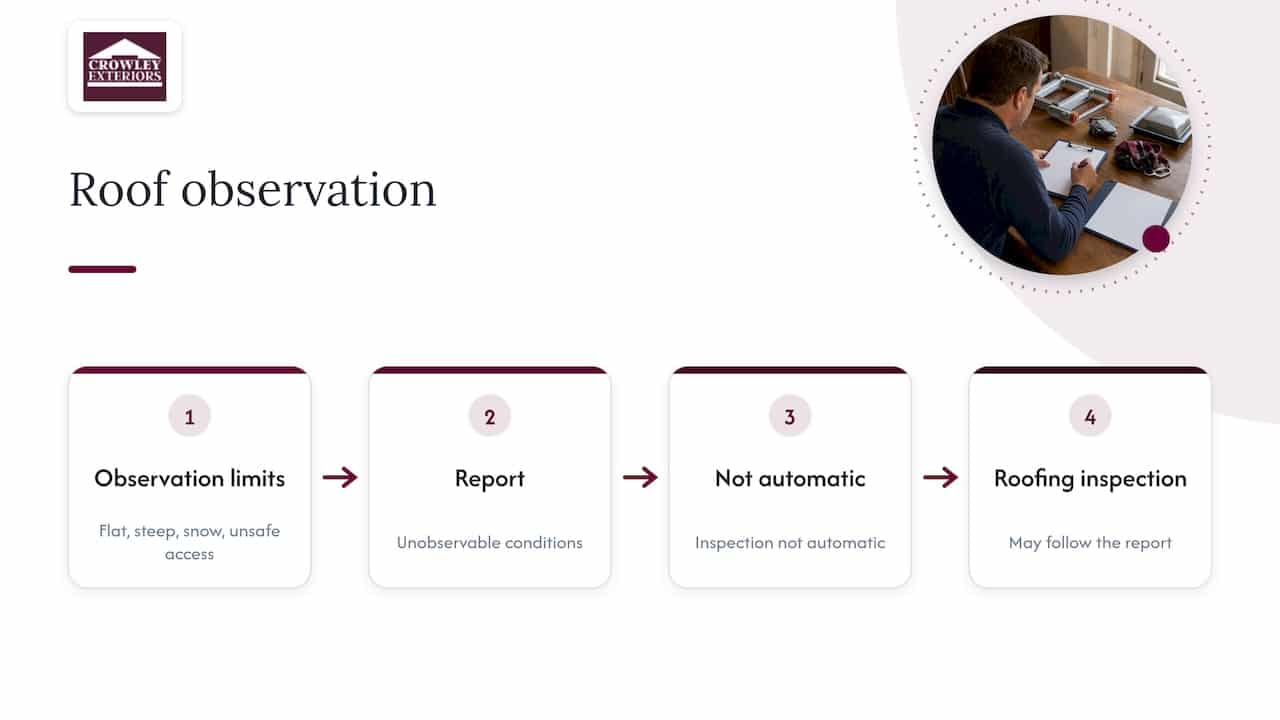
Flat roofs, steep slopes, snow cover and unsafe access all limit what an appraiser can observe. FHA does not automatically require an inspection of every flat or unobservable roof. The appraiser must report what could not be observed, and the appraiser or underwriter may then call for a roofing inspection based on what was reported (HUD Archives).
The attic matters too. HUD’s guide requires attic observation. The homeowner or seller must provide clear access, and the appraiser must at minimum put head and shoulders into the attic. A hatch blocked by boxes or painted shut can create a delay you did not need.
If you are the seller, clear the hatch and make sure there is a safe way up before appraisal day.
Buyer’s playbook: before you offer
If you are a first-time buyer using an FHA loan, the roof is one of the few items that can add a surprise four- or five-figure bill. A few habits protect you:
- Look at the roof yourself during the showing. Curling shingles, bare patches, sagging lines and stained ceilings are visible without a ladder.
- Order a standard home inspection and ask for roof and attic detail. A home inspection is separate from the FHA appraisal. The appraisal protects the lender’s collateral and the minimum standards. Your inspection protects you.
- Ask for a roofer’s report if the roof looks 15 or more years old, or if you see leak signs. For real estate transactions, a documented roof report gives you something concrete to negotiate from.
- Put roof language in your contract. Repair requirements, credits and timelines belong in writing. Our guide on roof contingency moves buyers use under FHA and VA rules walks through the options.
Also know that FHA conditions are a negotiating point, not necessarily a deal breaker. A seller who has to fix a leak to close often has a clear incentive to do so.
Seller’s playbook: before you list
Sellers with buyers on FHA financing face the same roof test. A listing with a visible roof problem can lose offers, or lose them late, after the appraisal.
Three steps help:
- Get a roof inspection before listing. It tells you what an appraiser may flag. Our article on roof inspection before listing compares setting your price around the findings with offering credits.
- Fix cheap, obvious defects. Resealed penetrations, replaced flashing and a handful of replaced shingles cost far less than a stalled closing.
- Keep paperwork. A written report, invoices and warranty details for earlier work speed up the lender’s review. A clear roof inspection report is the kind of document underwriters can use.
If you are in Missouri, see our notes on seller roof inspections in Missouri, including how to check actual cash value on insured roofs and avoid storm chasers.
Repair or replace? How to decide when FHA flags the roof
A flagged roof does not always mean a new one. The cost gap between a repair and a full replacement is large, and FHA’s standard is about function and remaining life, not newness.
Use this rough decision frame:
- Repair when damage is localized, the decking is sound, and a roofer can credibly say the roof has at least two years left after the fix.
- Replace when damage is widespread, the same area has been patched repeatedly, shingles are brittle across the whole roof, or the roofer cannot support the remaining life estimate.
Many roofers use a percentage-of-damage rule of thumb. We explain how it works in the 25 to 30% rule for repair or replacement. Treat it as a starting point and let the inspection decide.
If the answer is replacement, underlayment and eaves details count. Our guide to roof underlayment types and ASTM D1970 at eaves covers what to ask your contractor. For timing and expectations, see our roof replacement process and timeline for St. Charles homeowners.
Getting the repair certified and documented
Once the work is done, the lender wants proof. Plan for this before the contractor starts:
- Get a written scope that names the defect from the appraisal.
- Ask the contractor for a completion statement and photos of before and after.
- Confirm with the lender who must certify the work and in what format.
- Keep signed authorizations and approvals organized. A simple roof repair authorization form keeps the scope, price and sign-off in one record.
Timing matters. Rate locks and closing dates do not wait for a roofer’s schedule, so call a contractor the day the condition is issued, not the week before closing.
Perspective: what we see on FHA roof conditions
We work on roofs across St. Charles County, and FHA-related roof calls tend to follow a pattern. Most of them are not dead roofs. They are roofs with one or two fixable problems, like old flashing around a chimney, a worn pipe boot, or a few storm-damaged areas, that an appraiser noticed and a lender wanted resolved.
Our advice is simple. Do not argue with the condition, and do not overbuy. Get an honest inspection, fix what the report calls for, and document it so the lender can sign off. Missouri weather is hard on roofs, with hail, wind and freeze-thaw cycles, so we also tell buyers to treat a clean FHA sign-off as a minimum, not a guarantee of decades of life.
We offer free inspections and no-obligation, itemized estimates, so you know the scope and cost before you commit, and we stand behind our roofing work with a 25-year guarantee. If a roof just needs a repair, we will say so.
— Mario
Get your roof checked before the appraiser does
If you are buying or selling in St. Charles County and an FHA appraisal is coming, a roof inspection tells you where you stand while there is still time to act. Crowley Exteriors provides roof inspections and leak detection, roof repair, real estate roof reports and full roof replacement, with free inspections and itemized estimates. If the roof needs a full replacement, see our roof replacement service.
FAQ
Does FHA require a new roof?
No. FHA requires that the roof keep moisture out, have no active defects and have reasonable remaining life, with at least two years as the HUD guidance benchmark. A roof that meets those tests does not need replacement. A roof that fails them may be repaired or replaced, depending on the roofer’s findings and the lender’s requirements.
Can a roof with a leak pass an FHA appraisal?
Not as it stands. HUD treats leakage as a defective condition, and the defect must be corrected and further damage made unlikely. The appraisal is typically written subject to repair, and the work is confirmed before closing.
Who decides whether the roof needs repairs?
The appraiser reports what they see, and the lender and underwriter decide which repairs are required for the property to be eligible. The lender also selects who certifies the roof condition and completed work. Ask your loan officer for their exact requirements.
Does the FHA appraisal replace a roof inspection?
No. The appraiser makes a visual observation and reports it. If the roof is not visible or the remaining life looks short, a professional roofing inspection may be required. Buyers should still get their own inspection.
Sources
- HUD Archives: HOC Reference Guide, Roofs & Attics
- HUD Appraisal Report and Data Delivery Guide
- HUD Handbook 4150.2, Appendix D: Valuation Protocol
- HUD Handbook 4150.2, Chapter 3: Property Analysis
- HUD Handbook 4155.2, Chapter 4: Property Valuation and Appraisals
Recommended
- 5 Roof Contingency Moves U.S. Buyers Use To Outsmart FHA And VA Rules
- What Should Be On Your Roof Estimate Checklist?
- Roof Inspection Before Listing: Set Price Or Offer Credits
- Missouri Seller Roof Inspections: Check ACV, Avoid Storm Chasers
This article was prepared with AI assistance for general information. For recommendations specific to your property, contact Crowley Exteriors. Call or text us at 314-839-3800.