


The most common roof leak signs are a stained or sagging ceiling, bubbling or peeling paint, a musty smell, damp or matted attic insulation, and dark streaks on rafters. Outside, look for missing, curling or cracked shingles, loose flashing and granules collecting in your gutters. Some leaks give none of these signs for months, so a few minutes in the attic after each big storm is the best habit you can build.
This guide covers what each sign means, how to trace water back to where it enters, which look-alike problems fool homeowners, and when to stop investigating and call a roofer.
TL;DR
- Check ceilings and upper walls for stains, bubbling paint or blistered drywall, then check the attic for dark wood, matted insulation, daylight and a musty smell.
- Water rarely drops straight down from the hole. Follow stains uphill along rafters to find the real entry point.
- Outside, scan from the ground with binoculars for damaged shingles, loose flashing, clogged gutters and granule loss.
- Condensation, plumbing and HVAC leaks can mimic a roof leak, so rule them out before you assume the roof has failed.
- Stay off a steep or wet roof. Call a roofer when the source is hard to find, the damage is widespread or the roof is hard to reach.
Table of Contents
- Signs of a roof leak inside your home
- Signs in the attic
- Signs on the outside of the roof
- After hail or wind: signs that appear later
- How to find where the leak is coming from
- Problems that look like roof leaks
- Staying safe while you check
- What to do right after you spot a leak
- When to call a roofer
- What does it cost to fix a roof leak?
- Our perspective
- Get a free roof inspection in St. Charles County
- FAQ
- Sources
Signs of a roof leak inside your home
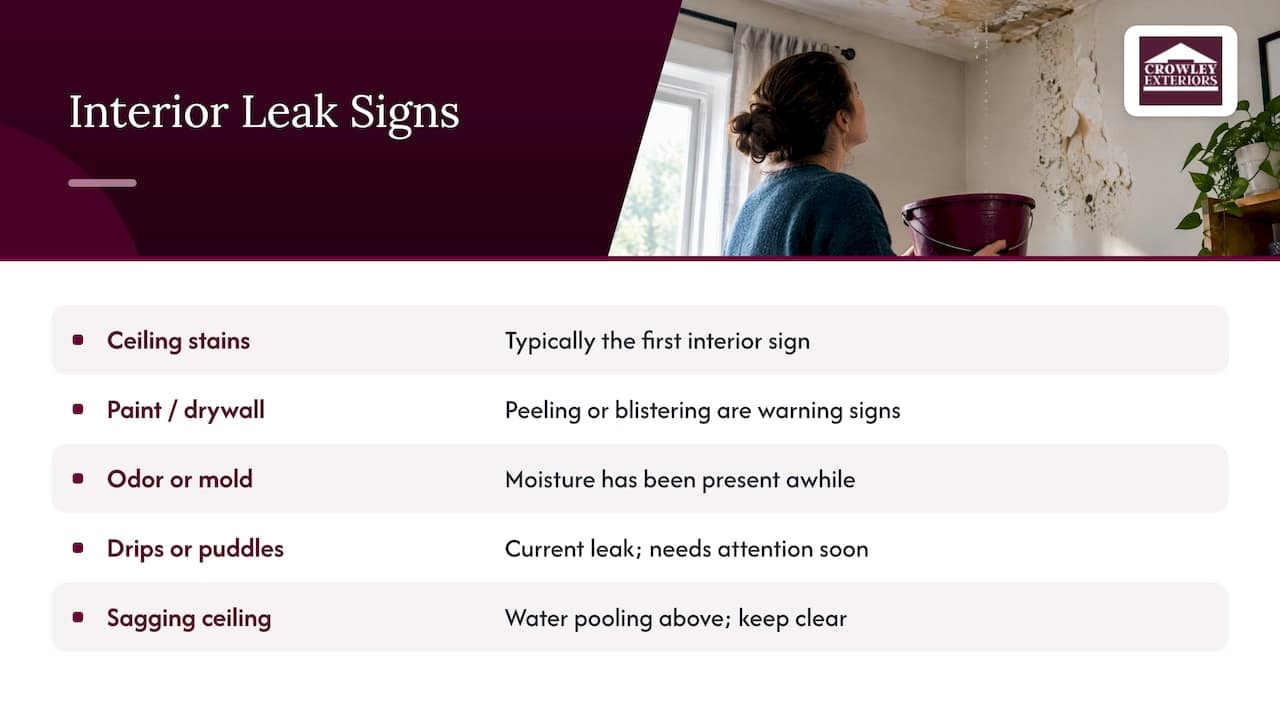
Interior signs are usually the first ones you notice, and they tend to show up well after the water first got in.
Ceiling and wall stains. This Old House says the first interior sign is typically a water stain on the ceiling. Stains often look tan, yellow or brown and may have a darker ring at the edge. If you are looking at one now, our guide to a ceiling water stain and what to do next walks through the next steps.
Peeling or bubbling paint and blistered drywall. The same source lists peeling paint and blistering drywall as warning signs. The National Roof Certification and Inspection Association also lists soft or stained ceilings and upper walls and bubbling paint.
Musty odors and mold. A damp smell in a room under the roof, or in the attic itself, suggests moisture has been present for a while. Mold on the ceiling or at the top of an exterior wall points the same way.
Dripping sounds or puddles. Active dripping during rain, or water pooling on attic floor boards, means the leak is current and needs attention soon.
Sagging ceiling sections. A bulging or sagging patch means water is pooling above it. The University of Wisconsin Extension advises that sagging roof sections or floors should be braced by a contractor or a knowledgeable person. Keep people and furniture out from under it.
Signs in the attic
The attic is the best place to catch a leak early, because water shows up there before it reaches your ceiling. Go up with a flashlight, ideally during or just after rain, and look for:
- Dark spots or trails on the roof deck, rafters or framing
- Insulation that is matted down, discolored or damp
- Daylight coming through the roof boards
- Condensation on nails, or rusty nail tips
- A musty smell or visible mold
- Sagging sheathing
GAF recommends checking the attic after severe weather for dark spots, holes or sagging sheathing. It notes that leaks can come from damaged shingles, failed underlayment or deteriorated flashing.
Move carefully when you do this. Step only on framing, keep clutter out of your path and carry a light. This attic safety checklist covers what to check, store and avoid up there.
Signs on the outside of the roof
You can learn a lot from the ground. Use binoculars and walk the full perimeter of the house.
| What you see | What it can mean |
|---|---|
| Missing, cracked or curling shingles | Exposed underlayment, a likely entry point |
| Loose, lifted or rusted flashing | Gaps at chimneys, walls, vents and valleys |
| Granules in gutters or at downspouts | Aging shingles or hail wear |
| Raised nail heads or “shiners” | Nails pushing through, letting in moisture |
| Rusted or sagging gutters | Water not draining away from the roof edge |
| Dark streaks or moss patches | Moisture lingering on the surface |
The NRCIA list includes gutter granules, damaged shingles, loose flashing and damage after hail or wind. If you find granules, our piece on roof granule loss, what is normal and what is not helps you judge how serious it is.
Flashing and valleys
Most leaks do not start in the middle of a shingle field. They start where the roof changes direction or something pokes through it: chimneys, skylights, dormers, vents, walls and valleys. This Old House tells homeowners to inspect all of those places. If you want to know what you are looking at, see our overview of roof flashing types. Valleys carry a lot of water, so a failure there can wreck a ceiling quickly. We cover that in what to do about a roof valley leak.
Nail pops and exposed fasteners
A raised nail can lift a shingle and open a path for water. Resist the urge to hammer it back down, which can crack the shingle. We explain why you should not hammer nail pops and what a proper repair involves.
Gutters and eaves
Gutters tell on your roof. GAF suggests checking eave and fascia undersides for rot or animal infestation, and checking gutters and downspouts for debris, sagging or leaks. The University of Wisconsin Extension lists clogged downspouts or eaves among the common causes of leaks. If water spills over the edge in a downpour, read gutter overflow causes and quick fixes. Seams that drip are a separate issue, covered in leaking gutter corners.
After hail or wind: signs that appear later
Storm damage often does not leak right away. A hail hit can bruise a shingle and shed granules, and the leak appears weeks later. Wind can lift shingles and loosen flashing without removing anything you would notice from the street.
Check the roof, gutters, vents and siding after any big storm. If you see damage, photograph it quickly, since insurance claims depend on good records. We have a 24 to 72 hour wind damage photo checklist and a guide to photographing wind damage roof signs. For hail specifically, see what to do about hail damage right now.
How to find where the leak is coming from
The spot on your ceiling is where water finally showed itself, not where it got in. The University of Wisconsin Extension notes that leaks are rarely directly above the ceiling spot. InspectAPedia adds that water can travel horizontally and over considerable distances, especially on flat or low-slope roofs.
Here is a practical order of attack.
- Start at the stain. Note its location and size. Take a photo and mark the edge with a pencil so you can see whether it grows.
- Go to the attic. Look directly above the stain, then work outward. Look for wet wood, a drip trail or damp insulation.
- Follow the water uphill. Home Depot advises tracing attic stains up the rafters. Water runs down the underside of the deck and framing, so the highest wet point is closest to the entry.
- Check penetrations. Pipes, vents, chimneys and skylights are the usual suspects. Water often drips down a pipe or vent.
- Look outside at the matching spot. Find the same location on the roof from the ground, with binoculars, and check for damaged shingles or flashing.
- Map what you find. Sketch the wet areas and measurements from a fixed point, such as a chimney.
Finding a leak when nothing looks damaged
When the roof looks fine, This Old House and Home Depot both describe a helper-and-hose test. One person stays in the attic with a flashlight while another soaks suspected roof areas from low to high, one section at a time, and waits for droplets to appear. Work slowly, because water can take minutes to show.
Use only a gentle stream. InspectAPedia warns that high-pressure spraying can damage roofing or create misleading water entry. Never do this test on a steep, wet or slippery roof. The person on the roof should be on a low, easily accessed section, or you should skip the test and call a pro.
Sometimes the answer is not on the roof at all. This brings us to look-alikes.
Problems that look like roof leaks
Not every ceiling stain comes from shingles. Before you spend money, rule out:
- Condensation. According to This Old House, condensation can cause damp walls, foggy windows, buckled ceiling materials, high humidity and musty odors. Poor attic ventilation and bathroom fans venting into the attic are common contributors.
- Plumbing leaks. Broken pipes can cause attic or ceiling moisture.
- HVAC leaks. Condensate lines and ductwork can drip onto insulation and drywall.
A few clues help tell the difference. A roof leak shows up during or after rain and tends to be worse in heavy storms. A plumbing leak can appear in dry weather. Condensation shows up in cold snaps, often as frost on nails that melts into drips. If you cannot tell which it is, a roof inspection can sort it out. Our roof maintenance schedule covering attic ventilation and gutters explains how those pieces work together to keep the attic dry.
One more caution: InspectAPedia notes old stains can remain after the roof has dried. A brown ring does not prove an active leak. Mark the edge, wait through the next rain and check whether it grew.
Staying safe while you check
The University of Wisconsin Extension advises homeowners to start with binoculars and the attic rather than risk serious injury on the roof, and says that ladder or roof unsteadiness can cause severe injuries. Unless you are experienced, it recommends a professional roofer for repairs.
In practice:
- Stay off the roof when it is wet, icy, windy or steep.
- Do not climb alone, and do not lean a ladder against gutters.
- Do not walk on a roof you suspect is soft or sagging.
- Keep away from power lines at the service entrance.
- In the attic, step only on framing and wear a dust mask if you see mold or insulation debris.
What to do right after you spot a leak
If water is coming in now, our guide to a roof leak emergency lays out what to do. The short version:
- Move belongings away and put a bucket under the drip.
- If the ceiling is bulging with water, a small hole in the lowest point lets it drain into a bucket instead of collapsing. Stay clear of the area while you do this.
- Turn off power to a room if water is near light fixtures or outlets.
- Photograph everything with dates before you clean up.
- Call a roofer and, if the cause is a storm, contact your insurer.
Temporary tarping is a stopgap, and it is best done by someone with the right equipment, not a homeowner on a wet roof.
When to call a roofer
This Old House says to call a professional if the roof is steep, multistory, unstable or hard to access, if the source is hard to find or damage is widespread, or if DIY work could affect your warranty. Today’s Homeowner adds multiple leaks, extensive damage, roofs nearing the end of their warranty and anyone not confident with heights or roofing materials. Bob Vila calls roof repair specialized work, since homeowners have to weigh injury risk and the chance of more roof damage against the cost of hiring.
In short: call if you see any of these.
- A stain that keeps growing or returns after you dry it
- Several leaks, or leaks in more than one room
- Sagging ceilings or soft decking
- Damage after hail or high wind
- Water you cannot trace after an attic check
What does it cost to fix a roof leak?
Price depends on the cause, and pinning down the cause early keeps it lower. Fixr reports typical U.S. leak repairs of $350 to $1,500, averaging $800, with minor fixes around $100 and structural damage pushing costs to $8,000 or more. Bob Vila reports leak repairs generally falling between $360 and $1,550. These are national figures, and your quote will vary.
Fixr says price depends mainly on:
- The extent of the damage
- Your roofing material
- Local labor rates, with labor averaging about 60% of the total
- Whether water caused mold, rot or structural and decking damage
Bob Vila adds roof size, pitch, design, features, location, repair type and season. The takeaway is that early action matters. A flashing repair now costs far less than replacing wet decking and insulation later.
When repairs start stacking up, the question becomes repair or replace. Our 25 to 30% rule for repairing or replacing a roof explains how to think about it. Before you sign anything, our roof estimate checklist shows what a clear written estimate should include.
Our perspective
Most of the leaks we are called to were visible months earlier. A faint ceiling ring, a few granules in the downspout, a lifted piece of flashing. People tend to wait for a drip, and by then the insulation and decking are usually wet.
We are a family-owned company with more than 20 years in St. Charles County, and Missouri weather is hard on roofs: hail, wind-driven rain, freeze and thaw. That is why we start with a free inspection and an itemized, no-obligation estimate. You should see exactly what we found and what each fix involves before deciding anything.
Our approach is to find the actual entry point, not just patch the stain. When a repair makes sense, we say so. When the roof has reached the point where replacement is the sounder choice, we explain why and stand behind our work with a workmanship warranty (10 years on full roof replacements, 1 year on most repairs).
If you are not sure whether what you see is a roof leak, ask us to look. It costs nothing, and it beats guessing.
Mario
Get a free roof inspection in St. Charles County
If you have found any of the signs above, we can trace the leak, show you what we find and give you a free, itemized estimate with no obligation. We handle roof repair, inspections and leak detection, storm and hail damage repair and insurance claim assistance, and roof replacement when repair is no longer the right call.
If the inspection shows your roof is past repair, here is how our roof replacement process works in St. Charles County.

Buying or selling a home? We also prepare real estate roof inspection reports for homeowners and property managers. Our roof inspection report guide explains what such a report covers.
FAQ
Can a roof leak with no stain on the ceiling?
Yes. Water can soak insulation and framing in the attic for a long time before it reaches the drywall. Check the attic for dark wood, damp or matted insulation, mold and musty smells, especially after storms.
How do I find a roof leak if the roof looks fine?
Start at the interior stain, then trace attic water uphill along the rafters to the highest wet spot. If that does not reveal the source, a helper can gently soak roof sections from low to high while you watch from the attic. Skip the test if the roof is steep or slippery.
Is a brown ceiling stain always an active leak?
No. Old stains can remain after the roof has dried, and plumbing, HVAC or condensation problems can cause similar marks. Outline the edge in pencil and check it after the next rain. If it grows, treat it as active.
How much does it cost to fix a roof leak?
Fixr reports typical U.S. repairs of $350 to $1,500, averaging $800, and Bob Vila reports $360 to $1,550. Costs climb when water has damaged decking, insulation or framing. We give free, itemized estimates so you can see the cost before committing.
Sources
- How To Find and Fix a Roof Leak, This Old House
- Got Leaks? What your roof isn’t telling you, NRCIA
- How to Identify Roof Damage and What to Look For, GAF
- Assessing and Repairing Leaky Roofs, University of Wisconsin Extension
- How to Fix a Leaky Roof, The Home Depot
- Roof Leaks: diagnosis and repair guide, InspectAPedia
- How To Detect and Fix Roof Leaks, Today’s Homeowner
- How Much Does Roof Repair Cost? Bob Vila
- How Much Does It Cost to Repair a Roof Leak, Fixr
Recommended
- What To Do About A Roof Valley Leak Before It Wrecks Your Ceiling
- 10 Roof Flashing Types Every Homeowner Should Know
- Ceiling Water Stain: What It Means And What To Do Next
- 25 To 30% Rule: When Homeowners Should Repair Or Replace A Roof
This article was prepared with AI assistance for general information. For recommendations specific to your property, contact Crowley Exteriors. Call or text us at 314-839-3800.