


Icicles hanging from your gutters form when snow on the roof melts, runs down to the cold edge and refreezes. A few small ones are common in winter. A heavy row of thick icicles, or ice building up along the roof edge, tells you heat is escaping from your house or water has nowhere to drain. Here is how to read what you see, what to do about it safely, and when to call a roofer.
TL;DR
- Icicles form from a melt-and-refreeze cycle: warm roof surfaces melt snow, and the cold eaves and gutters freeze the runoff.
- Icicles that hang free from the gutter, with no water backing up behind them, usually do not mean an ice dam has formed. Heavy, recurring icicles deserve a closer look.
- Do not knock icicles down or climb up to remove them. Falling ice and ladders on snow cause injuries, and the impact can break the gutter.
- The lasting fix is upstream: clear gutters in fall, keep roof snow down from the ground, and reduce heat loss into the attic.
- Water stains on a ceiling or wall, or ice backed up under the shingles, mean it is time for a professional inspection.
Table of Contents
- Why icicles form on gutters
- Icicles or ice dam: how to tell the difference
- Can icicles damage your gutters or hurt someone?
- Do icicles mean poor insulation?
- How to stop icicles from forming, safely
- Our perspective on gutter icicles
- What to do about damage and insurance
- Get the roof edge checked in St. Charles County
- When icicles are a reason to call a roofer
- FAQ
- Sources
Why icicles form on gutters
An icicle is simple physics repeated many times. Water drips from melting snow or ice on the roof, meets air below freezing and freezes. As more water keeps flowing over the frozen tip, the icicle grows layer by layer, which is why icicles take that long, tapered shape, according to the University of Wisconsin’s Weather Guys.
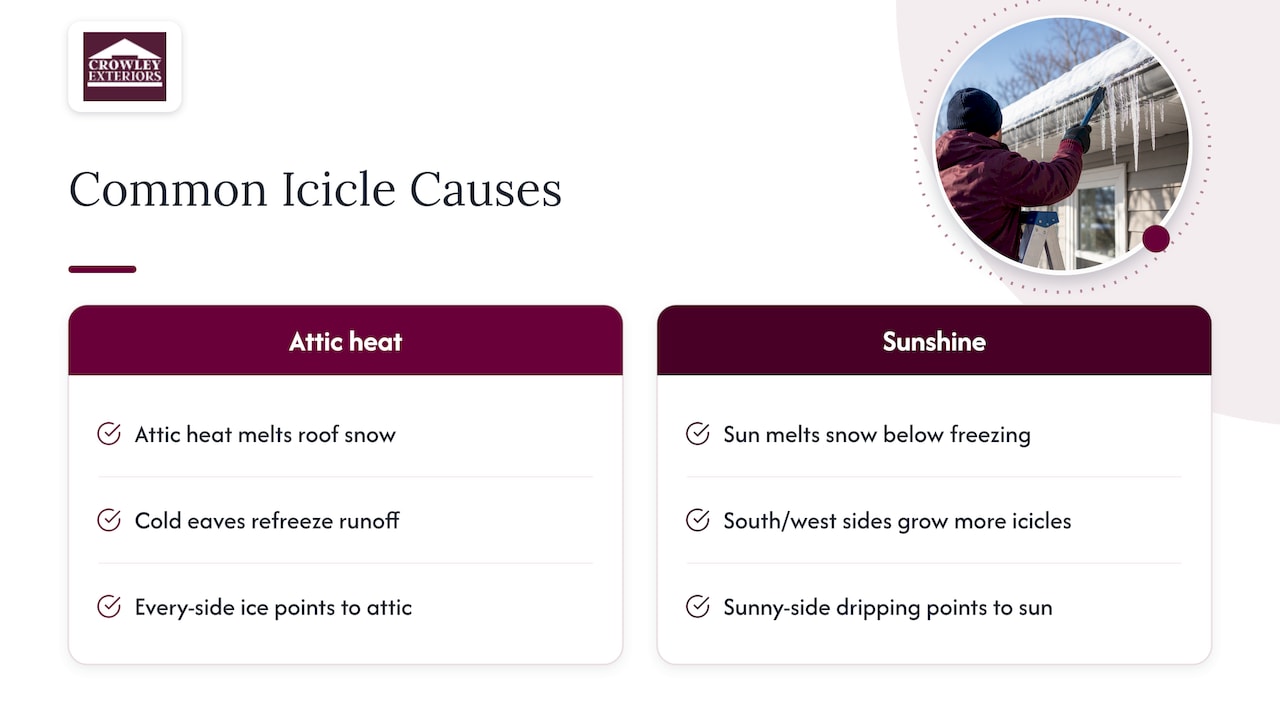
The real question is why the roof is melting snow while the air is freezing. There are two common reasons.
Heat from inside the house. Michigan’s emergency-preparedness guidance explains that heat above freezing in the attic melts the snow on the roof, while the colder eaves and gutters refreeze the runoff. The warm part of the roof sends water down, and the cold edge turns it to ice.
Sunshine. The same Wisconsin source notes that sun can melt roof snow even when the outdoor air is below freezing. That is why the south- and west-facing sides of a house often grow more icicles than the shaded north side. If only the sunny side drips, the sun is probably the main cause. If every side of the house is fringed with ice, look at the attic.
The pattern the National Weather Service describes is the same one Missouri homeowners see after a snowfall followed by a cold snap: snow melts during the day and refreezes overnight, and repeated cycles keep adding ice at the edge.
What a clogged gutter adds
A gutter full of leaves and debris cannot carry meltwater away. Water pools, freezes in place and builds ice that icicles then hang from. Ice that forms on top of gutter guards works the same way: slow melt and refreezing leave a crust on the surface. Clean, properly pitched gutters with working downspouts give meltwater a path, so ice has less chance to build.
If your gutters overflow in ordinary rain, they will almost certainly do worse in winter. Our guide to common gutter overflow causes walks through the usual culprits.
Icicles or ice dam: how to tell the difference
Most people searching this topic want to know one thing: is this normal, or is my roof in trouble? Travelers’ guidance says that icicles confined to the gutters with no water trapped behind them likely mean an ice dam has not formed, though they can be a precursor. Michigan’s guide adds that significant icicles along the gutters or eaves may indicate ice damming, so the inspection should also look for backed-up water and moisture inside.
An ice dam is a ridge of ice at the roof edge that traps melting water behind it. The University of Minnesota Extension says ice dams need snow on the roof, upper roof surfaces averaging above 32°F, lower surfaces below 32°F and outside temperatures below freezing. Trapped water can then be pushed back under shingles and into ceilings, walls and insulation.
| What you see | What it likely means | What to do |
|---|---|---|
| A few thin icicles hanging free from the gutter, mostly on the sunny side | Normal melt and refreeze | Watch them, keep clear of the drop zone, no action needed |
| Thick, long icicles along most of the roofline after every snow | Heat escaping into the attic or gutters not draining | Plan an attic and gutter check |
| A solid ridge of ice along the eave with water pooling above it | Ice dam | Call a roofer for an inspection before water gets in |
| Stains, drips or damp spots on ceilings or exterior walls | Water already getting inside | Act now, see what a ceiling water stain means |
| Gutter pulling away from the fascia | Ice weight is straining the gutter | Have it inspected and reattached |
If you want the full picture on dams, our article on ice dam roof damage and how to stop it goes deeper.
Can icicles damage your gutters or hurt someone?
Yes to both. Ice is heavy. Thick icicles and the ice mass behind them add load that can bend gutters, pull them loose from the fascia or tear them off the house. Falling icicles are a hazard to anyone walking under them, especially at a front door, a driveway or a path where children play.
The instinct is to knock them down. Bob Vila’s guidance says not to knock icicles down yourself: the impact can break the gutter, falling ice can injure you, and unsafe ladders or roof access add more risk. If the icicles cannot be reached safely from the ground, a licensed contractor or roofing professional should handle removal.
OSHA’s guidance on snow removal shows how serious the roof itself is. It reports that falls cause the most worker fatalities and injuries during rooftop snow removal, and it recommends methods that keep people off roofs whenever possible. It also advises keeping people on the ground out of the drop zone and wearing head and eye protection when removing ice.
Practical rules for the week after a freeze:
- Keep children, pets and guests away from walkways under heavy icicles.
- Do not stand beneath icicles to inspect or photograph them. Use a zoom lens from the side.
- Do not climb a ladder onto an icy surface or onto the roof.
- If a large icicle hangs over an entrance, call a roofer instead of swatting it down.
Do icicles mean poor insulation?
Sometimes, but not automatically. A few icicles from sun-warmed snow are not a sign of a bad attic. Heavy icicles on every side, appearing after each snowfall while neighbors’ houses stay mostly clear, point toward heat loss.
The University of Minnesota Extension identifies heat loss from the house, especially air leakage through ceiling penetrations, as a major route contributing to ice dams. Think of recessed lights, attic hatches, bath fan ducts, chimney chases and wiring holes. Warm indoor air leaks up through them, warms the roof deck and melts the snow above.
It helps to think of the roof as a surface that should stay one even, cold temperature in winter. The University of Minnesota Extension frames ice dams as primarily a roof-temperature uniformity problem: heat loss warms the upper roof while the cold eaves freeze the runoff. Seal the air leaks, add insulation, and let the attic breathe.
How to stop icicles from forming, safely
The National Weather Service recommends three steps: keep gutters and downspouts clear, use a ground-based roof rake to reduce snow, and evaluate attic insulation and ventilation. Here is how those play out in practice.
Before winter
- Clean the gutters and downspouts. Clear leaves and debris so melting snow can drain. Make sure downspouts discharge away from the foundation, and consider downspout extensions if water pools near the house.
- Check the gutter pitch and fasteners. A sagging section holds water that turns to ice. Our gutter installation and repair page explains what a free inspection looks at.
- Look at the attic. Insulation should be even, with no gaps around penetrations. Air should move from the soffits along the underside of the roof and out through the roof vents, as the National Weather Service describes.
- Check the roof edge details. Bob Vila lists a properly installed drip edge, along with adequate insulation, ridge-and-soffit ventilation, regular gutter cleaning and professionally installed heating cables, among measures that can reduce icicles and winter damage. Our drip edge checklist shows what correct installation looks like.
- Put it on a schedule. Gutters and attic ventilation work together, and our roof maintenance schedule shows when to check each. Clearing roof snow and keeping drainage working belongs on the same fall checklist as winter garage door preparation.
During winter
- Use a roof rake from the ground. Michigan recommends a long-handled roof rake used from the ground, and notes that less snow on the roof also lowers the risk of failure from weight. OSHA advises removing small amounts at a time and staying out of the drop zone.
- Keep the gutter edge clear where you safely can. The National Weather Service suggests keeping gutters and downspouts clear of snow and icicles through the winter. Do that from the ground only.
- Know the limits of emergency measures. For an existing ice dam, Travelers describes removing snow three to four feet back from the roof edge with a rake, then placing calcium chloride, not rock salt, in a nylon stocking to melt a channel, while protecting plants nearby. That is a stopgap to let water drain, and it should be done only from the ground. A roofer should deal with the cause.
The lasting fix
The durable answer, per the University of Minnesota Extension, is to reduce heat loss and air leakage, improve insulation and keep the roof surface temperature uniform. Everything else treats the symptom.
Our perspective on gutter icicles
Most homeowners call us after the first heavy row of icicles, asking whether the roof is failing. Usually it is not, but the icicles are the roof telling you something. In St. Charles County we get snow, a thaw, then a hard freeze, sometimes within the same week. That cycle is hard on an exterior that was never set up to handle it.
Our view is simple. Treat the roof, gutters, attic ventilation and roof edge as one system. A gutter that is pitched correctly and kept clear, a drip edge that is installed properly and an attic that breathes will do more than any quick fix on the ice itself. That is why our free inspection looks at the whole system, not just the part you can see from the driveway.
We would rather tell you what we see, in an itemized estimate with no obligation, than have you climb a ladder on a frozen morning. If icicles come with ceiling stains, sagging gutters or ice at the eave, call us. Small problems found early are far cheaper than a ceiling or a section of decking.
Mario
What to do about damage and insurance
If water has already reached your ceiling, move fast. Place a container under any drip, move belongings and photograph the damage. Our roof leak emergency guide lists the steps to take first.
On coverage, the Insurance Information Institute says standard U.S. homeowners policies commonly list the weight of ice, snow or sleet as a covered peril under broad and special forms, but policies vary and the wording of yours controls. Read your own policy, or call your agent, before you assume anything either way.
Document everything: dated photos of the ice, the gutters and any interior stains. A roofer’s written inspection helps when you talk to your insurer.
Get the roof edge checked in St. Charles County
Crowley Exteriors is a family-owned company with more than 20 years of experience in residential roofing, siding and gutters in St. Charles County. We offer free inspections and no-obligation, itemized estimates, and we do roof repair, leak detection, storm damage repair, seamless gutter installation and replacement, and insurance claim assistance. Our roofing services carry a workmanship warranty (10 years on full roof replacements, 1 year on most repairs).
If your icicles are heavy, your gutters are pulling away or you see stains inside, book an inspection through our roofing and exterior services page, or look at seamless gutter installation if your gutters are the weak point.

If the inspection shows the roof itself is near the end of its life, see our roof replacement options, and read what to know about winter roof replacement before you decide on timing.
When icicles are a reason to call a roofer
You do not need a contractor for every icicle. Call one when you notice any of these:
- Ice forming a continuous ridge along the eave, with water pooling behind it.
- Brown or yellow stains, peeling paint or dampness on ceilings, especially along exterior walls.
- Gutters bowing, sagging or separating from the house.
- Icicles that grow back thick every time after you clear them from the ground.
- Shingles that look lifted or curled near the edge. Our guide to curling roof shingles explains the causes.
When you call, tell the roofer when it happens (after snow, in sun, on all sides), where the ice sits and whether you have seen any interior moisture. That narrows the search for the cause quickly.
FAQ
Are icicles on gutters bad?
Not always. Small icicles hanging free with no water trapped behind them are a normal winter sight and usually do not mean an ice dam has formed. Heavy, recurring icicles, or any sign of water inside, call for an inspection.
How do I stop icicles from forming on my gutters?
Keep gutters and downspouts clear in fall, remove roof snow from the ground with a roof rake, and have your attic insulation and ventilation checked. Reducing heat loss into the attic is the lasting fix, because it keeps the roof cold and even.
Can I knock icicles off my gutters?
It is better not to. Falling ice can injure you or someone below, and the impact can break the gutter. If icicles hang over an entrance or you cannot reach them safely from the ground, hire a roofing professional.
Does homeowners insurance cover ice dam damage?
Standard U.S. homeowners policies commonly cover the weight of ice, snow or sleet, but policies differ and your wording controls. Photograph the damage and talk to your insurer or agent. We can provide an inspection and help with the claim process.
Sources
- Preventing Roof Ice Dams, National Weather Service
- Preventing Roof Ice Dams, Michigan MI Ready
- Dealing with and preventing ice dams, University of Minnesota Extension
- Why are icicles shaped like long skinny carrots? The Weather Guys, University of Wisconsin
- How to Identify and Help Remove an Ice Dam, Travelers
- Why You Should Never Knock Down Icicles Yourself, Bob Vila
- Falls and Other Hazards to Workers Removing Snow from Rooftops, OSHA
- Which disasters are covered by homeowners insurance? Insurance Information Institute
- Winter garage door preparation
Recommended
- Ice Dam Roof Damage: What To Do And How To Stop It
- Gutter Overflow Causes: Quick Diagnosis And Fixes
- Leaking Gutter Corners: Causes, Fixes And When To Replace
- Homeowners: Free Inspection To Decide Gutter Installation And Repair
This article was prepared with AI assistance for general information. For recommendations specific to your property, contact Crowley Exteriors. Call or text us at 314-839-3800.