

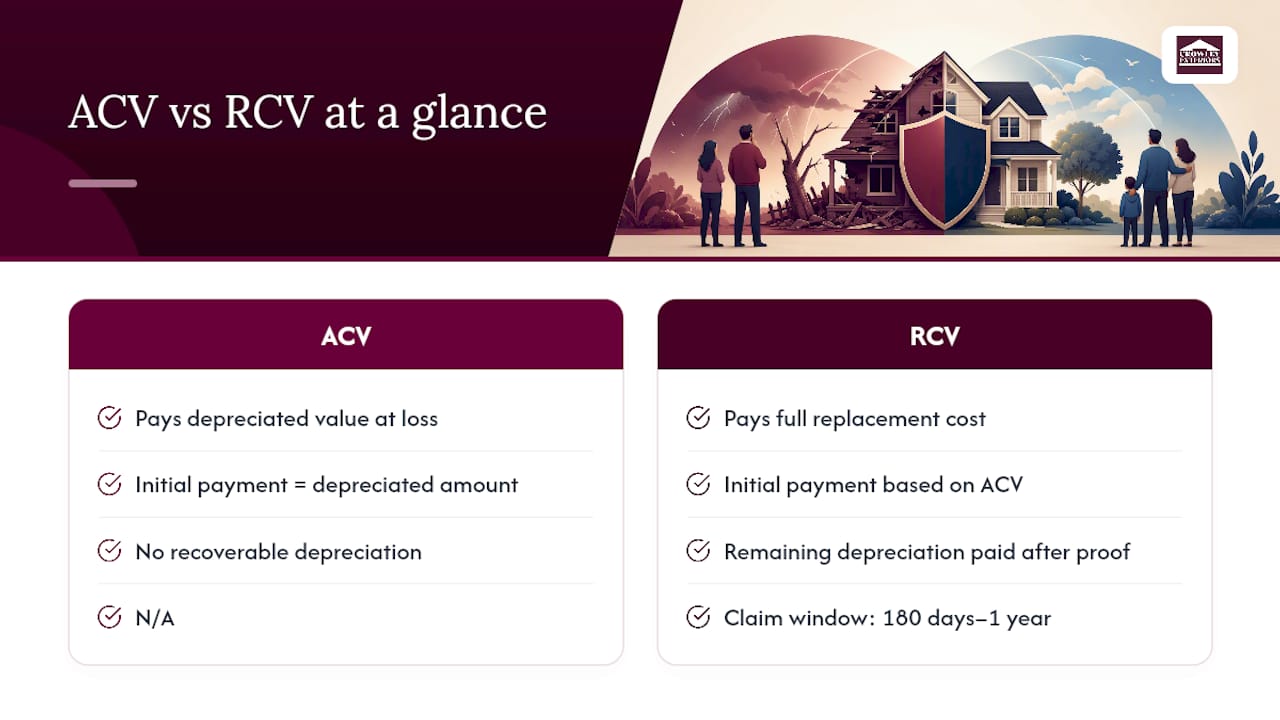
ACV pays what your damaged item is worth today, after depreciation. RCV pays what it costs to replace with a new equivalent, sometimes in two payments once you prove the work is done. Most homeowners with a standard policy carry replacement cost value on the house itself and actual cash value on the roof once it passes a certain age, so knowing which applies where matters more than most people realize. The NAIC and the Insurance Information Institute both stress the same starting point: read your declarations page before you file a claim, not after.
Pro Tip: Pull your declarations page now and look for the phrase “loss settlement.” If it says “actual cash value” next to your roof or personal property, you already know where the gap will show up.
Key Takeaways
RCV pays the full replacement cost in two stages while ACV pays a single depreciated amount, and the difference can total thousands of dollars on a single roof claim.
| Point | Details |
|---|---|
| ACV pays less upfront | Replacement cost minus depreciation, calculated by age and expected life. |
| RCV requires proof to finish paying | Submit a signed contractor invoice and paid receipt to recover withheld depreciation. |
| Deadlines are real | Most carriers give 180 days to one year to complete repairs and file documentation. |
| Roofs often default to ACV | Many insurers apply ACV to roofs over 15 to 20 years old, even under RCV dwelling policies. |
| Crowley Exteriors supports the process | Free inspections and itemized invoices help homeowners meet carrier deadlines and recover depreciation on roof claims. |
Table of Contents
- ACV vs RCV Explained: The Math Behind Each Payout
- How Do Insurers Pay ACV and RCV Claims?
- Where Does ACV Apply vs RCV on a Standard Policy?
- What Does RCV Cost, and Is It Worth Upgrading?
- How Do You Decide Between ACV and RCV Coverage?
- Real Scenarios: What ACV vs RCV Actually Costs You
- What I’ve Learned Watching Homeowners Navigate Claims
- Get Help Documenting Your Claim and Recovering Depreciation
- Frequently Asked Questions About ACV vs RCV Insurance
- Sources
ACV vs RCV Explained: The Math Behind Each Payout
Actual cash value is replacement cost minus depreciation. The formula insurers use is straightforward: ACV = Replacement Cost − (Depreciation Rate × Age of Item). Replacement cost value skips that subtraction. It pays what a new, like-kind item costs today, though insurers often withhold the depreciated portion, called recoverable depreciation, until you prove you actually replaced the item.
Two examples show the gap clearly:
- Roof: A 10-year-old roof with a 25-year expected life depreciates at roughly 4% per year. That’s a 40% cut from the replacement cost before you see a dime.
- Electronics: A laptop with a $1,000 replacement cost and a 5-year life expectancy loses about 20% of its value annually. At two years old, its ACV lands at $600, even though a comparable new laptop still costs $1,000.
The steps behind that math run the same way every time:
- Insurer determines full replacement cost for the item or structure.
- Insurer applies the annual depreciation rate based on age and expected life.
- Insurer pays the depreciated ACV figure first, minus your deductible.
- If you have RCV, the withheld depreciation becomes recoverable once you replace the item and submit proof.
How Do Insurers Pay ACV and RCV Claims?
Here’s the part that catches homeowners off guard: even with a full replacement cost policy, the first check you receive is calculated on ACV. Insurers pay that way regardless of which coverage you carry, then release the rest later if your policy includes RCV.
The typical flow looks like this:
- You file the claim and an adjuster documents the damage.
- The insurer issues a payment based on ACV, minus your deductible.
- You hire a contractor, complete the repair or replacement, and keep every invoice.
- You submit the signed contractor invoice and final paid receipt to the insurer.
- The insurer releases the recoverable depreciation, up to the original RCV amount.
Deadlines matter here. Many carriers set a window of 180 days to one year from the date of loss to complete repairs and submit documentation. Miss that window without requesting an extension, and you forfeit the withheld depreciation permanently.
Pro Tip: Treat the first check as a deposit, not a final answer. Practical claims guidance consistently frames that initial ACV payment as partial, with the remaining depreciation tied directly to proof of repair.
Where Does ACV Apply vs RCV on a Standard Policy?
Coverage defaults shift depending on the policy form and what’s being insured, and this is where a lot of confusion starts.
- Dwelling coverage on a standard HO-3 policy is usually RCV, covering the structure itself.
- Personal property (furniture, electronics, clothing) often defaults to ACV unless you’ve added an RCV endorsement or carry an HO-5 policy.
- Older homes insured under an HO-8 policy frequently use ACV across the board, reflecting the realities of insuring historic structures.
- Roofs specifically often get carved out even when the rest of the dwelling is RCV. Many carriers apply ACV to any roof older than 15 to 20 years, regardless of your overall policy.
Check your declarations page for the “loss settlement” section and look for the phrase “roof surfacing” or a separate roof schedule; that’s usually where an age-based ACV restriction gets written in.
What Does RCV Cost, and Is It Worth Upgrading?
RCV costs more because the insurer is on the hook for full replacement value, no depreciation deducted, which raises their exposure on every claim. Adding an RCV endorsement to personal property typically runs in the $25 to $50 range annually, a modest premium bump against the risk of eating thousands in depreciation on a total loss.
For the dwelling itself, two upgrade options go further than standard RCV:
- Extended replacement cost adds a buffer of roughly 25% to 50% above your dwelling limit, protecting you if rebuild costs spike after a regional disaster drives up labor and materials.
- Guaranteed replacement cost goes further still, covering the full rebuild cost even if it exceeds your policy limit, though fewer carriers offer it and it costs more.
| Comparison Dimension | ACV | RCV |
|---|---|---|
| Payout timing | Single payment at time of loss | Staged: ACV first, depreciation after proof |
| Depreciation applied | Yes, deducted up front | Withheld, then recoverable |
| Typical premium impact | Lower | Higher, often $25–$50/year for contents endorsement |
| Best-for scenario | Older homes, aged roofs, tight budgets | Newer homes, high-value contents, full protection |
Underinsurance is the quiet risk here. If your dwelling limit doesn’t reflect current labor and material costs, even RCV won’t fully rebuild your home after a total loss, which is exactly the gap extended and guaranteed replacement cost are built to close.
How Do You Decide Between ACV and RCV Coverage?
Start with a short self-audit before calling your agent:
- How old is your roof, and does it fall near the 15- to 20-year threshold most carriers use for ACV cutoffs?
- Have you renovated recently, adding value that your current dwelling limit might not reflect?
- What’s the replacement value of your electronics, furniture, and appliances combined?
- Could you cover a $5,000 to $15,000 depreciation gap out of pocket if a major claim hit tomorrow?
- Does your dwelling limit match actual local rebuild costs, including current labor rates?
Then bring these exact questions to your carrier or agent:
- What’s the loss settlement language on my roof specifically?
- How long do I have to submit documentation for recoverable depreciation?
- What would an RCV endorsement on personal property cost on my policy?
- Do you offer extended or guaranteed replacement cost, and what’s the premium difference?
Red flags that suggest you’re underinsured: a roof near that 15 to 20 year mark, a kitchen or basement remodel you haven’t reported, or a dwelling limit that hasn’t been adjusted in the last five years despite rising construction costs.
Real Scenarios: What ACV vs RCV Actually Costs You
Scenario one: the storm-damaged roof. A hailstorm destroys a 10-year-old roof with a $15,000 replacement cost. Under ACV, the payout lands around $9,000 after the 40% depreciation cut. Under RCV, the insurer pays that same $9,000 first, then releases the remaining $6,000 once you hire a contractor and submit the paid invoice. The homeowner’s move: get the roof replaced and file that paperwork before the deadline closes.
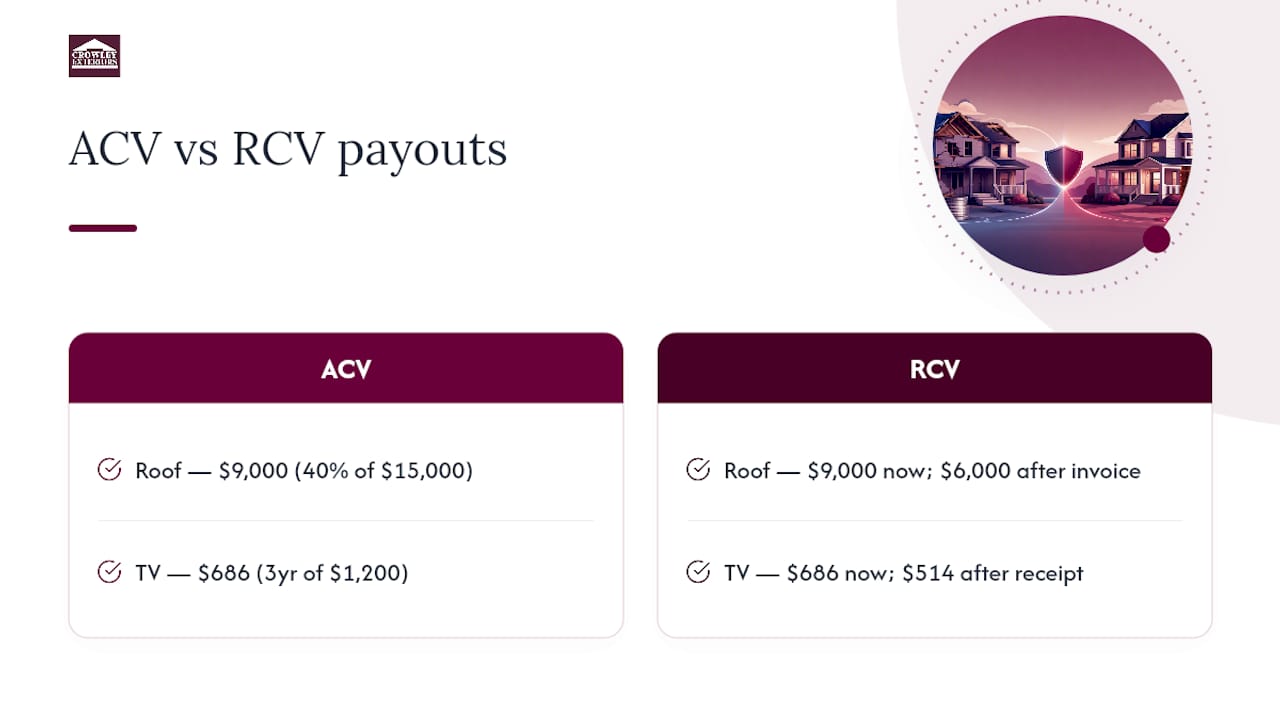
Scenario two: the stolen television. A $1,200 TV, three years old with a 7-year life expectancy, gets stolen. ACV pays roughly $686 after depreciation. RCV pays that upfront, then the remaining $514 once you buy a replacement and send the receipt. The takeaway: without RCV, that $514 gap is money you’ll never see again.
What I’ve Learned Watching Homeowners Navigate Claims
Most homeowners assume their first insurance check is the final word on what a repair is worth. It rarely is. In our work documenting storm damage across St. Charles County, the gap between that initial ACV payment and the real cost of materials and labor is often where homeowners get stuck, not because the insurer is being difficult, but because nobody explained the recoverable depreciation step clearly upfront.
What actually speeds up recovery of that withheld money isn’t a lawyer or a public adjuster. It’s a contractor invoice that itemizes materials and labor the way the carrier expects, submitted well inside the deadline. That’s the unglamorous part nobody talks about: paperwork discipline recovers more depreciation than any negotiation ever does.
Get Help Documenting Your Claim and Recovering Depreciation
If your roof is aging toward that 15 to 20 year ACV threshold, or you’re staring at a claim check that feels short, Crowley Exteriors can help close that gap. We provide free inspections, no-obligation estimates, and the kind of itemized documentation carriers need to release recoverable depreciation on time.

Every roof replacement we complete in St. Charles County comes backed by a 25-year guarantee, and our team knows exactly what paperwork your insurer will ask for before you even file. Beyond roofing, our full services lineup covers siding, gutters, and windows, useful if your storm damage extends past the roof. If you’re weighing whether to replace now or wait, request a free inspection through Crowley Exteriors and get a written estimate before your claim deadline closes.
Frequently Asked Questions About ACV vs RCV Insurance
What’s the main difference between ACV and RCV insurance?
ACV pays the depreciated value of a damaged item at the time of loss. RCV pays the full cost to replace it with a new equivalent, often in two installments once you prove the repair or replacement is complete.
Does RCV mean I get a bigger check right away?
No. Even with RCV, insurers issue the first payment based on ACV. The remaining recoverable depreciation only arrives after you submit proof of repair.
How long do I have to claim recoverable depreciation?
Most carriers set a window between 180 days and one year from the date of loss. Confirm your exact deadline with your carrier, since it varies by policy.
Is my roof automatically covered under RCV?
Not always. Many insurers apply ACV to roofs older than 15 to 20 years, even if the rest of your dwelling coverage is RCV. Check the loss settlement section of your declarations page.
Should I upgrade to RCV if I have an older home?
It depends on your risk tolerance and budget. RCV endorsements on personal property often cost $25 to $50 a year, a small price against the risk of losing thousands in depreciation on a major claim.
What documents do I need to recover depreciation?
A signed contractor invoice and a final paid receipt are the standard requirements. Submit both before your policy’s deadline to receive the remaining payment.
This article is general information, not a substitute for advice from a qualified financial advisor. Consult a qualified financial professional about your own circumstances before acting on anything here.
Sources
- What’s the Difference Between Actual Cash Value Coverage and Replacement Cost Coverage?
- Understanding depreciation when you have an insurance claim | The Zebra
- Understanding ACV vs. RCV in Homeowners Insurance
- Understanding depreciation | Travelers
- Replacement cost vs. actual cash value | Progressive