


If your gutters leak, sag, or fail to move water away from your foundation by an adequate distance, it’s time to call a professional rather than patch things yourself. A free inspection is the right next step: it tells you whether you’re looking at a simple repair or a full replacement, with no pressure to decide on the spot. We offer exactly that kind of no-obligation estimate, and it’s usually the fastest way to get a clear answer.
TL;DR:
- A thorough inspection first can identify whether a gutter issue is a simple repair or a sign of needing full replacement, depending on damage extent.
- Common problems such as corrosion, leaks, or repeated failures suggest that replacement may be more cost-effective than multiple repairs over time.
- Proper gutter material choices, downspout placement, and sufficient system capacity are critical factors to prevent water pooling and foundation damage.
- Gutter guards reduce debris buildup but still require regular maintenance, especially in areas with mature trees or frequent storms.
- Effective water drainage away from the foundation in cold climates may involve alternative solutions like underground systems or rain gardens, especially where gutters freeze or clog.
Table of Contents
- What professional gutter installation actually includes
- Common gutter problems: repair or replace?
- Gutter guards, cleaning frequency, and what maintenance really costs
- What a professional inspection and repair process looks like
- What drives cost, and how to compare bids fairly
- Stormwater and cold-climate drainage: where the water actually goes
- Why we lead with inspection, not assumption
- Getting started with a free gutter inspection
- FAQ
- Sources
What professional gutter installation actually includes
A typical installation starts with a choice of material. Seamless aluminum is the practical default for most homes because it has fewer joints and therefore fewer places to leak. Sectional aluminum costs less upfront but introduces more seams. Copper is a long-term, architectural choice that makes the most sense for homeowners planning to stay in a home for decades, since it ages into a distinctive patina and rarely needs replacing.
Beyond material, a quote should spell out downspout count and placement. We look at roof area and gutter run to decide spacing, since too few downspouts leave water nowhere to go during heavy rain.
A clear, itemized quote typically includes:
- Linear footage of gutter by section and material type
- Number and location of downspouts, plus any lateral piping needed
- Fascia or hanger repairs required before installation
- Cleanup and disposal of old materials
Common gutter problems: repair or replace?
Most gutter trouble falls into a handful of categories: pulled fasteners, leaking seams, sagging sections, corrosion, detached fascia boards, and clogged downspouts. Diagnosing which one you have from the ground is the first step toward deciding whether to repair or replace.
- Isolated leaks or a few loose hangers usually point to a repair, often a same-day fix involving resealing a seam or reattaching a hanger.
- Repeated failures in the same spot after a prior repair suggest the underlying system is undersized or worn out, which points toward replacement.
- Extensive corrosion or rust-through on aluminum or steel gutters is rarely worth patching since the metal will keep failing nearby.
- Continuous overflow despite clearing debris often means the gutter capacity doesn’t match your roof’s water volume, a sign the whole system needs rethinking rather than another patch.
Pro Tip: Ask any contractor to walk you through both a repair option and a replacement option with separate costs. A reputable installer will offer both when the problem is genuinely borderline.
Watch for red flags during an inspection: a contractor who refuses to get on a ladder, won’t document what they find, or pushes replacement without explaining why a repair wouldn’t hold are all signs to get a second opinion.
Gutter guards, cleaning frequency, and what maintenance really costs
Gutter guards reduce debris buildup, but none of them eliminate cleaning entirely. Mesh and micro-mesh guards block most leaves and grit but still need occasional rinsing. Reverse-curve guards shed large leaves well but can struggle with pine needles and fine debris. Brush-style inserts are the cheapest option and the least effective at the finer debris.
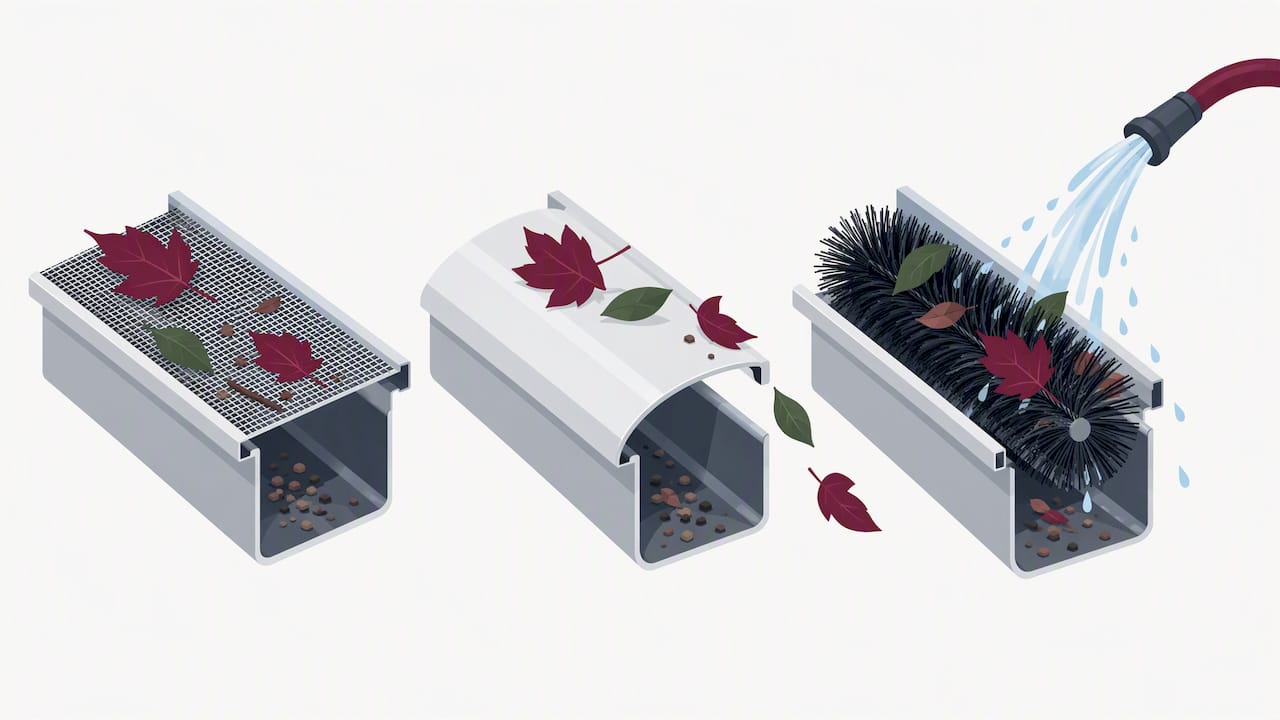
How often you clean depends on what’s overhanging your roof. A home surrounded by mature oaks needs attention more often than one with a clear roofline, regardless of which guard is installed. For a practical breakdown of keeping different guard types working, this gutter guard cleaning guide is a useful reference.
A seasonal maintenance checklist should include:
- Clearing debris before fall leaf-drop and again after it ends
- Checking downspout outlets for blockages each spring
- Inspecting hangers and seams after major storms
- Confirming guards are seated correctly after winter freeze-thaw cycles
What a professional inspection and repair process looks like
A trustworthy inspection covers the roof edge and drip line, hanger spacing, gutter slope, seam condition, downspout routing, and the grade immediately around your foundation. Each of these affects whether water actually leaves your property or pools where it shouldn’t.
- The inspector documents findings with photos, not just a verbal summary.
- You receive an itemized estimate showing material options and their respective costs, not a single take-it-or-leave-it number.
- Small repairs are often completed within hours to a day; partial replacements usually take half a day to a full day.
- A full gutter replacement on an average home typically runs one to two days, extending if weather, permit requirements, or difficult roof access come into play.
Steep rooflines, multiple stories, or tight property lines can add time regardless of the crew’s experience.
What drives cost, and how to compare bids fairly
Gutter pricing depends on linear footage, material choice, the number of downspouts and any lateral piping required, removal and disposal of old gutters, and how difficult the roof is to access safely. A single-story ranch with simple rooflines costs less to work on than a two-story home with multiple roof planes and limited ladder access.
Rather than comparing one lump-sum number across bids, ask each contractor for a price per linear foot and a list of exactly what’s included. The checklist below helps keep bids apples-to-apples:
- Does the quote include downspout extensions and lateral piping, or are those extra?
- Is removal and disposal of the old system included in the price?
- What warranty applies to materials versus labor?
- Is cleanup of the yard and gutters after installation part of the job?
A lower bid that excludes cleanup or warranty coverage often costs more over time than a slightly higher one that includes both.
Stormwater and cold-climate drainage: where the water actually goes
Getting water off the roof is only half the job. It also needs somewhere safe to land. The Building America Solution Center recommends downspouts terminate at least 5 feet from the foundation, or route to an underground catchment system at least 10 feet away, a distance that matters because water pooling near a foundation is one of the more common causes of basement moisture problems.
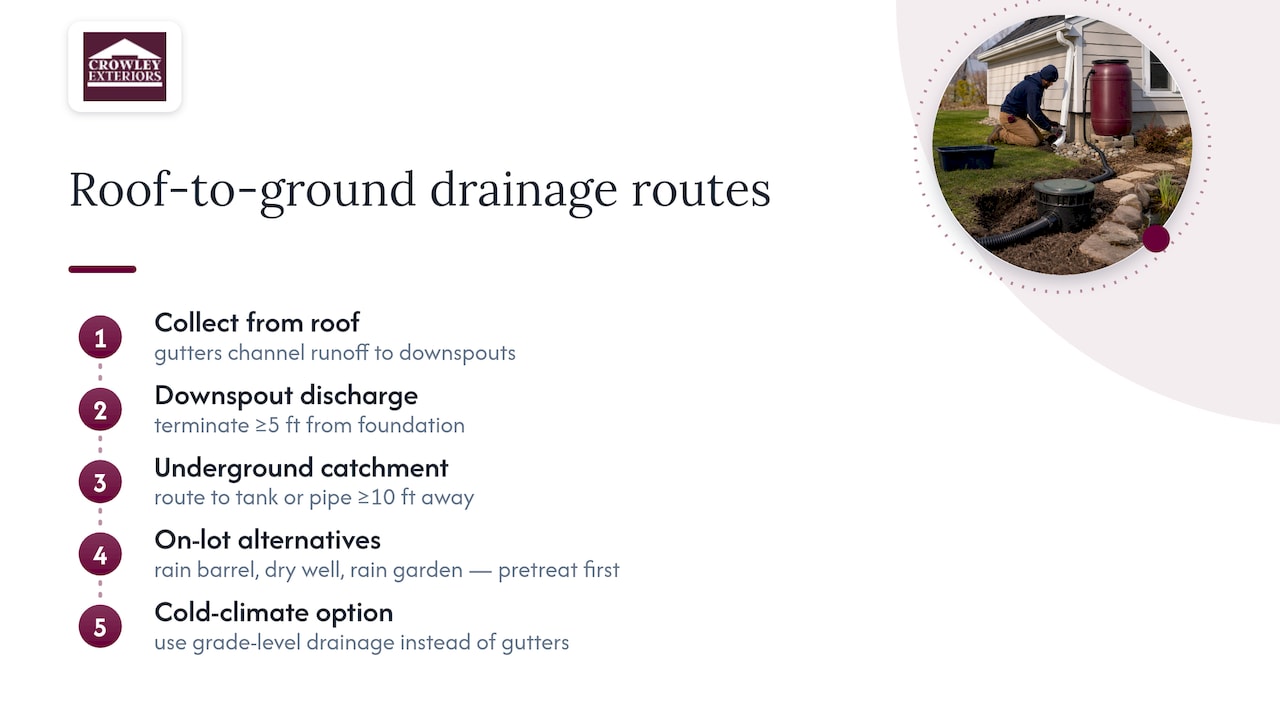
In very cold climates, gutters themselves can become a liability. Ice buildup inside a gutter can force water under roof edges, and the Building America Solution Center notes that grade-level drainage is often the better alternative in these conditions rather than gutters at all.
On-lot options like rain barrels, dry wells, and rain gardens can supplement or replace traditional gutter drainage, though they need pretreatment to avoid clogging over time, according to EPA guidance on stormwater controls. For broader surface drainage ideas around patios and walkways, this paving drainage guide covers swales and trench drains that pair well with gutter systems. Saturated soil near your foundation, standing water after rain, or damp basement walls are all signs your current drainage route isn’t working, whatever the gutters above look like.
Why we lead with inspection, not assumption
Too many gutter quotes get written from the driveway. We’ve built our process around getting on the roof first, because a hairline seam leak and a structurally failing hanger can look identical from the ground.
We back our installations with a workmanship guarantee and start every job with a free, no-obligation inspection. You’ll walk away with an itemized estimate, a plain explanation of what we found, and warranty paperwork you can actually read. If you know where past leaks or sagging have shown up, point it out before we climb the ladder. It saves time and sharpens the estimate.
— Mario
Getting started with a free gutter inspection
Deciding between a repair and a full replacement gets a lot easier once someone experienced has actually looked at your gutters. We make that first step free, so there’s no cost to finding out where you stand.

Here’s how it works:
- Reach out through our contact page to set up a visit
- We inspect your gutters, downspouts, and the grading around your foundation
- You receive an itemized, no-obligation quote with material options explained
- Approve the work and we schedule it, including cleanup and warranty documentation
For a closer look at what’s included in a full system replacement or repair, our seamless gutter installation page breaks down materials and guard options available in St. Charles County. If storm damage or an insurance claim is part of the picture, we can also walk you through that process during the same visit.
FAQ
How much should it cost to install a gutter?
Installation cost depends on linear footage, material choice, and how many downspouts your home needs, so pricing varies by project rather than following one flat rate. We provide itemized, no-obligation estimates so you can see exactly what’s included before committing to a price.
How much should it cost to fix a gutter?
A small repair, like resealing a seam or reattaching a loose hanger, is typically a quick fix, while more extensive damage costs more depending on scope. The only way to get an accurate number is a visual inspection, which is why we offer ours free.
What are the common problems with gutter installation?
The most frequent issues are pulled fasteners, leaking seams, sagging sections from improper hanger spacing, and downspouts that don’t carry water far enough from the foundation. Corrosion and clogged downspouts also show up often, especially in homes near mature trees.
Can gutters be repaired instead of replaced?
Yes, isolated leaks, a few loose hangers, or localized seam issues are often repairable without replacing the whole system. Replacement becomes the better option when failures repeat in the same areas, corrosion is widespread, or the gutter capacity can’t handle your roof’s water volume.
Sources
- Gutters and Downspouts | Building America Solution Center
- NPDES: Stormwater Best Management Practice, On-Lot Treatment (EPA)
Recommended
This article was prepared with AI assistance for general information. For recommendations specific to your property, contact Crowley Exteriors. Call or text us at 314-839-3800.