


Most homeowners policies apply a flat-dollar deductible to roof damage claims, though wind and hail losses often trigger a percentage deductible calculated from your Coverage A dwelling limit instead. Before you do anything else, pull your declarations page, calculate that percentage in real dollars, and confirm with your insurer which deductible actually applies to your loss. If a contractor offers to “waive” or “eat” your deductible, stop. That practice is illegal in several states and can get your entire claim denied.
TL;DR:
- Homeowners policies may have multiple deductibles, including flat-dollar and percentage-based, depending on the peril and coverage specifics.
- For wind, hail, and hurricane damage, percentage deductibles often range from 1% to 5% of the dwelling limit, which can result in high out-of-pocket costs.
- Contractors offering to waive or reduce your deductible illegally risk claim denial and legal consequences; always verify deductible rules with your insurer.
- Filing a claim makes sense when damage approaches or exceeds your deductible, especially if repairs could worsen or additional documentation is needed.
- Roof damage exclusions commonly involve wear, age, or cosmetic issues, which are not covered, and pre-existing damage can lead to claim denial even with deductible payment.
Table of Contents
- Understanding Roof Deductible Rules: Flat-Dollar Vs. Percentage
- How To Calculate Your Roof Deductible In Dollars
- Wind, Hail, Hurricane, And Earthquake Deductibles: Why They’re Different
- Why Contractor Deductible Waivers Are Illegal Or Risky
- Deductibles, Repair Timing, And When Filing Makes Sense
- Your Checklist After Roof Damage
- Common Exclusions Tied To Roof Deductibles
- How To Dispute Or Negotiate A Deductible Amount
- Roof Deductibles Vs. Deductibles For Other Property Damage
- Crowley Exteriors’ Approach To Deductibles And Claims
- Schedule A Free Roof Inspection With Crowley Exteriors
- Sources
Understanding Roof Deductible Rules: Flat-Dollar Vs. Percentage
Most standard homeowners policies default to a flat-dollar deductible, commonly $500, $1,000, or $2,500, applied to any covered loss including roof damage. But once wind, hail, or hurricane exposure enters the picture, many insurers switch to a percentage deductible instead, calculated against your Coverage A dwelling limit rather than a flat number.
A policy can carry more than one deductible at once. State Farm explains that deductibles typically apply per claim, though hurricane-specific deductibles sometimes work differently depending on your state and policy language.
Your declarations page (the summary page at the front of your policy packet) spells all of this out, usually in a section labeled “deductibles” with separate line items for “all other perils” and “wind/hail” or “named storm.”
- Flat-dollar deductibles: fixed amount, easy to calculate
- Percentage deductibles: calculated from Coverage A, not from the damage amount
- Layered policies: one standard deductible plus one or more peril-specific deductibles
Pro Tip: Don’t assume your deductible amount from memory. Insurers change Coverage A limits at renewal to keep pace with rebuilding costs, and that quietly raises your percentage deductible in dollars even if the percentage itself never changes.
How To Calculate Your Roof Deductible In Dollars
Percentage deductibles apply to your Coverage A dwelling limit, not to the size of your loss. LegalClarity’s breakdown uses a clean example: a 2% deductible on a $400,000 dwelling limit equals $8,000 out of pocket, whether your roof damage totals $9,000 or $90,000.
Here’s how that math plays out across common dwelling limits:
- 1% deductible: a small percentage of the dwelling coverage
- 2% deductible: a moderate percentage of the dwelling coverage
- 5% deductible: a higher percentage of the dwelling coverage
Compare that to a flat-dollar policy, where your deductible stays at $1,000 or $2,500 no matter what your dwelling limit says. Lemonade’s guidance points out the trap here: homeowners in storm-prone regions sometimes discover their percentage deductible exceeds the cost of a straightforward shingle repair, meaning the insurer pays nothing and the entire bill lands on the homeowner. Run this math before you file, not after.
Wind, Hail, Hurricane, And Earthquake Deductibles: Why They’re Different
Insurers price wind, hail, and hurricane risk separately from everyday perils like fire or theft because storm losses hit large numbers of policyholders at once. GEICO notes that percentage deductibles for wind/hail typically run 1% to 5% of Coverage A, with hurricane and earthquake deductibles frequently set even higher in coastal or seismic zones.
State rules vary widely on how these deductibles get triggered and disclosed. Florida uses tiered hurricane deductibles that only activate once a storm is officially named. Texas regulators publish consumer guidance on wind and hail deductibles specifically because confusion around these clauses generates so many complaint calls. The Insurance Information Institute tracks how these peril-specific deductibles differ from state to state, since no single federal rule governs them.
Missouri homeowners mostly deal with wind and hail deductibles rather than hurricane triggers, but the mechanics are identical:
- Named-storm deductibles activate only when a storm receives an official name, not for generic thunderstorms
- Earthquake deductibles are almost always separate policies or endorsements, often 10% to 15% of Coverage A
- A Coverage A increase at renewal raises your percentage deductible in dollars even if your policy terms look unchanged
Why Contractor Deductible Waivers Are Illegal Or Risky
A contractor who offers to waive your deductible, quietly inflate the invoice to cover it, or hand you a rebate check is proposing insurance fraud in most states. Texas Department of Insurance guidance states plainly that this practice can void your claim and expose both you and the contractor to fraud liability. Insurers can and do request proof that you actually paid your deductible, typically a canceled check, bank statement, or itemized receipt.
If a contractor raises this idea, take these steps:
- Pause the conversation and get the offer in writing if possible
- Call your insurer to confirm they require deductible proof
- Document every conversation with dates and names
- Report the offer to your state insurance department if it persists
Pro Tip: If cash flow is the real problem, ask about a documented payment plan or contractor-arranged financing instead. Those are legal, leave a paper trail, and don’t touch your claim’s legitimacy.
Deductibles, Repair Timing, And When Filing Makes Sense
If your roof damage totals less than your deductible, your insurer pays nothing. That doesn’t always mean skip the claim entirely. Filing still matters when damage is likely to worsen (a compromised seal ahead of Missouri’s spring storm season) or when you need an official adjuster report for future reference.
- Adjusters sometimes scope repairs conservatively near the deductible line, so a second opinion on the estimate can shift the math
- Filing a claim can affect your renewal premium even when the payout is small, so weigh that against the repair cost
- Choosing a higher deductible at policy renewal lowers your premium but raises your exposure on the next storm
- Deductibles generally apply per claim, though named-storm or hurricane deductibles sometimes apply once per season depending on your policy, per State Farm’s explanation
Your Checklist After Roof Damage
Work through this sequence before you sign anything or call your insurer:
- Locate your declarations page and identify which deductible applies to your damage type
- Calculate that deductible in dollars using your current Coverage A limit
- Photograph all visible damage from the ground and, if safe, closer angles
- Get at least one written estimate before filing, using a roof estimate checklist to compare contractors fairly
- Call your insurer to confirm the exact deductible applied to your specific claim
Ask your insurer directly which deductible triggers for your loss type and whether a named-storm clause applies. Ask any contractor how they handle filing the insurance claim itself, and whether they offer documented financing for the deductible portion.
Pro Tip: Keep every receipt, canceled check, and payment plan document in one folder. If your insurer ever audits the claim, that paper trail is what protects you.
If you’re weighing a DIY patch instead of hiring a professional to manage this process, it’s worth understanding the common pitfalls of DIY exterior repairs before you decide.
Common Exclusions Tied To Roof Deductibles
Deductibles only apply to covered perils, and roof policies carry exclusions that catch homeowners off guard. Wear-and-tear, age-related deterioration, and manufacturer defects in roofing materials typically aren’t covered at all, deductible or not, because insurers treat those as maintenance issues rather than sudden covered losses.
Cosmetic damage clauses are another common trap. Some insurers add an endorsement that excludes cosmetic hail damage (dents in metal roofing or granule loss that doesn’t cause leaks) even when the same hailstorm caused fully covered structural damage elsewhere on the roof. Read your endorsement pages carefully, because this exclusion sometimes hides in an attachment separate from the main policy.
Pre-existing damage is excluded by definition. If an adjuster determines a leak predates the storm you’re claiming, the entire line item gets denied regardless of your deductible. This is one reason a documented roof inspection report from before storm season matters. It establishes a clean baseline condition.
Age-based roof exclusions are increasingly common in Missouri and other states prone to hail. Many insurers now cap roof coverage at actual cash value once a roof passes 15 to 20 years old, meaning depreciation eats into your payout even after the deductible is satisfied. Some policies exclude roofs entirely past a certain age unless a recent inspection proves good condition. Check your policy’s roof-specific endorsements every renewal, not just the deductible line.
How To Dispute Or Negotiate A Deductible Amount
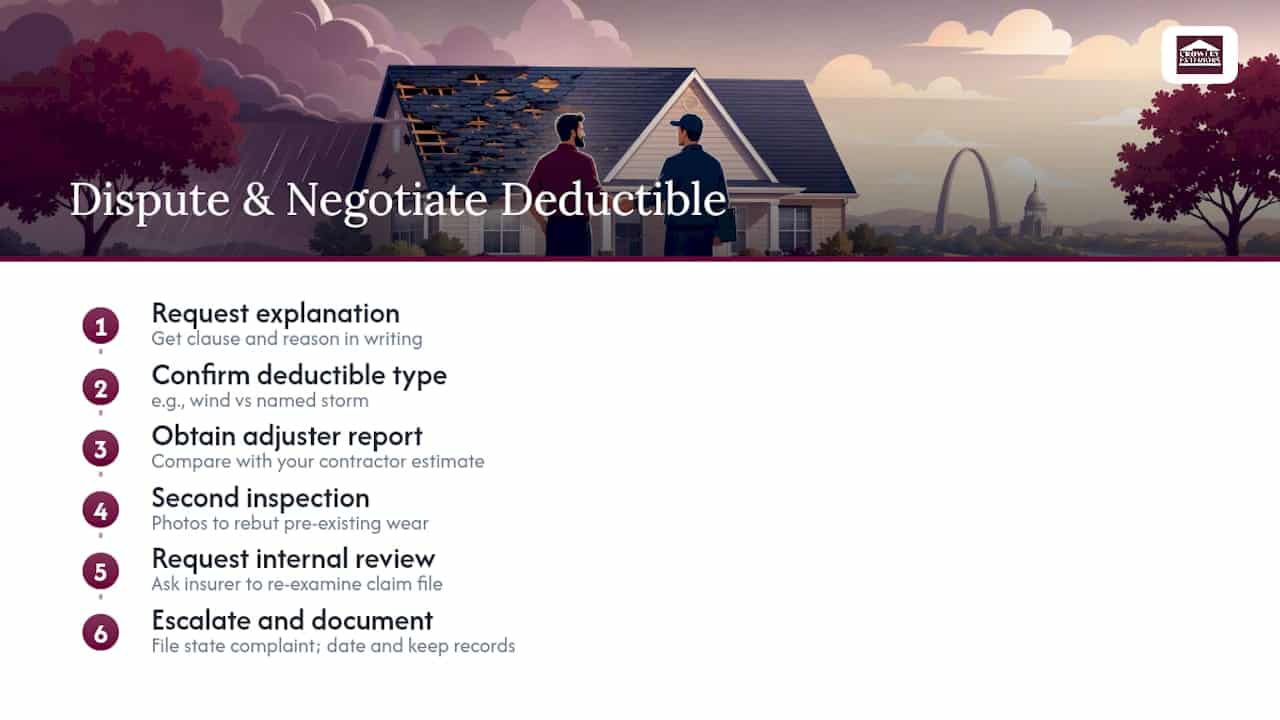
You generally cannot negotiate the deductible percentage or dollar figure written into your active policy. That number is contractual and fixed for the policy term. What you can dispute is which deductible applies to your specific loss, and that distinction resolves more conflicts than homeowners expect.
Start by requesting a written explanation from your insurer stating exactly which deductible clause applied and why. If your damage resulted from straight-line wind rather than a named storm, and your policy only imposes the higher percentage deductible for named storms, that’s a legitimate dispute worth raising in writing.
Ask for the adjuster’s full damage report and compare it against your own contractor estimate. If the adjuster classified storm damage as pre-existing wear to justify excluding it from a covered peril, a second inspection with photo documentation can support an appeal. Most states allow homeowners to request internal insurer review before escalating further.
If internal review stalls, most state insurance departments offer a formal consumer complaint process or, in some cases, mediation between homeowner and insurer. This route pressures insurers to re-examine borderline claims without the cost of litigation. Keep every piece of correspondence dated and organized. That is what actually settles this issue in your favor when someone reviews the file weeks later.
The deductible amount itself changes only at renewal, when you can request a lower percentage or switch to a flat-dollar structure, usually in exchange for a higher premium.
Roof Deductibles Vs. Deductibles For Other Property Damage
Roof deductibles frequently differ from the deductible applied to the rest of your dwelling, and this is the single most misunderstood piece of a homeowners policy. A burst pipe, kitchen fire, or theft claim typically falls under your standard flat-dollar deductible, often $1,000 or $2,500. But that same policy can carry a completely separate percentage-based deductible that applies specifically to wind, hail, or named-storm roof damage.
This means a single home can have two different dollar amounts on the same policy depending on what caused the damage. A $1,000 flat deductible for a burst pipe in the kitchen, but an $8,000 deductible on a $400,000 dwelling limit for wind damage to the same roof, per the math LegalClarity outlines. Homeowners who assume one deductible applies across their whole policy often get blindsided by this gap after a storm.
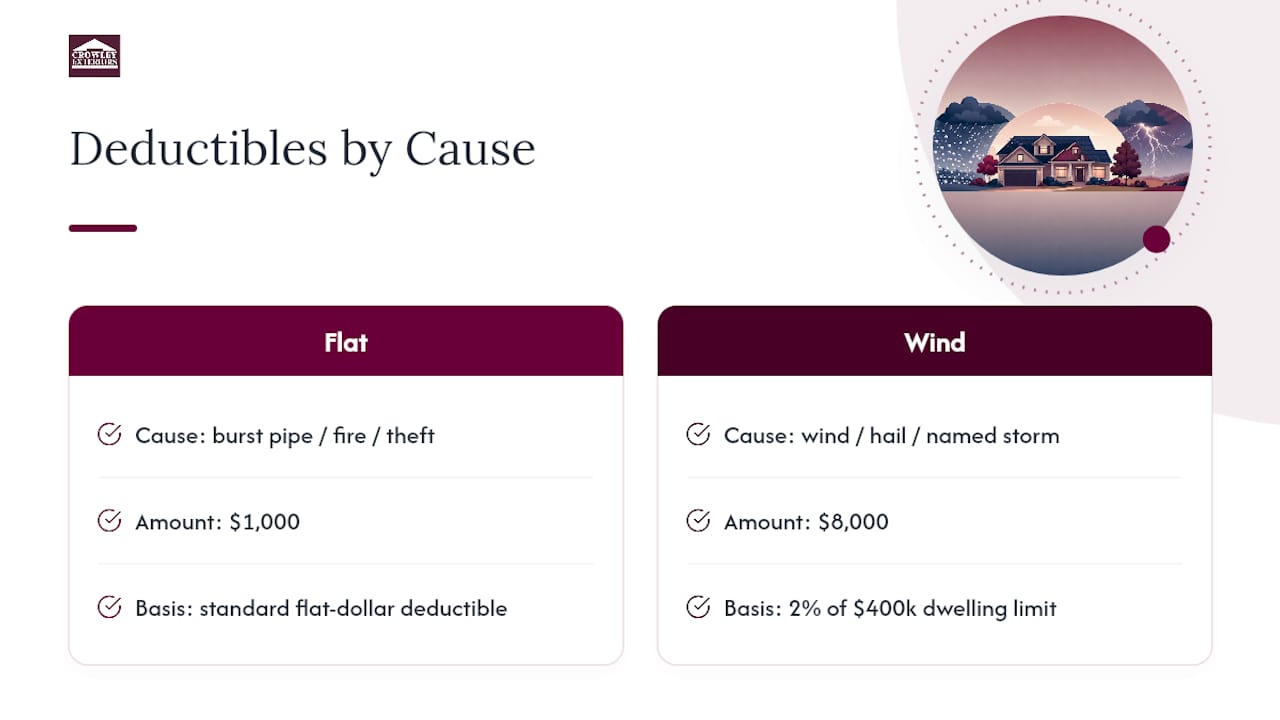
The practical effect: interior water damage from a leaking roof might fall under one deductible, while the roof damage that caused the leak falls under another, depending on how your insurer’s claims team classifies the loss origin. This is worth clarifying with your insurer before, not during, a claim dispute.
Crowley Exteriors’ Approach To Deductibles And Claims
Crowley Exteriors has worked with St. Charles County homeowners for more than 25 years, and every job follows the same lawful sequence: free inspection, written estimate, documented invoicing, then help submitting proof of payment to your insurer. We never propose waiving, rebating, or quietly absorbing your deductible into inflated pricing, because that practice can void your entire claim and expose you to fraud liability.
Every roof we replace carries a 25-year workmanship guarantee, backed by paperwork built to satisfy insurer documentation requests, not just to close a sale.
— Mario
Schedule A Free Roof Inspection With Crowley Exteriors
Crowley Exteriors gives you what a rushed storm-chaser quote never will: a free, no-obligation inspection with documentation built specifically to satisfy your insurer’s proof requirements, backed by a 25-year workmanship guarantee on the finished repair.

When you contact us, expect a straightforward process. We inspect the roof, walk you through exactly which deductible your policy likely applies, and hand you a written estimate you can compare against our roof estimate checklist line by line. If a claim makes sense, we help you organize the documentation your insurer will ask for, including proof of your deductible payment, without ever proposing a workaround that risks your coverage.
Ready to see where you stand? Schedule your free inspection with Crowley Exteriors and get a straight answer on your roof, your deductible, and your next step.
This article is general information, not a substitute for advice from a qualified financial advisor. Consult a qualified financial professional about your own circumstances before acting on anything here.
Sources
- Homeowners Insurance Deductibles: Flat vs. Percentage – LegalClarity
- How Homeowners Insurance Deductibles Work – State Farm®
- What is a Home Insurance Deductible? | GEICO