
Don’t sign anything, and don’t endorse any insurance check, until you’ve verified the contractor’s license and physical address. If someone knocks within days of a storm and pushes you to sign now, call your insurance company first and check the contractor’s license and Secretary of State filing before you say another word. The National Insurance Crime Bureau and your state contractor licensing board both keep records that take five minutes to check and can save you thousands.
TL;DR:
- Only verify the contractor’s license and local address with official state and business registration sites before signing any documents or making payments.
- Be cautious of storm chaser roofers who knock on doors within 72 hours of a storm, especially if they have out-of-state plates, quick LLC filings, or pressure you to sign on the spot.
- Avoid contractors offering to cover your insurance deductible or seeking large upfront deposits, as these are common signs of insurance fraud or substandard work.
- Disputing AOB agreements and stopping payments immediately, along with filing complaints and documenting everything, can help recover funds and prevent future scams.
- Choosing a local, established roofing company that provides detailed written estimates, permits, and permits ensures better control of your insurance claim and quality of work.
Table of Contents
- What Are Storm Chaser Roofers, Exactly?
- Red Flags That Signal a Storm Chaser
- What Storm Chasers Actually Cost You
- A Six-Step Vetting Checklist Before You Hire Anyone
- Already Signed Something? Here’s What to Do Now
- Crowley Exteriors: A Local, Verifiable Alternative
- An Editorial Perspective: Why Verification Beats Urgency
- How Crowley Exteriors Can Help After the Storm
- Sources
- FAQ
What Are Storm Chaser Roofers, Exactly?
A storm chaser roofer is an out-of-area crew that follows severe weather from region to region, canvassing neighborhoods block by block right after a hailstorm or high-wind event. State consumer-protection pages warn that these crews typically show up door-to-door within 24 to 72 hours after the storm passes, often before most homeowners have even called their insurance company.
The business model follows a predictable pattern:
- A quick LLC gets filed in the state, sometimes days before the crew arrives
- Temporary labor canvasses streets, knocking on doors and pointing out “damage” from the sidewalk
- Homeowners get pushed to sign an Assignment of Benefits (AOB) on the spot
- The crew does fast, often substandard work, then leaves the state once the insurance payout clears
The incentive is purely financial. Insurance payouts, especially the first actual cash value (ACV) check, represent real money that a transient crew can collect and disappear with long before anyone notices water stains under a new roof deck.
Red Flags That Signal a Storm Chaser
Some warning signs matter more than others. Treat the first three as automatic disqualifiers.
- A knock within 72 hours of the storm. Legitimate local roofers are usually swamped with existing customers right after a major storm and rarely have time to canvass strangers’ doors that fast.
- Out-of-state plates or magnetic door signs on the truck. A rotating magnetic sign is often a giveaway that the “company name” changes with the market.
- Pressure to sign today, especially an AOB. Any solicitor who needs your signature before you’ve even called your insurer is telling you something about how they operate.
- Offers to “cover your deductible.” This sounds like a discount. It’s actually insurance fraud in most states, and you can be held liable along with the contractor.
- No local address, or an LLC filed days ago. A five-minute Secretary of State search shows the filing date and registered address; if it was formed last week and lists a UPS mailbox, walk away.
- No verifiable license number. If they can’t give you one on the spot, or the number doesn’t match their name on your state licensing board’s site, that’s disqualifying.
- Cash-only payment or a large upfront deposit. Reputable contractors typically work on a payment schedule tied to milestones, not full payment before a shingle is touched.
- Refusal to pull permits or provide a line-item estimate. A vague one-page quote with no material breakdown is a document designed to hide problems later.
- A “lifetime” warranty with nothing in writing. Verbal warranties from a crew that will be three states away next month are worthless.
Pro Tip: Keep your phone recording (where legally allowed) or take notes during the pitch. If the company later disputes what was promised, your notes and their business card become evidence for a fraud complaint.
What Storm Chasers Actually Cost You
The damage from a bad storm chaser experience usually goes well beyond a leaky roof. Once you sign an AOB, you transfer legal control of your insurance claim to the contractor, meaning they now deal directly with your insurer and can collect payment without your approval on the final number.
A related and even more direct scam involves the ACV check itself. Some crews insist homeowners endorse that first insurance check over to them immediately, then finish the job poorly or not at all, leaving the homeowner with no funds and no recourse.
- Mechanic’s liens: unpaid material suppliers can file a lien against your property, even if you paid the contractor in full and they simply never paid their supplier.
- Fraud exposure: accepting a deductible waiver can expose the homeowner to insurance fraud charges, not just the contractor.
- Incomplete or defective work: with no local presence, there’s nobody to call back when shingles start lifting six months later.
Insurance-fraud watchdogs note that contractor-linked fraud adds billions of dollars to insurer payouts after major disaster events, a cost that eventually shows up in everyone’s premiums.
A Six-Step Vetting Checklist Before You Hire Anyone
Run through this before any contractor touches your roof, storm chaser or not.
- Verify the state contractor license. Look up the license number, classification, and status directly on your state licensing board’s website, not on the contractor’s business card; for detailed guidance, see our Home Inspection Virginia: Verify a licensed inspector first.
- Check the Secretary of State filing. A fast business registration search shows entity age and principal address. A brand-new LLC with a mail-drop address is a hard pass.
- Request a certificate of insurance. Call the insurer or broker listed on the COI directly to confirm active general liability and workers’ compensation coverage.
- Confirm manufacturer certification. GAF, Owens Corning, and CertainTeed all maintain searchable certified-installer directories, and asking for recent local references adds another layer of confirmation.
- Require a written, line-item estimate and permit plan. Refuse to sign anything resembling an AOB or a check-endorsement authorization.
- For emergency protection, authorize documented tarping only. A verified local contractor can secure your roof temporarily while you finish vetting the full repair.
Some quick supplemental checks worth five extra minutes:
- Search the company name plus “complaints” and check its Better Business Bureau profile and rating history.
- Cross-reference the physical address on Google Maps. If it’s a residential house or an empty lot, that’s your answer.
- Ask how the estimate breaks down materials versus labor; a line-item checklist makes comparing bids far easier.
Already Signed Something? Here’s What to Do Now
If you’ve signed an AOB or handed over a check, move fast and in this order.
- Call your insurer’s fraud unit and your adjuster immediately. Explain what was signed and ask about stop-payment options on any uncashed check.
- Send a written revocation of the AOB by certified mail. Many states allow a cooling-off period for door-to-door sales, sometimes as short as three business days, so check your state’s rules right away.
- File complaints with NICB, your state attorney general, your state contractor licensing board, and the BBB. Reporting doesn’t just help your case; it builds the pattern record investigators use to stop repeat offenders in the next storm cycle.
- Photograph everything and keep every document. Contracts, business cards, truck photos, and texts all matter if this becomes a legal dispute.
- Consult an attorney if a lien has been filed or funds are missing. An attorney can help with lien defense and claim recovery options specific to your state.
A homeowner’s guide to filing a roof insurance claim walks through how the claims process should work when nothing has gone wrong yet, which is worth reading even after the fact to understand what your adjuster should be doing.
Crowley Exteriors: A Local, Verifiable Alternative
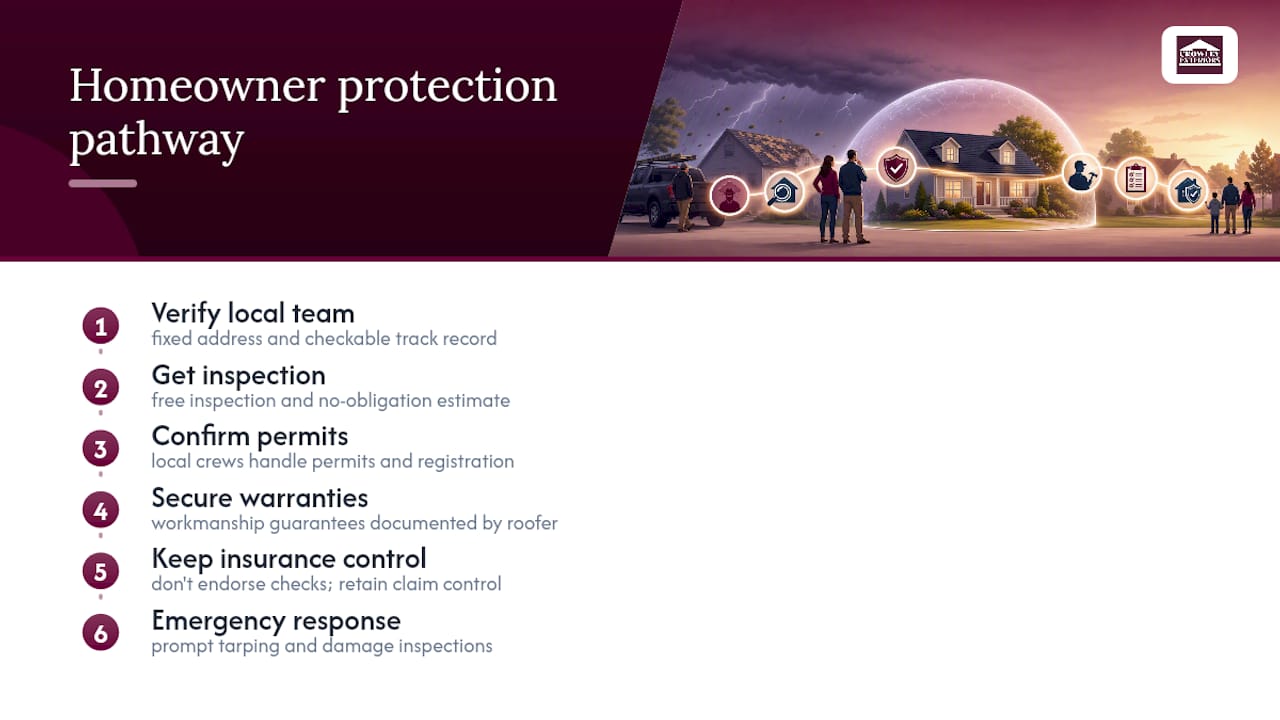
A family-owned roofing, siding, and gutter company operating locally for many years with a fixed address and a checkable track record can offer assurance to homeowners. Jobs often start with a free inspection and an estimate without obligation, and workmanship guarantees may apply. Local crews typically handle permits and warranty registration, allowing homeowners to maintain control of their insurance claims without needing to endorse checks prematurely. Verified local teams can often provide emergency tarping or damage inspections promptly, without requiring premature claims assignment.
An Editorial Perspective: Why Verification Beats Urgency
Every storm chaser pitch relies on urgency beating your judgment. Practice saying it out loud: “I don’t sign anything the same day, and I’m calling my insurer first.” That single sentence ends most bad pitches on the spot. Documentation and a phone call to your insurer will always outrank whatever deadline a stranger in your driveway invents. Run the vetting checklist even when you’re exhausted and your roof is leaking. That’s exactly when it matters most.
— Mario
How Crowley Exteriors Can Help After the Storm
Homeowners looking for a verifiable, local alternative can consider established companies that offer free inspections and no-obligation estimates, ensuring a documented, detailed assessment rather than a rushed sales pitch.
Services often include roof inspections, emergency tarping, and insurance-claim support designed to help homeowners maintain control of their insurance process. Before you call, have your policy number, the storm date, and any photos of visible damage ready. That speeds up both the inspection and the claim conversation. Reach out through Crowleyexteriors’ contact page to schedule an inspection, or review the roof replacement timeline to know what to expect once repairs begin.
This article is general information, not a substitute for advice from a qualified financial advisor. Consult a qualified financial professional about your own circumstances before acting on anything here.
Sources
- North Carolina Department of Justice — roofers and consumer protection
- NICB — roofing fraud requires vigilance
- Florida Office of Insurance Regulation — Assignment of Benefits overview
FAQ
What are the red flags of storm chaser contractors?
The biggest ones are a door-knock within 72 hours of a storm, out-of-state plates, pressure to sign an Assignment of Benefits, offers to cover your deductible, and no verifiable license or local address.
What is the average pay of a storm chaser?
Pay structures vary widely by crew and region, and no reliable public data tracks average storm-chaser earnings specifically. Commission-based pay tied to closed jobs is common, which is part of why crews push for fast signatures.
Where do roofers make the most money?
Roofing income tends to track storm frequency and local labor costs more than any single region, since demand spikes hardest in states that see frequent hail and wind events. There’s no verified national ranking of highest-paying roofing markets.
What is the 25% rule for roofing?
Definitions of this vary by insurer and building code jurisdiction, so check your specific policy and local code. In general, it refers to a threshold some insurers and codes use to determine whether a roof needs full replacement versus a partial repair, based on the percentage of damaged roof area.
Should I let a contractor endorse my insurance check?
No. Deposit the initial ACV check into your own account and pay the contractor on documented milestones, keeping final control of the claim until the work is verified complete.
Recommended
- Storm Damage Roof: What To Do In The First 72 Hours
- What To Do About Hail Damage To Your Roof Right Now
- Roof Leak Emergency: What Homeowners Must Do Now
- What Should Be On Your Roof Estimate Checklist?
This article was prepared with AI assistance for general information. For recommendations specific to your property, contact Crowley Exteriors. Call or text us at 314-839-3800.