

If a tree limb has landed on your roof, stay off the roof, check that everyone is safe, and keep clear of anything touching a power line. Then photograph the damage from the ground, cover any openings, call your insurer, and have a roofer and a tree service handle the rest. A limb that looks harmless can hide cracked decking, torn shingles and a slow leak that shows up weeks later.
This guide walks through those steps in order, explains how to tell cosmetic damage from the kind that needs a repair or a replacement, and covers who pays when the tree belongs to a neighbor. It also covers how to keep it from happening again.
TL;DR
- Safety first: stay off the roof, and treat any limb touching a wire as live. Call the utility, not a tree crew.
- Photograph and video everything from the ground before anything is moved, then call your insurer promptly and keep every receipt.
- Cover openings with a temporary tarp, but leave permanent repairs until you have talked with your insurer.
- Limbs and trees under tension are unpredictable. Hire an insured tree professional for removal and a roofer for the inspection.
- Trim branches back from the roofline before storm season so the next limb never reaches the shingles.
Table of Contents
- First steps when a limb lands on the roof
- Why you should not climb up and pull it off yourself
- How to tell how bad the damage is
- Covering the roof temporarily
- Insurance: what is usually covered and what to expect
- Whose problem is it when the tree is your neighbor’s?
- Who removes the limb, and in what order
- Repair or replace?
- Perspective: why we look at the roof, not just the limb
- Preventing the next limb from landing there
- Promo: a free look at what the limb did
- FAQ
- Sources
First steps when a limb lands on the roof
The order matters more than speed. Most injuries and most denied claims come from doing the right things in the wrong sequence.
- Check on people and pets. Move everyone out of any room directly under the impact if you see sagging ceilings, cracks or daylight.
- Look for hazards before you look at the roof. Leave the house if you smell gas or see downed wires, and call 911 or the utility. The NAIC post-disaster claims guide lists protecting people first and contacting emergency services or the utility as the starting point.
- Do not touch a limb that is on or near a power line. Rocky Mountain Power’s safety guidance says to never remove a branch tangled with or lying across a power line and to call the utility instead.
- Survey from a safe spot. Consumer Reports advises looking at the roofline, windows, siding and walls, and for water damage, while staying off the roof.
- Document before you move anything. Take wide shots, close-ups and a slow video walk-around. Include the tree, the limb, the point of contact and any interior water stains.
- Call your insurer. Do this promptly, and keep a log of who you spoke to and when.
If the storm that dropped the limb was strong, other damage is likely. Our first 72 hours checklist for a storm-damaged roof covers the full sequence, and our wind damage photo checklist shows what claim reviewers like to see in the pictures.
Why you should not climb up and pull it off yourself
It is tempting. The limb is right there, and you have a ladder. But the risk is not the limb you can see.
UConn Extension warns that storm-damaged trees and limbs that are leaning, hanging or on the ground can spring, snap and shift unpredictably, and recommends a licensed arborist rather than attempting hazardous cleanup. A limb resting on a roof is often bearing weight at two or three points. Cut one and the rest can move.
UF/IFAS says homeowners should not attempt tree felling, climbing or rope work and should not run a chainsaw without experience. Add a pitched, possibly wet roof and a compromised deck underneath, and the footing is worse than it looks.
UMass Extension offers a simple rule of thumb for ladders and pruning: if the job requires you to lift your second foot off the ground, call a certified arborist. Amica’s homeowner guidance also says to avoid hauling large limbs yourself.
A small, light twig on the ground is one thing. Anything you cannot reach with your feet planted on the ground belongs to a professional.
How to tell how bad the damage is
You are looking for three categories of damage, from a distance.
| What you see from the ground | What it may mean | Next step |
|---|---|---|
| Scattered leaves and small twigs, no visible marks | Usually cosmetic, but shingle granules can be scuffed | Schedule a roof inspection after the next dry day |
| Torn, lifted or missing shingles, scraped areas, bent flashing or gutter | Water can now reach the underlayment | Temporary cover, photos, insurer call, roof repair estimate |
| A limb embedded in the roof, sagging ridge or roofline, cracked windows or siding, ceiling stains | Structural damage is possible | Stay out of rooms below, call the insurer and a roofer at once |
Consumer Reports lists shifts in the roofline, damage to windows, siding and walls, and water damage as the things to check, and says extensive damage is a reason to contact your insurance agent for a preferred contractor.
Inside, check the attic with a flashlight if you can reach it safely from the access hatch. Look for daylight, damp insulation, dark stains on the underside of the decking, and drips. Then check ceilings below for brown rings. If you find any, our roof leak emergency guide explains how to contain water and what to record.
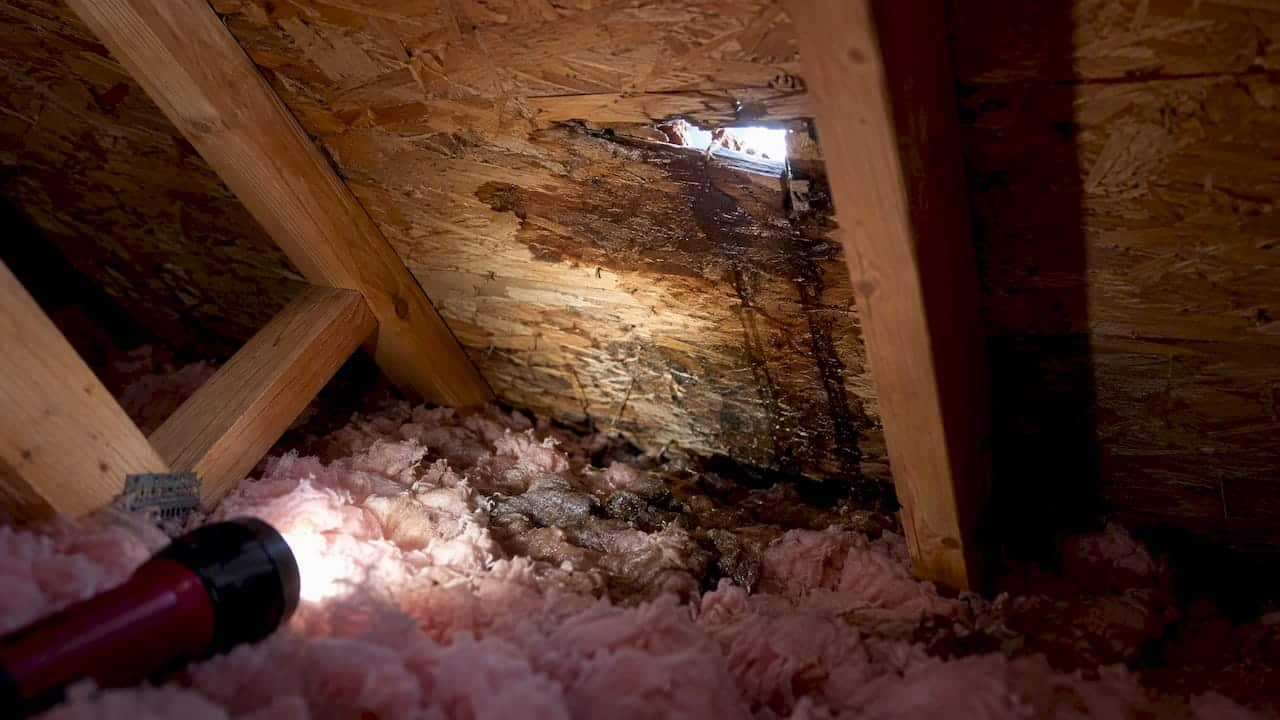
A roofer should still look at the roof even when nothing seems wrong. Impact damage can crack a shingle mat without tearing it, and the leak that follows may take a couple of rainstorms to appear. That is also why a first-time buyer inspecting a house with overhanging trees should look for patched areas, scuffed shingles under the branches and stained ceilings below them.
Covering the roof temporarily
If the limb has opened the roof, or shingles are missing and rain is coming, temporary protection is reasonable and expected. Most insurers expect you to prevent further damage and many cover reasonable materials and labor for temporary repairs, but photograph the damage first and talk with your insurer before making permanent repairs.
A few practical points:
- Keep the tarp job to what stops water. It is not the time to replace a section of roof.
- Do not nail a tarp over an unstable section from a ladder. Tarping is work for a crew with fall protection. Our emergency roof tarping guide explains what a safe job looks like and what to ask before someone climbs up.
- Save every receipt, including the tarp, the labor and any hotel night if a room is unusable.
The NAIC makes the same point: prevent further damage with essential repairs, keep receipts, and discuss permanent repairs with the insurer first.
Insurance: what is usually covered and what to expect
Coverage depends on your policy, so read yours, or ask your agent which perils and limits apply. Understanding what triggers storm coverage in general is worth a few minutes, and this explanation of how storm insurance coverage thresholds work shows why wording and definitions matter.
Here is what official guidance says in the US:
- Many homeowners policies pay for damage from falling objects such as trees, and tree removal coverage commonly applies when a storm-damaged tree damages the house or blocks a driveway. Trees that fall only in the yard are usually not covered.
- FEMA notes that many policies cover removal when a tree damages the home or blocks access, and that FEMA does not directly remove trees from private property.
- After your claim, an adjuster will inspect and estimate the damage. The NAIC says you should prepare photographs, notes and receipts and should not assume the insurer will pay for permanent work it did not authorize.
Policies differ, so check your own policy wording and ask your agent. Your deductible also matters. For a small repair, the cost may sit near or below it, and your agent can help you decide whether a claim makes sense.
Getting estimates after the adjuster visits
Amica recommends licensed, bonded and insured companies, multiple quotes, and keeping estimates and receipts. After a storm, out-of-town crews arrive fast and some are not what they seem, so read our guide to storm roofing scams before you sign anything or hand over a deposit.
We help homeowners through this process with free inspections, itemized estimates and insurance claim support, and we can meet your adjuster at the house if you want us there.
Whose problem is it when the tree is your neighbor’s?
This is the question that stalls many homeowners. In general terms, if a healthy tree or limb falls in a storm, the damage is treated as an act of nature, and the insurance on the damaged home usually responds regardless of whose yard the tree stood in. Insurance.com explains that a neighbor’s tree falling on your house is normally paid by your own policy, with the exception of negligence: if a neighbor knew a tree was dead or diseased and did nothing, they may be held liable.
What that means in practice:
- File with your own insurer first. It can pursue the neighbor’s insurer if negligence applies.
- If you have already warned a neighbor about a dying tree, put it in writing, with photos and the date. That record matters if a limb falls later.
- Do not cut or throw limbs back into their yard without talking to them. Property lines and local ordinances vary, and your insurer will want the evidence left alone until it has been documented.
For disputes, a local attorney can advise on Missouri law. We are roofers, not lawyers, so we stick to the roof.
Who removes the limb, and in what order
Amica notes that after a claim you may need roofers, general contractors, certified arborists and debris-removal specialists. The sequence we see work best:
- Utility first if any wire is involved.
- Photos and insurer call before anything moves.
- Tree professional removes the limb. Choose one with liability and workers’ compensation insurance. UMass Extension stresses training, safety procedures, equipment and insurance as what to look for.
- Roofer inspects the exposed deck, repairs or replaces what is damaged and ties flashing back in.
- Adjuster review of the final scope, with your roofer’s itemized estimate in hand.
It can help to have the roofer present when the limb comes off. The deck underneath sometimes looks different once the weight is gone, and we can photograph exactly what was hiding.
Repair or replace?
A single limb usually means a localized repair: new shingles, maybe a section of decking, flashing and a sealed penetration. The picture changes when the roof is already old, when impact cracked the mat across a wide area, or when several repairs have already been made. Our repair-or-replace guide lays out the thresholds we use, and our roof replacement process page explains what the work looks like if it comes to that.
Gutters get hit as well. A limb can bend a run, pull brackets loose or crush a corner. Seamless gutters can be repaired or replaced, and a loose run sends water behind the fascia, so look at them while you are surveying.
Perspective: why we look at the roof, not just the limb
Most calls we get after a limb falls start with “it looks fine.” Sometimes it is. Often, once we are on the roof with the right gear, we find a cracked shingle, a lifted flashing edge or a soft spot in the deck that no one could see from the ground.
We have been working on St. Charles County roofs for more than 20 years, through hail, straight-line winds and freeze-thaw cycles. That history shapes how we inspect: we look at the impact point, the slope around it, the flashing, the gutters and the attic side of the deck. We also write an itemized estimate, so you and your adjuster can see what each line costs.
Our inspections and estimates are free and come with no obligation. If your roof needs work, we back our roofing with a workmanship warranty (10 years on full roof replacements, 1 year on most repairs). If you only need a sound roof confirmed, you will have a written record that you can keep with your home documents, which also helps when you sell.
Mario
Preventing the next limb from landing there
Prevention is cheaper than any claim. Consumer Reports recommends that before storm season you remove dead branches, trim limbs overhanging the roof, and thin canopies of wind-vulnerable trees, and have an arborist evaluate hazardous trees. It also suggests considering a tree’s mature size before planting near the house.
The New York State Department of Environmental Conservation recommends checking trees annually or after severe storms and treats dead, broken or loose branches as hazards. If the work is above ground reach, involves complete removal or is near power lines, it says to contact the utility or a professional tree-care company.
Some habits that pay off:
- Walk the yard each fall and spring and look up. Dead limbs often have no leaves in summer.
- Keep limbs trimmed back from the roofline. Limbs that rub shingles in the wind wear them down, and leaves that pile up in valleys and gutters hold moisture.
- Keep gutters clear. Our gutter overflow diagnosis guide shows how debris from overhanging trees backs up water.
- Book an arborist for any tree that is leaning, cracked, hollow or dropping large dead wood.
Promo: a free look at what the limb did
If a limb has hit your roof, or you are not sure it did, we will inspect the roof, gutters, siding and windows, photograph what we find and give you an itemized written estimate at no cost. We handle repairs, full replacements and insurance claim support across St. Charles County.
See our roof repair, inspection and storm damage services or reach us through Crowley Exteriors to schedule.
If the inspection shows your roof is past repair, here is how our roof replacement process works in St. Charles County.
FAQ
What do you do when a tree falls on your roof?
Make sure everyone is safe and stay away from downed wires or gas smells, calling 911 or the utility if needed. Photograph the damage from the ground, cover openings with a temporary tarp, call your insurer and keep every receipt. Then have a tree professional remove the tree and a roofer inspect the roof.
Will insurance pay for a tree limb on my roof?
Many homeowners policies cover damage from falling objects such as trees, but coverage depends on your policy, your deductible and the cause. Tree removal is commonly covered when a tree damages the house or blocks access, and usually not when it falls only in the yard. Ask your insurer exactly what applies to you.
Can I remove a branch from my roof myself?
We advise against it. Limbs on a roof can be under tension and shift when cut, and a ladder, a saw and a pitched surface are a bad combination. A small limb you can lift from the ground is different, but anything that requires climbing is a job for an insured professional.
How far should branches be from my roof?
One roofing resource suggests keeping branches 6 to 10 feet away from the roof to reduce physical damage and shade, but the right distance depends on the species and how it sways. Ask an arborist about your trees. Anything near a power line should be left to the utility.
Sources
- Post-Disaster Claims Guide, NAIC
- FEMA: I need a tree removed from my property
- Consumer Reports: How to Keep Your Home Safe
- Amica: What to Do if a Tree Falls on Your House
- UConn Extension: Dealing with Wind and Storm Damaged Trees
- UMass Extension: Pruning and Ladder Safety
- NYSDEC: Managing Risk in Urban Trees
- Rocky Mountain Power: Safety tips for your home this fall season
- Insurance.com: Whose homeowners insurance covers damage from a fallen tree?
Recommended
- Emergency Roof Tarping: A Safety-First Guide For Homeowners
- Homeowners: 24–72 Hour Wind Damage Roof Photo Checklist For Claims
- Roof Leak Emergency: What Homeowners Must Do Now
- Storm Damage Roof: What To Do In The First 72 Hours
This article was prepared with AI assistance for general information. For recommendations specific to your property, contact Crowley Exteriors. Call or text us at 314-839-3800.