

Buckling vinyl siding is almost always a movement problem. Vinyl expands and contracts with temperature, and when something stops it from sliding (nails driven too tight, panels cut too long, a heat source, or a wall that is uneven or wet behind the panel), the panel has nowhere to go but out. Whether the fix is a few minutes of loosening nails or a repair behind the wall depends on which of those causes you have. This guide shows how to tell them apart.
TL;DR
- Vinyl moves with the weather. Buckling happens when nails, trim or a structural problem restrict that movement.
- The most common culprits are tight fastening, panels cut too snug, reflected sunlight from windows, and heat from grills and fire pits.
- A wave that follows one panel is often a fastening fix. Waves across a whole wall, soft spots or stains point to moisture or a wall problem.
- Moisture behind siding, warped sheathing and uneven framing need a contractor to open the wall and find the cause.
- We offer free inspections and no-obligation estimates in St. Charles County, so you can find out which kind of problem you have.
Table of Contents
- Why vinyl siding buckles, waves or warps
- Is a little waviness normal?
- Cause 1: Nails driven too tight
- Cause 2: Panels cut too long or jammed into trim
- Cause 3: Heat from reflections, grills and fire pits
- Cause 4: Moisture behind the siding
- Cause 5: Uneven walls, warped sheathing and settlement
- How buckled siding gets fixed
- When to call a siding professional
- How to prevent siding from buckling again
- Get a free look at your siding
- FAQ
- Sources
Why vinyl siding buckles, waves or warps
Vinyl siding is designed to hang loosely, like a floating skin, not to be fixed rigidly to the wall. A Family Handyman article quotes a construction specialist describing it as a floating system, which is the key to everything that follows. Each panel has slotted nail holes so it can slide side to side as it heats up and cools down.
The scale of that movement is bigger than most homeowners expect. According to the American Society of Home Inspectors, PVC has a high coefficient of thermal expansion, and a 12-foot length of vinyl siding expands and contracts by half an inch or more. A manufacturer’s installation guide puts expansion and contraction at as much as 3/8 of an inch and says this must be allowed for in advance to prevent buckling.
If that movement is blocked anywhere along the panel, the stress goes somewhere. It shows up as a ripple, a bulge, a wave that grows in summer, or a panel that bows out from the wall. The ASHI article notes that poor installation can result in buckling, especially in hot weather, and that is why many homeowners first notice the problem on a July afternoon.
There are five main causes:
- Fasteners driven too tight or in the wrong place.
- Panels cut too long, or without room at trim and channels.
- Heat from reflected sunlight or from grills and fire pits.
- Moisture behind the siding.
- Wall problems: warped sheathing, uneven framing, or settlement.
We will take them in turn.
Is a little waviness normal?
Vinyl is a flexible material, and a long, thin panel will never look like a sheet of glass. Some very slight unevenness is part of the product, especially on walls with minor bows in the framing. Dark colors show it more, because light and shadow exaggerate every ripple, and this effect is often called oil canning.
The line between acceptable and a real problem is practical:
- Normal: Soft, shallow ripples that look the same year after year and do not change much with temperature.
- Worth attention: Waves that get worse in hot weather, panels that visibly bow away from the wall, gaps opening at the seams, or a panel that will not slide when you press it sideways.
- Act now: A bulge with a soft, damp or stained wall behind it, melted or distorted patches, or waviness across several walls.
If the siding is only a few years old, a significant wave is not something to accept as normal. Waviness that appears soon after installation usually traces back to how the panels were hung, and that can be corrected.
Cause 1: Nails driven too tight
This is the most common installation error. A siding nail is supposed to hold the panel from falling off the wall while letting it slide. The CertainTeed installation instructions for its vinyl soffit say to always leave about 1/16 inch between the nail head and the nail hem so the panel can move as it expands and contracts. The same principle applies to vinyl siding panels.
The InterNACHI vinyl siding inspection guide adds two more details. Fasteners should be straight, level and centered in the nailing slot, because crooked fasteners can distort and buckle panels. And face-nailing, where a nail goes through the visible surface of the panel instead of the slot, restricts horizontal movement.
Signs of a fastening problem:
- The wave is centered on one or two panels rather than the whole wall.
- The panel does not slide sideways when you push it gently.
- Nail heads sit flush against the vinyl or you can see nails in the face of the panel.
- The ripple worsens on hot days and eases on cool mornings.
Cause 2: Panels cut too long or jammed into trim
The ends of a panel need room too. The CertainTeed instructions call for about 1/4 inch of clearance at receiving channels when the temperature is above 40°F, and 3/8 inch when it is below 40°F. Cold-weather installation needs a larger gap because the panel is at its shortest and will grow the most once warm weather arrives.
When a crew cuts panels to fit tight against J-channel or corner posts, that gap disappears. In winter, the panel is fine. In July, it pushes against the trim with nowhere to go and buckles outward. If you see waves that sit near the ends of panels, or gaps that have closed up completely at corners and window trim, this is the likely cause.
A crew working in cold weather can also install panels at their contracted length without allowing for the summer growth. That is one reason experienced local installers think in terms of the whole year, not the day of installation. Missouri swings from sub-freezing winter days to hot, humid summers, so the range the siding must handle is wide.
Cause 3: Heat from reflections, grills and fire pits
Heat damage looks different from installation buckling. It tends to appear in a localized patch, often with a melted, glossy or sagging look.
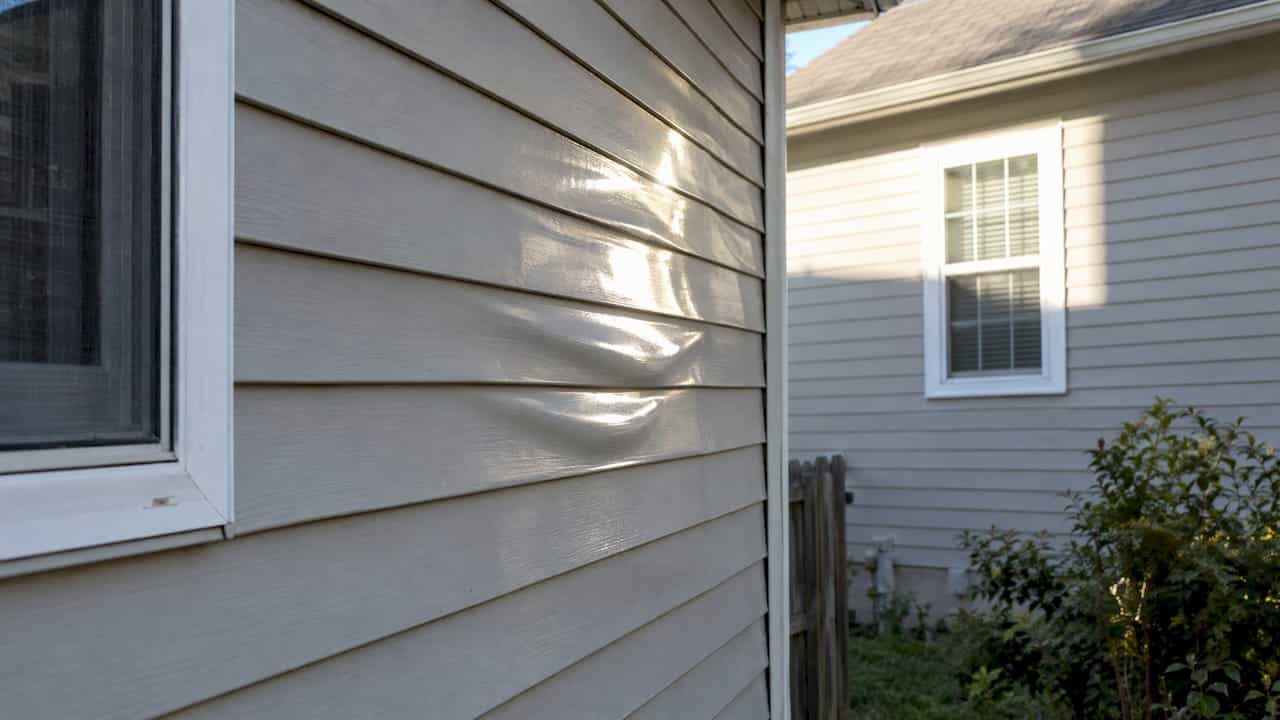
The ASHI article explains that vinyl siding typically begins to soften at roughly 160°F, and that reflected sunlight can push vinyl surface temperatures well above 200°F. It describes reflected sunlight from windows in adjacent buildings as a cause of significant vinyl siding failures. Problems most often occur when buildings are less than 30 feet apart, though damage has been documented at up to 100 feet.
The same article describes a mechanism worth knowing about: the outer pane of a double- or triple-glazed window can deflect inward because of barometric pressure differences, creating a slightly concave surface that acts like a magnifying mirror and concentrates sunlight onto the siding. Low-e glass may make this worse because it increases the amount of reflected ultraviolet light. A construction specialist quoted by Family Handyman says he has seen barbecue grills, fire pits and sunlight reflecting off Low-E windows turn siding into a melted mess.
You can spot heat distortion by its pattern:
- It sits at a consistent height, in line with a window, a grill or a patio fire pit.
- The affected patch moves across the wall over the course of the season as the sun angle changes.
- It tends to be one small area, not a full wall.
Heat damage also matters for warranties. A manufacturer’s standard warranty document from 2019 excludes deformation caused by high heat sources, including grills, fire pits and reflections from foil sheathing and low-e glass, along with improper installation and wall defects such as movement, cracking or settling. Read your own product warranty, since terms vary by manufacturer and year.
The fixes are practical. Move the grill or fire pit well away from the wall. For reflections, window films, exterior screens or landscaping can break up the beam. Then replace the distorted panels, because once vinyl has softened and deformed it does not return to shape.
Cause 4: Moisture behind the siding
Siding is a rain screen, not a waterproof seal. Water that gets behind it can pool, soak the sheathing and make panels bulge. Another specialist quoted in the Family Handyman piece explains that moisture can get in if house wrap is not sealed well or ventilation is poor, and that clogged gutters, damaged flashing and leaky pipes are other ways water finds its way behind the panels. Hail damage can also cause bubbling, according to the contractor quoted there.
Moisture problems look different from fastening problems:
- Waves that appear after heavy rain or in humid spells.
- Stains, mildew, or streaks below a seam or window.
- Soft or spongy wall when you press near the bulge.
- Peeling paint or swelling on interior walls below the area.
- Insect activity. The same article notes termites and other insects can chew through the sheathing beneath siding, leading to warping or bubbling.
If any of these show up, loosening nails will not solve it. The water source needs to be found first. Our guide to water behind siding covers the warning signs and what to do, and the house wrap checks explain why the layer under the panels matters. If gutters overflow onto the wall, that is worth fixing at the same time; see gutter overflow causes.
If hail or a windstorm came through recently, photograph the siding before anything is repaired. Our page on siding hail damage explains the 72-hour window we recommend for protecting an insurance claim.
Cause 5: Uneven walls, warped sheathing and settlement
Sometimes the siding is fine and the wall is not. Vinyl follows whatever is underneath it. A technical bulletin from a siding supplier notes that warped sheathing or uneven wall framing can cause visible waves in vinyl siding, and that the repair means checking and correcting any structural deflection.
Building settlement is another possible cause. The ASHI article says settlement can make siding buckle, tear or come loose, though it describes this as rare compared with thermal movement. Look for other signs: cracks in drywall or brick, doors and windows that stick, or gaps between the siding and trim that keep widening.
An important clue is that wall-related waves usually stay in the same place regardless of the weather, and they often run in a vertical line along a stud or a horizontal line along a sheathing joint. A pattern like that tells a contractor to look behind the siding.
How buckled siding gets fixed
The repair matches the cause. The usual progression runs from simple to involved:
| What is wrong | Typical repair |
|---|---|
| Nails too tight or in the wrong spot | Release the panel, back the fasteners off so the panel slides, and re-hang |
| Panel too long or jammed in trim | Re-cut or replace the panel to leave proper expansion gaps |
| Panel not locked to the course below | Remove and re-hang it correctly so it is clipped in |
| Heat or reflection damage | Replace distorted panels and remove or redirect the heat source |
| Moisture behind the wall | Find and stop the water, dry or replace damaged sheathing and wrap, then reinstall siding |
| Warped sheathing or uneven framing | Correct the wall surface, then reinstall siding |
For the simplest case, the process is to unlock the panel above the bulge with a zip tool, ease the nails so the heads stand a hair away from the vinyl, confirm there is end clearance, and snap the panel back into place. Lowe’s guidance on installation gives the same targets of about 1/4 inch at accessories and about 1/16 inch under the nail head. Hold the work for a mild day, since vinyl is more brittle in the cold and more flexible when warm.
A quick test tells you how deep the problem goes. Check whether the panel slides horizontally by hand. If it does not slide, it is probably nailed too tightly or cut too long against vertical trim or J-channel. If it slides freely and is still wavy, the cause is probably behind it.
If a panel was never clipped properly to the course below, it can also come loose in wind. InspectAPedia recommends removing and re-hanging it correctly.
Another point on repair: vinyl that has actually softened, melted or creased will not flatten again. Those panels are replaced, not adjusted. Matching an older color can be tricky because vinyl fades over the years, which is a good reason to inspect the whole wall and decide whether replacing a section or a full elevation makes more sense.
When to call a siding professional
Loosening nails on one panel is simple in theory, but on a two-story wall it means ladder work, and a hidden problem is easy to miss. Bring in a professional when:
- The bulge remains after the panel moves freely.
- The wall behind is wet, soft, stained or smells musty.
- The waviness spreads across more than one wall.
- You see melted or distorted vinyl.
- The siding is newer and the problem appeared soon after installation.
- A storm recently hit the house and you may have a claim.
On a first visit, a good contractor will test panel movement, look at nail placement and end gaps, check trim and corners, probe for soft sheathing, and look at where water from the roof and gutters is going. Then they should explain the cause plainly and put the repair in writing. If you are weighing a bigger project, our guide to comparing 2 to 3 local siding bids explains what an itemized estimate should include. If you are replacing siding anyway, it can be worth reading about insulated vinyl siding, which adds a backing to the panel. Remember that standard vinyl siding is cladding, not insulation, according to InterNACHI.
How to prevent siding from buckling again
- Hire for installation quality. Ask how fasteners are set and how expansion gaps are handled, and whether the crew works differently in cold weather.
- Keep heat away. Position grills and fire pits well out from the wall and consider what a neighbor’s windows may reflect onto the house.
- Choose color with care. Dark colors absorb more heat and show waves more, so check manufacturer guidance and warranty terms before choosing deep tones, and before repainting vinyl a darker color.
- Keep water moving away. Clean gutters, sound flashing and downspouts that discharge away from the wall protect the sheathing behind the siding.
- Look at the wall each season. A walk around the house in spring and fall catches a loose panel or a new wave before it spreads.
Our perspective
In our experience around St. Charles County, a buckled panel is a symptom, and the question that matters is what is holding it. Missouri weather swings hard from season to season, so siding that was hung a little too tight in a cool spring will complain the first July heat wave.
That is why we start with the cause and not with the quickest cover-up. We look at nailing, trim gaps, the wall behind the panel, the gutters above it and the roof lines that send water down the wall. Sometimes the answer is a simple re-hang. Sometimes it is replacing a section, or the wall layers behind it, so the new siding sits flat for years.
As a family-owned company with more than 20 years of experience, we would rather explain what we find and give you an itemized, no-obligation estimate than guess. You decide what makes sense for your house.
Mario
Get a free look at your siding
If your siding is waving, bulging or bowing and you are not sure why, we can look at it with you. We install and repair siding for homeowners and property managers across St. Charles County, and our inspections and estimates are free and come with no obligation. We can also help with storm damage and insurance claim support if weather played a part. See our siding installation and replacement services, or contact us through our site to arrange a visit.
If you are buying or selling a home and the siding looks wavy, we also provide real estate reports, so you know what the exterior needs before you sign.
FAQ
Why is my vinyl siding buckling?
Usually because something restricts the panel’s movement. Tight nails, panels cut too long, heat from reflections or grills, moisture behind the wall, or an uneven wall surface are the main causes. Where the wave sits and how it changes with the weather points you toward the cause.
Can warped vinyl siding be repaired?
Often yes. If the panel is only restricted, it can be released, re-nailed with proper play and re-hung. If the vinyl has melted or creased, the panel needs replacing. When the wall behind is damaged, that gets corrected before new siding goes on.
Is a little waviness in vinyl siding normal?
Slight, stable ripples are common because vinyl is flexible, and dark colors make them easier to see. Waves that grow in hot weather, bow away from the wall or come with stains and soft spots are not something to ignore.
Does heat from a grill or a neighbor’s windows really damage siding?
Yes. According to ASHI, vinyl starts to soften at about 160°F, and reflected sunlight or direct heat can exceed that. Distortion usually appears in a localized patch at the height of the heat source.
Is buckled siding covered by warranty?
It depends on the product and the cause. Some manufacturer warranties exclude damage from heat sources such as grills and reflections, and from improper installation. Check your warranty and any installer workmanship guarantee.
Sources
- Vinyl Siding: Facts and Foibles, American Society of Home Inspectors
- Why Is My Vinyl Siding Bubbling? Family Handyman
- Vinyl siding installation guide
- CertainTeed installation instructions via BuildSite
- Vinyl Siding Inspection, InterNACHI
- TechTopic: Wavy Siding
- How to Install Vinyl Siding, Lowe’s
Recommended
- Replacing Siding? Is Insulated Vinyl Siding Worth $1–$3.50/ft²?
- Water Behind Siding: Causes, Warning Signs And What To Do
- Yes, You Need House Wrap Under Siding: 6 Checks For Homeowners
- Inspect Siding Hail Damage Within 72 Hours To Protect Your Claim
This article was prepared with AI assistance for general information. For recommendations specific to your property, contact Crowley Exteriors. Call or text us at 314-839-3800.