

Roofing rules in Missouri are set by whatever city or county has jurisdiction over your parcel, not by a single statewide code. Before signing any contract, confirm which local building department covers your address, then ask about permit triggers like a roof slope under 4:12, a change in roofing system, or multiple existing layers. Most Missouri jurisdictions permit reroofing under locally adopted versions of the International Residential Code, but the specific thresholds and paperwork depend entirely on your local authority having jurisdiction.
TL;DR:
- Most Missouri jurisdictions require permits for low-slope roofs, system changes, structural deck repairs, or layering beyond local limits, with thresholds varying by city or county.
- Local amendments to the IRC govern many roofing details, including fire ratings, flashing, wind resistance, and weatherproofing, making inspection standards different across jurisdictions.
- Identifying your parcel’s jurisdiction and confirming permit triggers before starting work can prevent delays, fines, or insurance issues caused by unpermitted roofing projects.
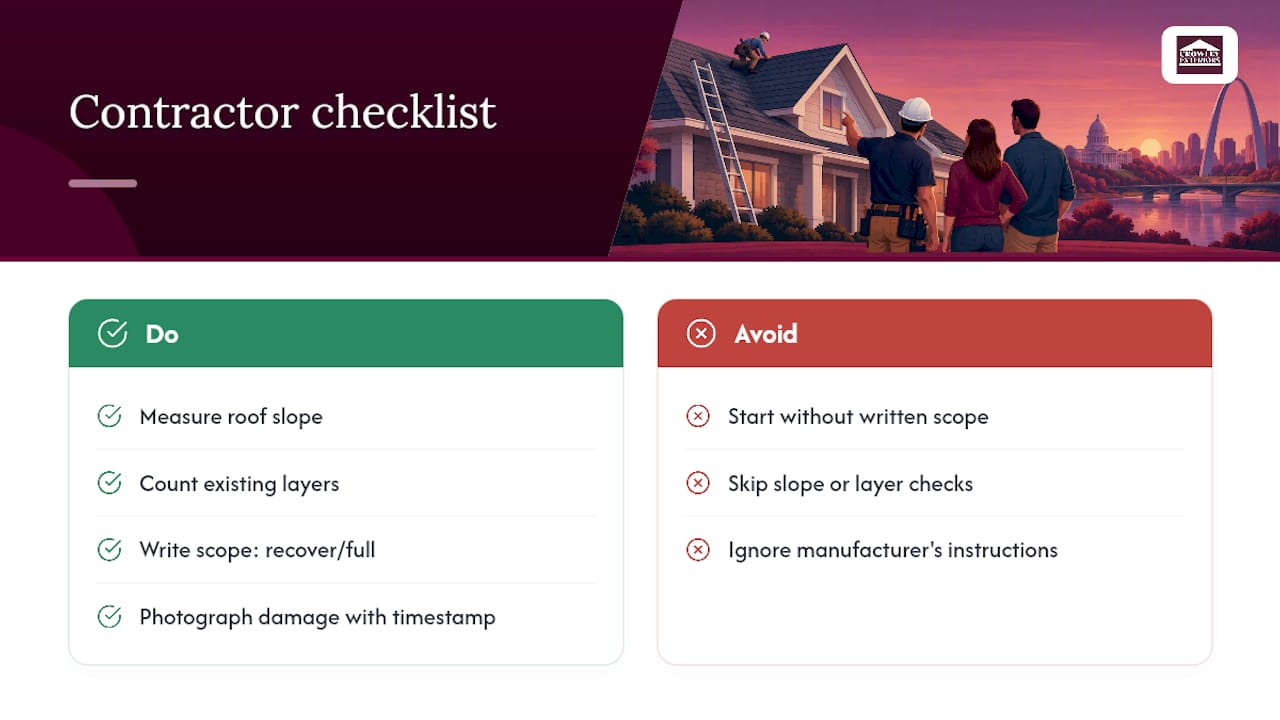
- Contractors should specify whether they plan to recover or fully replace the roof, measure roof slope, and check existing layers to ensure compliance and avoid post-project surprises.
- Keeping detailed documentation, such as permits, photos, product specs, and disposal records, significantly simplifies future claims, resale inspections, and dispute resolution.
Table of Contents
- How Missouri’s Building Code Roofing Rules Actually Work
- What IRC Chapter 9 Covers for Roofing Projects
- When You Need a Permit for Roof Work in Missouri
- Roof Inspection Stages and What Inspectors Actually Check
- Records Every Homeowner and Property Manager Should Keep
- What Local Roofing Contractors Get Right and Wrong
- How to Find Your Local Roofing Authority in Three Steps
- Missouri’s State-Level Amendments to the IRC for Roofing
- Wind and Hail Resistance Standards for Missouri Roofs
- Penalties for Skipping Permits or Ignoring Code Requirements
- Why Checking Your Parcel First Beats Guessing at the Code
- Get a Code-Compliant Roof From a Local Crowley Exteriors Crew
- Sources
- FAQ
How Missouri’s Building Code Roofing Rules Actually Work
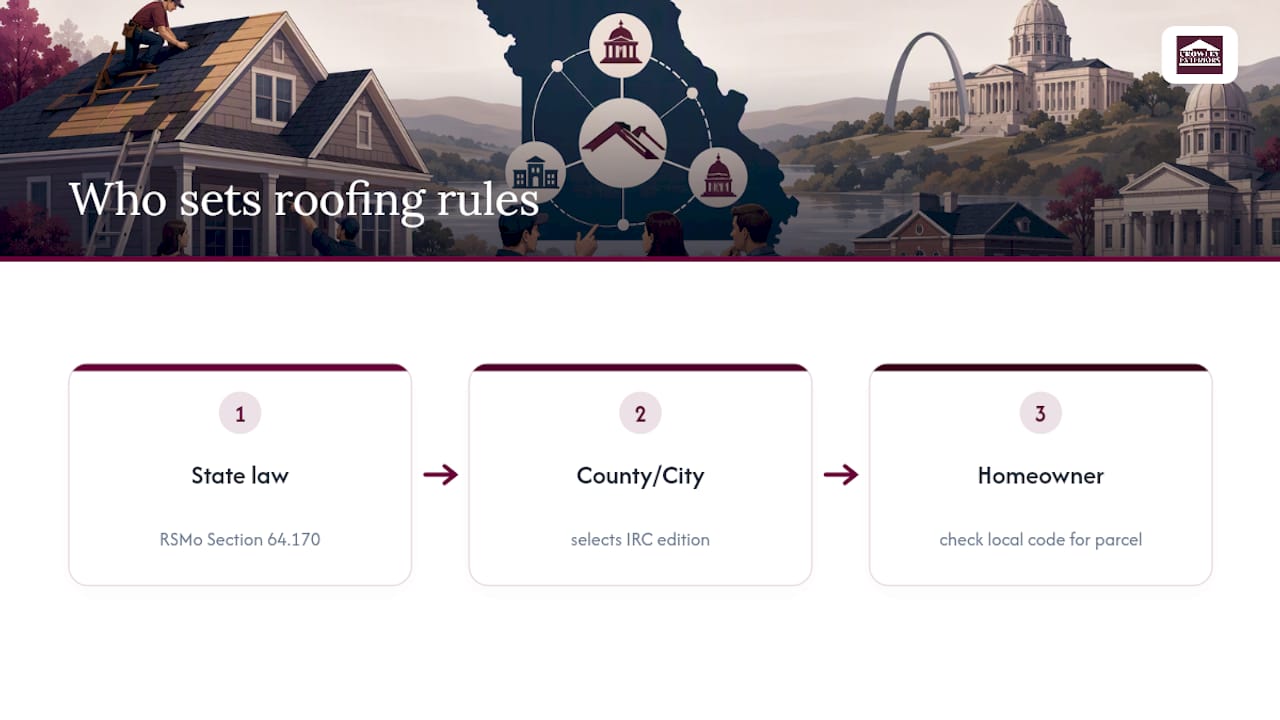
Missouri has no single residential roofing code that applies from the Bootheel to the Iowa border. Instead, Missouri Revised Statutes Section 64.170 hands counties the authority to adopt building codes and issue permits within their boundaries. That statute is the reason two houses ten miles apart, in different counties, can face completely different reroofing rules for the exact same job.
Cities and counties typically respond by adopting a version of the International Residential Code (IRC) or International Building Code (IBC), then layering on their own amendments. St. Louis County, for example, has adopted its own residential building code referencing IRC standards, with local modifications spelled out in a user-friendly summary of the 2015 code. St. Charles County, O’Fallon, and dozens of other municipalities run their own versions with their own tweaks to fire classification, wind resistance, and permit thresholds.
The Missouri Division of Fire Safety confirms there is no statewide fire code, either. Its own FAQ page states plainly that local jurisdictions adopt and enforce their own fire and building codes, and directs residents to check with their specific city or county for applicable rules. That single fact explains most of the confusion homeowners and contractors run into when they search generic terms like “Missouri roofing code” and get answers that don’t match what their local building department tells them.
This is why a jurisdiction-first approach beats a codes-first approach every time. Instead of trying to memorize a universal rulebook that doesn’t exist, start by identifying who actually regulates your property. Here’s the practical sequence:
- Pull up your county assessor’s website or GIS parcel viewer to confirm which municipality or unincorporated county area you fall under.
- Search that jurisdiction’s name plus “building department” to find its permitting page.
- Look for a reroofing checklist, permit application, or adopted code reference on that page.
- If nothing is posted online, call the building department directly and give them your parcel number.
Skipping this step is how homeowners end up with a contractor who assumed county rules applied, when the property actually sits inside city limits with its own stricter amendments. A five-minute parcel check at the start saves weeks of rework later.
What IRC Chapter 9 Covers for Roofing Projects
IRC Chapter 9 is the technical backbone that most Missouri jurisdictions build their local roofing amendments around, even when they haven’t adopted the exact 2021 edition. It governs roof assemblies, coverings, flashing, weather protection, and reroofing provisions, and it’s the section your inspector is thinking about even when local ordinance language sounds different.
Fire classification comes first in most inspections. Roof coverings are rated Class A, B, or C based on fire resistance, and some jurisdictions require a specific class depending on proximity to other structures or local wildfire risk considerations. Most standard asphalt shingle products carry a Class A rating when installed per manufacturer specs, but substitutions or unusual underlayment combinations can drop that rating without anyone noticing until an inspector flags it.
Flashing and moisture control get the most attention on actual job sites. A municipal example from O’Fallon’s adopted code, Section R903.2, requires flashing at wall and roof intersections and at every roof penetration to prevent moisture entry. Inspectors check this closely because flashing failures are the single most common source of leak calls, chimney rust stains, and rotted decking that homeowners discover years after a “successful” reroofing.
Wind uplift and material testing matter more in Missouri than in milder climates. Manufacturers test shingles and underlayment against standards like UL 790 for fire and various ASTM wind resistance classifications, and product packaging or spec sheets should list the rating. If your estimate doesn’t name a specific product line with a wind rating, ask why.
Energy and photovoltaic intersections show up more often now than five years ago. Adding solar panels or upgrading attic insulation during a reroof can trigger additional plan review in some jurisdictions, since the roof deck now has to support new point loads and penetrations that weren’t part of the original design.
Pro Tip: Ask your contractor to name the specific shingle product, underlayment type, and flashing metal gauge in writing before work starts. If they can’t name a wind or fire rating off the top of their head, that’s worth a second question.
A quick reference for what Chapter 9 actually regulates:
| Chapter 9 topic | What it governs | Why it matters on site |
|---|---|---|
| Fire classification | Class A/B/C rating of roof coverings | Determines allowed materials for your zone |
| Flashing (R903.2 style) | Moisture barriers at joints and penetrations | Top cause of post-install leak claims |
| Wind uplift testing | UL 790, ASTM wind ratings on products | Protects against storm damage claims |
| Weather protection | Underlayment, ice barriers where required | Affects warranty validity |
| Reroofing provisions | Rules for recover vs. full replacement | Determines permit and inspection scope |
When You Need a Permit for Roof Work in Missouri
Permit requirements hinge on a short list of triggers that show up in almost every Missouri jurisdiction’s reroofing rules, even though the exact thresholds vary by city or county. Knowing these triggers before you call a contractor keeps you from getting blindsided by a permit fee or inspection you didn’t budget for.
- Roof slope below 4:12. St. Louis County’s reroofing checklist requires plans and specifications when the roof slope falls under 4:12, since low-slope roofs typically need different membrane systems than standard steep-slope asphalt shingles.
- Any change in roof-covering system. Switching from three-tab shingles to standing-seam metal, or from asphalt to a synthetic slate product, almost always requires a permit even if the slope hasn’t changed, because the load, fastening pattern, and flashing details are different.
- Structural repairs to the deck. If tear-off reveals rotted sheathing that needs replacement, that structural work generally requires its own inspection separate from the cosmetic reroofing.
- Layering beyond the allowed limit. Most codes cap how many layers of roofing material can stack on a deck before a full tear-off is mandatory, since excess weight strains the structure and hides moisture damage.
There’s an important administrative distinction buried in most local codes: recover versus replace. A recover means installing new material over existing layers without tearing off the old roof. A replace means stripping the deck to bare sheathing first. St. Louis County’s checklist treats these differently for inspection purposes, since a recover can hide deck problems that a full tear-off would expose. Two layers of recovered shingles create additional inspection concerns around weight and flashing depth that a single-layer replacement doesn’t.
When you’re getting quotes, ask each contractor directly: Is this a recover or a full replacement? What’s the current slope? How many layers exist now? Those three answers determine most of your permit exposure before anyone pulls a tape measure.
Roof Inspection Stages and What Inspectors Actually Check
Most Missouri jurisdictions that require permits for reroofing also require at least one inspection, and larger jobs often involve two or three checkpoints. Knowing what each stage covers helps you avoid the most common cause of delay: a failed inspection that could have been caught by the crew before the inspector ever showed up.
The first checkpoint is usually a plan review, which happens before work starts if your project involves a system change or low-slope specifications. The second is a deck inspection after tear-off, when the sheathing is exposed and the inspector can verify its condition and any structural repairs. The third is the final roof inspection, covering the completed installation.
Inspectors consistently flag the same handful of issues:
- Missing or improperly lapped flashing at chimneys, vents, and wall intersections.
- Wrong underlayment type or an incorrect fastener pattern for the shingle manufacturer’s specs.
- Ventilation errors, including blocked soffit vents or mismatched intake and exhaust ratios.
- Incorrect slope application, such as using a steep-slope shingle system on a roof that should have gotten a low-slope membrane.
Coordinating inspections well comes down to a few habits: keep the manufacturer’s installation instructions on site in case the inspector wants to compare the work against spec, notify the inspector as soon as the deck is exposed rather than waiting until shingles are already down, and photograph flashing details before they’re covered. A crew that builds these steps into its schedule rarely needs a second inspection visit.
Records Every Homeowner and Property Manager Should Keep
A signed permit isn’t the finish line. What you keep afterward is what actually protects you if a leak shows up in year three, an insurance adjuster disputes a claim, or you’re selling the property and a buyer’s inspector asks questions.
- The permit itself, or written confirmation from the local building department that the job was permit-exempt.
- Plans and specifications, especially for any low-slope or system-change project that required them.
- Pre-work and post-work photos, particularly of flashing, deck condition, and any structural repairs made before the new roof went down.
- The final inspection report or certificate of completion from the local jurisdiction.
- Manufacturer product and installation instructions for the shingles, underlayment, and flashing materials used.
- An itemized invoice showing scope of work line by line, not just a lump-sum shingle brand and price.
- Disposal manifests documenting how many layers were torn off and where the material went.
That last item matters more than most homeowners realize. A St. Louis County guide on commercial reroofing requirements makes clear that layer counts and disposal records become part of the compliance trail property managers need for future repairs or resale. If a dispute ever comes up with an insurer or a buyer’s attorney, the difference between “we have photos and a permit” and “we have a receipt” is the difference between a quick resolution and a drawn-out argument.
Pro Tip: Take dated photos with your phone at the start of tear-off, after deck inspection, and after the final layer goes down. Store them in a labeled folder with the permit number. That’s usually enough documentation to satisfy an insurer or a future buyer’s inspector without digging through old text messages.
For property managers overseeing multiple units, a guide on documenting property condition offers a useful framework for building that kind of paper trail consistently across properties, not just for roofing but for any exterior work.
What Local Roofing Contractors Get Right and Wrong
Years of pulling permits across St. Charles County have made one pattern obvious: the jobs that go sideways almost always trace back to a slope that wasn’t measured, a layer count that wasn’t checked, or a scope that was never written down clearly before the crew showed up.
Measuring roof slope and counting existing layers before selecting a shingle assembly isn’t optional paperwork. It’s the single fastest way to avoid discovering, mid-project, that the roof needs a membrane system instead of standard shingles. Low-slope sections, common on porch roofs and additions even when the main roof is steep, often get missed during a walk-around estimate and only show up once the crew is already on the ladder.
The written scope should state plainly whether the job is a recover or a full replacement, and it should disclose deck condition honestly, including any suspected rot that will need inspection once tear-off starts. A contractor who won’t put that distinction in writing is leaving you exposed if the job turns out bigger than quoted.
Matching installation to the manufacturer’s instructions matters just as much as the code itself, since those instructions are often the standard inspectors compare the work against, and skipping them risks both a failed inspection and a voided warranty.
For storm and insurance work, document preexisting damage before touching the roof, and get the scope agreed in writing with the insurer or homeowner before work starts. That single step prevents most of the payment disputes that drag insurance-related reroofing jobs into months-long arguments. Some local contractors build free inspections around exactly this kind of documentation, since a clear photographic record protects both the homeowner’s claim and the contractor’s invoice. Reviewing common flashing types before a storm inspection also helps homeowners spot obvious problems themselves.
Pro Tip: If your roof was hit by hail or wind, take your own photos within 24 hours, before any contractor arrives. Insurers weigh timestamped homeowner photos heavily when preexisting damage becomes a dispute point.
How to Find Your Local Roofing Authority in Three Steps
Finding the right jurisdiction and its code text takes less time than most people expect, and it’s worth doing before you get a single estimate.
- Identify your parcel’s jurisdiction. Use your county assessor’s office or GIS parcel viewer to confirm whether your address falls under a city, an incorporated municipality, or unincorporated county authority. Boundaries aren’t always obvious from a street address alone.
- Check the local building department’s website. Most post reroofing checklists, permit applications, and links to their adopted code edition. St. Louis County, for instance, publishes both a reroofing checklist and a notice on filing plans electronically for projects that require them.
- Call the permitting office with your parcel ID in hand. Ask about permit triggers for your specific roof type, whether plans are required, expected fees, and how inspections get scheduled. A five-minute phone call answers questions no generic online guide can.
Missouri’s State-Level Amendments to the IRC for Roofing
Missouri itself doesn’t publish a single state-mandated version of the IRC that overrides local roofing rules. Instead, the state leaves adoption and amendment entirely to counties and municipalities under the authority granted by RSMo Section 64.170. What that means in practice is there’s no “Missouri amendment” to look up the way you might in states with a mandatory statewide residential code.
What you’ll actually find is a patchwork of local supplements layered onto whichever IRC edition each jurisdiction chose to adopt. St. Louis County’s version references the IRC with its own local modifications documented in its user-friendly building code summary, while O’Fallon runs its own 2021 edition with sections like R903.2 spelled out with local specificity. St. Charles County and other municipalities each maintain their own amendment lists, often covering wind speed design values, snow load assumptions, and specific fastening schedules suited to local weather patterns.
The practical takeaway: don’t search for “Missouri IRC amendments” expecting one document. Search for your specific city or county’s adopted code edition and amendment list instead, since that’s the actual legal text your inspector will apply.
Wind and Hail Resistance Standards for Missouri Roofs
Missouri sits in a wind and hail zone that regularly produces severe spring and summer storms, and local codes reflect that reality more than a generic national baseline would. Roofing products installed in the state typically need to meet wind uplift ratings tested against ASTM standards, with fastening schedules that account for gust speeds common in tornado-prone regions of the Midwest.
Hail resistance works differently from wind resistance in most codes. There’s no universal Missouri-wide mandate requiring impact-resistant shingles on every reroofing job, but many insurers offer premium discounts for Class 4 impact-rated shingles, and some municipalities encourage or require them in hail-prone zones through local building department guidance. Ask your contractor whether your jurisdiction has any impact-resistance preference before finalizing a shingle selection.
Because storm damage claims are so common in Missouri, documentation before and after a hail or wind event carries extra weight. A roof installed to proper wind uplift specifications, with the product’s rating documented in your job file, gives you a stronger position if a later storm claim gets questioned by an insurance adjuster.
Penalties for Skipping Permits or Ignoring Code Requirements
Working without a required permit creates problems that go well beyond an awkward phone call from the building department. Most Missouri jurisdictions can issue stop-work orders on unpermitted roofing jobs, forcing the crew to halt mid-project until the paperwork catches up, which often costs more in delay than the permit fee itself would have.
Unpermitted work also creates real financial exposure down the line. Selling a home with unpermitted roofing work can trigger a buyer’s inspector flagging the issue, forcing a retroactive permit application, an as-built inspection, or a price renegotiation. Insurance claims tied to unpermitted work sometimes get denied outright if an insurer determines the installation didn’t meet code requirements that a permit and inspection would have verified.
Fines vary by jurisdiction and aren’t standardized across the state, since enforcement is a local matter under the same statutory authority that governs permitting itself. Some counties charge doubled permit fees for work discovered after the fact; others require full compliance inspections before signing off. The safest assumption is that skipping a required permit rarely saves money once you account for potential fines, forced retroactive fixes, and insurance complications.
Why Checking Your Parcel First Beats Guessing at the Code
The biggest mistake homeowners and even seasoned contractors make is treating “Missouri roofing code” as a single rulebook they can memorize once and apply everywhere. It isn’t. Every jurisdiction’s authority traces back to the same statute, but the actual rules on the ground shift block by block.
That’s not a bureaucratic inconvenience. It’s the reason a five-minute parcel check at the start of a project beats an hour of general research every time. Contractors who work permit-savvy jobs, ones who know the difference between a recover and a replacement, who document deck condition before covering it up, who keep manufacturer instructions in the job file, cost less in the long run than the ones who wing it and hope an inspector doesn’t notice.
Good documentation isn’t paperwork for its own sake. It’s what turns a disputed insurance claim into a fast payout, and what turns a resale inspection question into a five-minute conversation instead of a renegotiation. Some local contractors build free inspections and itemized estimates around exactly that principle: check the parcel, document the scope, and coordinate with whatever permitting office actually has jurisdiction, rather than assuming one set of rules covers every roof in St. Charles County.
— Mario
Get a Code-Compliant Roof From a Local Crowley Exteriors Crew
Local roofing companies often have crews familiar with which St. Charles County building departments require plans for low-slope sections and which ones just want a final inspection scheduled.
That local knowledge shows up in the estimate itself. Every free inspection comes with an itemized breakdown, not just a shingle brand and a number, so you can see exactly what’s included: tear-off scope, flashing work, underlayment type, and whether your project is a recover or a full replacement. Crowley Exteriors backs its roof replacements with a 25-year workmanship guarantee and keeps manufacturer installation instructions on file for every job, which matters if an inspector or a future buyer’s inspector ever wants to compare the work against spec. Some contractors assist with insurance claim documentation when storm damage is involved, coordinating scope agreements before work starts to help prevent payment disputes.
If you’re not sure whether your roof needs a permit, a system change, or just a repair, consider requesting a free inspection to get a clear answer along with an estimate.
Sources
- Missouri Revisor of Statutes – Revised Statutes of Missouri, RSMo Section 64.170
- Missouri Department of Public Safety — Division of Fire Safety FAQs
FAQ
What Is the 25 Percent Rule in Roofing?
The 25 percent rule generally refers to a code provision stating that if more than 25 percent of a roof needs repair or replacement within a defined period, the entire roof section must be brought up to current code rather than patched piecemeal. Whether and how this rule applies depends on your local jurisdiction’s adopted code, since it isn’t a uniform statewide requirement in Missouri.
Does Missouri Require Roofers to Be Licensed?
Missouri does not require a statewide roofing contractor license, but many cities and counties require local business licenses or registration before a contractor can pull permits. Always confirm licensing and permit eligibility with your specific local building department rather than assuming a statewide standard applies.
What Is the Code for Roof Sheeting?
Roof sheathing requirements fall under IRC Chapter 9, which sets standards for deck materials, thickness, and fastening patterns depending on the roof covering being installed. Local jurisdictions may add specific fastening schedules based on wind speed design values common in Missouri’s storm-prone climate.
Are There Building Codes in Missouri?
Yes, but they’re adopted and enforced locally rather than through a single statewide code, under authority granted by RSMo Section 64.170. Most Missouri cities and counties adopt a version of the IRC or IBC with their own amendments, so the specific requirements depend on which jurisdiction covers your parcel.
How Do I Know if My Roof Needs a Permit?
Common triggers include a roof slope under 4:12, any change in the roofing system, structural repairs to the deck, or adding layers beyond your jurisdiction’s limit, as outlined in St. Louis County’s reroofing checklist. The fastest way to confirm is calling your local building department with your parcel number and asking directly.
Recommended
- How To File A Roof Insurance Claim: A Homeowner’s Guide
- When To Replace Your Roof: Signs, Timelines, And Costs
- Roof Warranty Coverage: What Homeowners Need To Know
- Three Checks Homeowners Can Do In 10 Minutes To Choose A Roofer
This article was prepared with AI assistance for general information. For recommendations specific to your property, contact Crowley Exteriors. Call or text us at 314-839-3800.