


Yes, get a dated, written roof inspection with photos before you list your Missouri home. Ask the inspector for a signed report with contact details, because Missouri’s seller disclosure rules rest on what you know, and the Missouri Department of Insurance ties coverage to roof age and condition.
TL;DR:
- Give buyers dated photos of every roof slope and problem area, plus the roof’s age, material, leak history, repairs, and signed inspector contact details.
- Missouri does not require a seller inspection or report, but its disclosure asks about roof age, leaks during ownership, repairs, replacement, the roofer, and records.
- Some insurers limit replacement cost coverage for common shingle roofs at about 15 years; older roofs may receive actual cash value, less depreciation.
- Start before listing, because inspections and reports take days, while repairs or replacement can take days to weeks, depending on permits and contractor availability.
- Verify contractor registration and insurance, compare written bids, and reject pressure tactics, cash only demands, full payment upfront, or requests to sign over insurance checks.
Table of Contents
- What is a seller roof inspection and what do you receive?
- What should the report and supporting paperwork include?
- What does Missouri’s seller disclosure law ask about your roof?
- How do roof age and insurance affect a sale?
- How do timing and repairs affect closing and negotiation?
- How do you vet an inspector or contractor and avoid storm chasers?
- What should you expect from a contractor visit and pre-listing repairs?
- Why we recommend documentation and quick, targeted fixes
- Our seller services: free inspections and written reports
- FAQ
- Sources
What is a seller roof inspection and what do you receive?
A pre-listing roof inspection is one you order before the house hits the market. A buyer’s inspection happens after an offer, on the buyer’s schedule and for the buyer’s protection. Yours happens first, so you see the roof the way a buyer eventually will.
Sellers order one for a few practical reasons. You answer the disclosure form accurately, you know what a buyer’s inspector will flag before they flag it, and you can respond to an insurer or lender request without scrambling. It also gives you leverage in negotiation, because a documented condition is harder to dispute than a rumor.
A solid seller inspection typically gives you:
- A signed written report with the inspector’s name and contact information
- Dated photos of each roof slope, flashing, vents and valleys
- An estimate of the roof’s age and remaining service life
- Notes on active or past leaks and visible repairs
- A short list of recommended fixes, if any
Think of that package as your evidence file. When a buyer asks about the roof, you hand over a document instead of a guess. That cuts down on surprises late in the deal, and surprises are what stall closings. A buyer who sees a clean, dated report often skips the back-and-forth about worst-case scenarios, and a buyer who sees a flagged issue with a repair estimate attached can negotiate a specific fix instead of a vague discount.
What should the report and supporting paperwork include?
Before you share a report, check it against a simple standard. A report you can hand to a buyer, lender or insurer should be complete enough to stand on its own.
- Photos with visible dates, covering every slope and each problem area
- A plain-language description of each issue, with its location on the roof
- The inspector’s signature, credentials and phone or e-mail
- An estimate of roof age and material type
- The date of inspection, clearly printed
Then gather the paper trail behind the roof. Repair invoices, permit records, manufacturer warranties and receipts for past work all answer questions before they are asked. If a previous owner had the roof replaced, look through closing documents for anything that names the roofer or the install date. If you filed a past insurance claim, keep the adjuster’s estimate and any paid invoices together.
Assemble everything in one folder, digital and printed. Put the inspection report on top, followed by invoices in date order, then permits and warranties. That single packet can serve your disclosure form, a buyer’s request and a lender’s review without any extra work.
Pro Tip: Photograph the roof yourself from the ground on the same day as the inspection, so your own dated images match the inspector’s report.
What does Missouri’s seller disclosure law ask about your roof?
Missouri treats the seller’s disclosure as a statement of what you know, not a warranty. The state’s rules also give licensees immunity for statements made by third-party inspectors, and you are not required to hand over a professional inspection report. Missouri also does not push sellers into inspections: under RSMo 436.345, effective August 28, 2024, a political subdivision cannot require a property owner to have a home inspection before a sale, with exceptions such as new construction or occupancy permits.
So the inspection is voluntary. What it does is make your disclosure honest and specific. The disclosure form asks about:
- The roof’s approximate age
- Whether it has leaked during your ownership
- Any repairs or replacements
- Who the roofer was
- Documentation you can attach
Industry commentary on the form notes that a disclosure reflects the seller’s memory, not a technical assessment, and buyers are urged to get their own inspection. That gap is where disputes start. If you wrote “no known leaks” and a buyer’s inspector finds old water staining, the question becomes what you knew.
A dated report narrows that gap. You can answer with confidence, attach the paperwork, and point to a professional’s findings. If you are unsure how to answer a specific question, ask your real estate agent or an attorney before you sign.
How do roof age and insurance affect a sale?
Buyers care about the roof partly because their insurer does. The Missouri Department of Insurance explains that some carriers limit replacement cost eligibility by roof age, and for common shingles some cap it at about 15 years. Past that point, a claim may pay actual cash value, which subtracts depreciation, instead of the cost to replace. Policies also do not cover ordinary wear and tear.
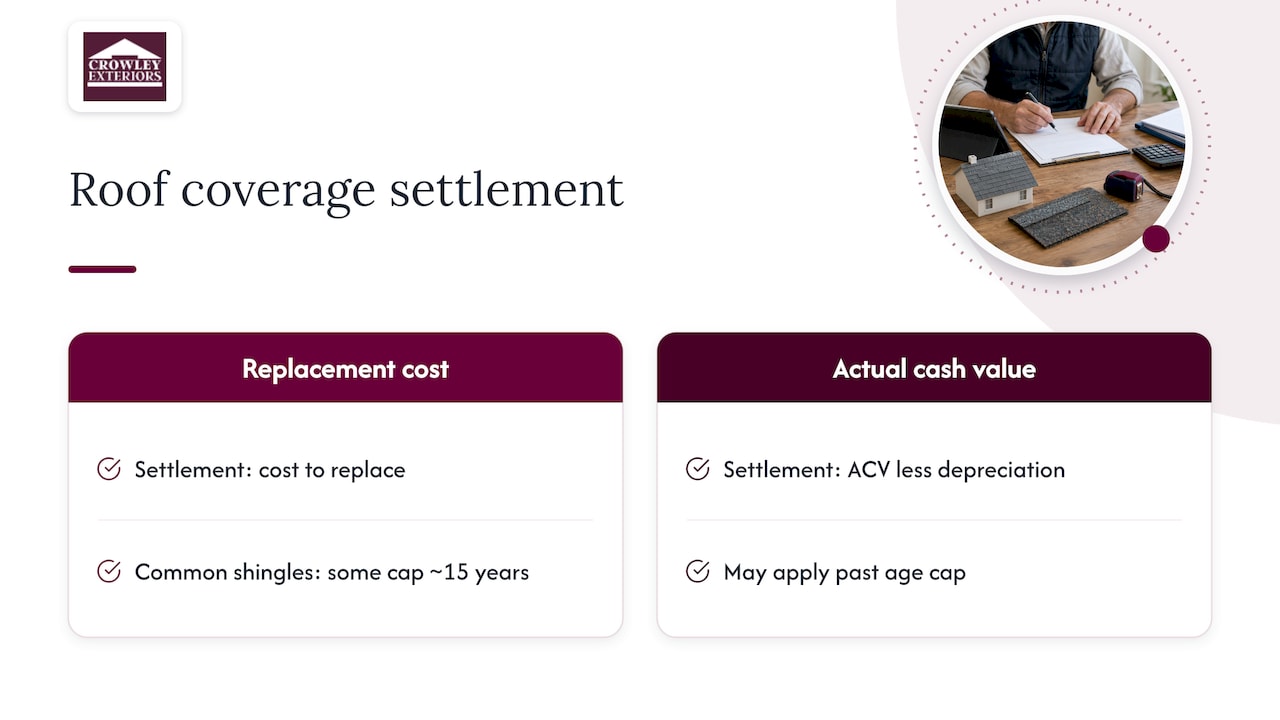
Insurers also look at condition, so a roof can fall out of replacement cost eligibility even when it is still keeping water out. Specific carrier rules vary, and the department publishes company-level examples such as Fire Insurance Exchange and American Family, which show how age and surface type can trigger actual cash value settlement.
For you as a seller, this means buyers and lenders may ask pointed questions about age, past claims and repairs. Seller-provided reports and paid invoices answer those questions up front and reduce the odds of a buyer discovering a coverage problem after the contract is signed.
Two steps help. First, read your own policy’s declarations page to see whether you carry replacement cost or actual cash value coverage and whether a separate wind or hail deductible applies. Second, point buyers to the department’s guidance when they ask how their own coverage might treat the roof.
How do timing and repairs affect closing and negotiation?
Plan on days for an inspection and report, days to weeks for minor repairs, and days to weeks for a replacement, depending on permits and contractor availability. Starting before you list gives you room to choose, instead of reacting to a buyer’s deadline.
When the report shows issues, sellers generally pick one of four paths:
- Disclose as is. Fastest and cheapest up front, but buyers often price in the worst case and ask for a larger credit.
- Complete targeted repairs. Fixes like flashing or pipe boot work remove specific objections and keep the file clean.
- Offer a repair credit. You skip the work, but you give up control over cost and the buyer may still worry about quality.
- Replace the roof. Highest cost, strongest message, and a new warranty to hand over.
If a replacement is on the table, our guide on when to replace your roof walks through the signs and timelines. For a ballpark, see our local article on Missouri roof replacement costs.
Whichever path you choose, put it on paper. Share written bids, paid invoices and before-and-after photos with the buyer’s agent and the lender early. A lender or underwriter who sees a completed repair with a receipt rarely holds up a closing over the roof. If you decide a sale as is makes more sense than repairs, some sellers also look at options such as cash home buyers, which explains how selling with roof damage can work.
How do you vet an inspector or contractor and avoid storm chasers?
Verify before you sign anything. The FTC warns that storm chasers offering free inspections after severe weather may pressure homeowners into unfair contracts, and that you should confirm a contractor’s license and insurance and never sign over an insurance check.
A sound vetting routine looks like this:
- Confirm the company’s registration and ask for proof of liability insurance
- Ask for local references and check permit history with your city or county
- Get more than one written bid, as FTC guidance on avoiding scams recommends
- Insist on a written contract that states scope, materials, price and timeline
- Keep every receipt and permit document
Red flags are easy to remember. Walk away from high-pressure sales, requests to sign over an insurance payment, cash-only demands, payment in full up front, and any refusal to put terms in writing. Our checklist for spotting storm chaser roofers goes deeper on the warning signs.
If storm damage prompted the inspection, take extra care. Our post on what to do after storm damage covers the basics, and finding your Missouri roofing jurisdiction shows you who to call about permits.
Pro Tip: Ask any inspector or roofer to email a sample report with photos before you hire them. A clear sample tells you more than a sales pitch.
What should you expect from a contractor visit and pre-listing repairs?
A contractor visit usually starts with a walk around the property, then a roof-level look at shingles, flashing, valleys, vents and gutters, followed by photos and a written estimate. Good estimates are itemized, so you can see what each fix costs.
Targeted repairs typically resolve the items that show up on a buyer’s inspection: flashing repair, isolated shingle replacement, valley work, pipe boot replacement and sealing. These are often completed quickly and can remove a negotiation point entirely. If your report finds a valley problem, our post on roof valley leaks explains what to do next.
Replacement is the usual recommendation when the roof is near the end of its life, hail damage is widespread, or leaks appear in more than one place. Our repair or replace rule of thumb helps frame that decision, and our replacement process page and cost article give local detail.
After any work, collect permit copies, paid invoices, before-and-after photos and warranty paperwork. Add them to your seller packet right away, while the details are fresh and the contractor is easy to reach.
Why we recommend documentation and quick, targeted fixes
We are a family-owned roofing company with more than 25 years of experience in Missouri, and our work in St. Charles County has taught us how sales go sideways. A seller finds out about a leak from a buyer’s inspector, scrambles for a quote, and loses valuable time.
A fast, documented inspection flips that script. You know the roof’s condition, you have photos and estimates in hand, and you decide on your terms. We also find that transparent estimates and clear permit records calm nervous buyers more than any sales talk. When the paperwork is tidy, closings tend to run smoother.
— Mario
Our seller services: free inspections and written reports
We offer free inspections and no-obligation, itemized estimates for homeowners getting ready to sell. You get a written report, plus help with permits, repairs and storm and hail claims support. Our roofing work comes with a 25-year workmanship guarantee.
Our report and targeted repairs give you what you need to finish your disclosure and keep your closing on schedule. See our roofing services or contact us to request your free inspection today.
FAQ
Do roofs have to be inspected before a sale in Missouri?
No. Under RSMo 436.345, local governments cannot require a home inspection before a sale, with limited exceptions. A voluntary inspection still helps you disclose accurately and negotiate with confidence.
Do roofers need to be licensed in Missouri?
Requirements vary by city and county, so check your local jurisdiction before hiring. The FTC advises verifying a contractor’s license and insurance either way. Our guide to finding your roofing jurisdiction shows where to start.
Is offering a free roof inspection soliciting?
Not by itself. A free inspection is a common, legitimate service, but after storms some offers come with pressure. The FTC cautions against unlicensed contractors and says to insist on written contracts and estimates.
What is the 25 rule in roofing?
It is a rule of thumb for deciding between repair and replacement, based on how much of the roof is damaged. Our post on the 25 to 30% rule explains how to apply it to your roof.
Sources
- Revisor
- Raising the Roof on Insurance Coverage | Missouri Department of Insurance
- How To Prepare for a Weather Emergency While Avoiding Scams | Consumer Advice
Recommended
- Homeowners: 6 Step Checklist To Spot Storm Chaser Roofers
- Storm Damage Roof: What To Do In The First 72 Hours
- When To Replace Your Roof: Signs, Timelines, And Costs
- Roof Inspection Report: Complete Template And Guide
This article was prepared with AI assistance for general information. For recommendations specific to your property, contact Crowley Exteriors. Call or text us at 314-839-3800.